Gavrilă B I, Ciofu C, Stoica V, Panaitescu E
"Dr. I. Cantacuzino" Clinical Hospital, Bucharest, Department of Internal Medicine and Rheumatology, "Carol Davila" University of Medicine and Pharmacy, Bucharest, Romania.
Department of Medical Informatics and Biostatistics, "Carol Davila" University of Medicine and Pharmacy, Bucharest, Romania.
J Med Life. 2015 Jan-Mar;8(1):79-84.
The following study aims to evaluate the monotherapy with biologic agents: Infliximab (IFX), Etanercept (ETA), Adalimumab (ADA) and Rituximab (RTX) in patients diagnosed with rheumatoid arthritis (RA).
To achieve these objectives, the database of "Dr. I. Cantacuzino" Clinical Hospital, Department of Internal Medicine and Rheumatology, was used. The study was retrospective and descriptive, covering 168 patients with RA, followed for 12 months, from January 2012 to January 2013. Admission criteria for the study were the following: patients diagnosed with RA according to ACR 1987/ EULAR 2010 criteria, disease activity score (DAS 28)> 5.1, positive inflammation tests, presence of RA refractory to classic remitting treatment administered at least 6 months prior to the initiation of biological therapy, on patients treated with RTX. They were considered non-responders after 6 months of treatment with anti tumor necrosis factor alpha (anti-TNF) and decided to switch agents with anti CD-20.
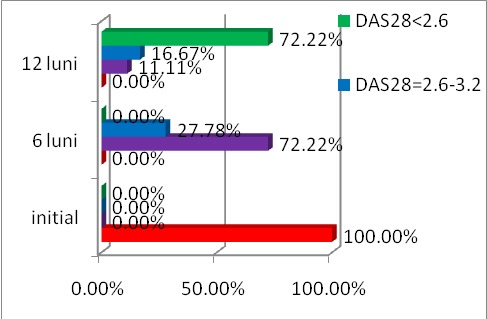
Comparing values between any two points in time (baseline - 6 months -12 months) for any type of therapy, there were significant decreases in the values of erythrocyte sedimentation rate (ESR), reactive C protein (CRP) and disease activity score (DAS 28). There were no significant differences between therapies regarding ESR at 6 months (p = 0.070, ANOVA) and 12 months (p = 0.375, Kruskal-Wallis), significant differences were regarding CRP at 6 and 12 months (p = 0.000, Kruskal-Wallis) and DAS 28 at 6 months (p = 0.000, Kruskal- Wallis) and 12 months (p = 0.018, Kruskal-Wallis).
All 4 therapies have proven efficient, prognostic markers decreasing gradually at 6 and 12 months.
以下研究旨在评估生物制剂单药治疗:英夫利昔单抗(IFX)、依那西普(ETA)、阿达木单抗(ADA)和利妥昔单抗(RTX)在类风湿关节炎(RA)患者中的疗效。
为实现这些目标,使用了“伊·坎塔库齐诺医生”临床医院内科和风湿病科的数据库。该研究为回顾性描述性研究,涵盖168例RA患者,从2012年1月至2013年1月随访12个月。该研究的纳入标准如下:根据美国风湿病学会1987年/欧洲抗风湿病联盟2010年标准诊断为RA的患者,疾病活动评分(DAS 28)>5.1,炎症检测呈阳性,在生物治疗开始前至少6个月接受经典缓解治疗无效的RA患者,接受RTX治疗的患者。在用抗肿瘤坏死因子α(抗TNF)治疗6个月后被视为无反应者,并决定改用抗CD - 20药物。
比较任何一种治疗在任何两个时间点(基线 - 6个月 - 12个月)的值,红细胞沉降率(ESR)、反应性C蛋白(CRP)和疾病活动评分(DAS 28)的值均有显著下降。在6个月时(p = 0.070,方差分析)和12个月时(p = 0.375,克鲁斯卡尔 - 沃利斯检验),各治疗组之间的ESR无显著差异;在6个月和12个月时CRP有显著差异(p = 0.000,克鲁斯卡尔 - 沃利斯检验),在6个月时DAS 28有显著差异(p = 0.000,克鲁斯卡尔 - 沃利斯检验),在12个月时也有显著差异(p = 0.018,克鲁斯卡尔 - 沃利斯检验)。
所有4种治疗均已证明有效,预后标志物在6个月和12个月时逐渐下降。