Mulat Amlaku, Bayu Hinsermu, Mellie Habtamu, Alemu Amare
Department of Midwifery, College of Health Sciences, Mekelle University, P.O. Box 1871, Mekelle, Ethiopia.
Department of Public Health, College of Medicine and Health Sciences, Debre Markos University, Debre Markos, Ethiopia.
Biomed Res Int. 2015;2015:256534. doi: 10.1155/2015/256534. Epub 2015 Mar 30.
Although the vast majority of abortions are performed in the first trimester, still 10-15% of terminations of pregnancies have taken place in the second trimester period globally. As compared to first trimester, second trimester abortions are disproportionately contribute for maternal morbidity and mortality especially in low-resource countries where access to safe second trimester abortion is limited. The main aim of this study was to assess the prevalence and associated factors of induced second trimester abortion in Amhara region referral hospitals, northwest Ethiopia.
Institution based cross-sectional study was conducted in Amhara region referral hospitals among 416 women who sought abortion services. Participants were selected using systematic sampling technique. Data were collected using pretested structured questionnaire through interviewing. After the data were entered and analyzed; variables which have P value < 0.2 in bivariate analysis, not colinear, were entered into multiple logistic regressions to see the net effect with 95% CI and P value < 0.05.
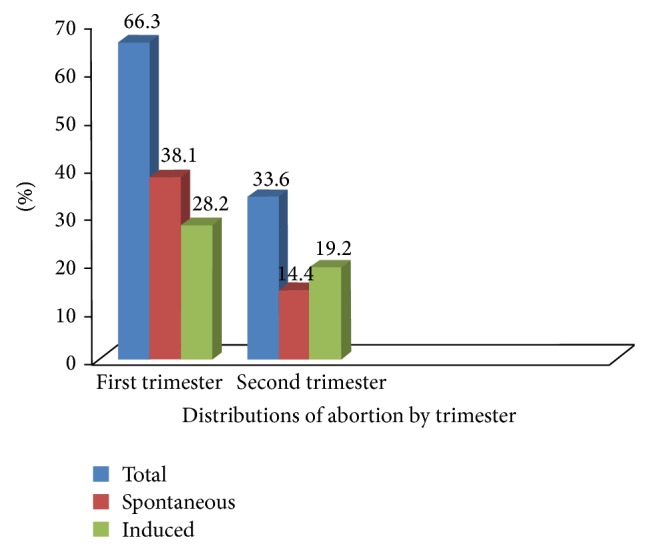
The prevalence of induced second trimester abortion was 19.2%. Being rural (AOR = 1.86 [95% CI = 1.11-3.14]), having irregular menstrual cycle (AOR = 1.76 [95% CI = 1.03-2.98]), not recognizing their pregnancy at early time (AOR = 2.05 [95% CI = 1.21-3.48]), and having logistics related problems (AOR = 2.37 [95% CI = 1.02-5.53]) were found to have statistically significant association with induced second trimester abortion.
Induced second trimester abortion is high despite the availability of first trimester abortion services. Therefore, increase accessibility and availability of safe second trimester abortion services below referral level, counseling and logistical support are helpful to minimize late abortions.
尽管绝大多数堕胎手术在孕早期进行,但全球仍有10%-15%的妊娠终止发生在孕中期。与孕早期相比,孕中期堕胎对孕产妇发病率和死亡率的影响尤为突出,特别是在资源匮乏的国家,这些国家安全的孕中期堕胎服务有限。本研究的主要目的是评估埃塞俄比亚西北部阿姆哈拉地区转诊医院中人工诱导孕中期堕胎的患病率及相关因素。
在阿姆哈拉地区转诊医院对416名寻求堕胎服务的女性进行了基于机构的横断面研究。采用系统抽样技术选取参与者。通过访谈使用预先测试的结构化问卷收集数据。数据录入和分析后;在双变量分析中P值<0.2、无共线性的变量被纳入多元逻辑回归,以查看95%置信区间和P值<0.05时的净效应。
人工诱导孕中期堕胎的患病率为19.2%。农村地区(调整后比值比[AOR]=1.86[95%置信区间=1.11-3.14])、月经周期不规律(AOR=1.76[95%置信区间=1.03-2.98])、早期未意识到自己怀孕(AOR=2.05[95%置信区间=1.21-3.48])以及存在后勤相关问题(AOR=2.37[95%置信区间=1.02-5.53])被发现与人工诱导孕中期堕胎存在统计学显著关联。
尽管有孕早期堕胎服务,但人工诱导孕中期堕胎率仍然很高。因此,提高转诊级别以下安全孕中期堕胎服务的可及性和可得性、咨询和后勤支持有助于减少晚期堕胎。