Chang Shen-Shong, Hu Hsiao-Yun
Division of Gastroenterology, Taipei City Hospital Yang-Ming Branch, Taipei, Taiwan; Department of Internal Medicine, Taipei City Hospital Yang-Ming Branch, Taipei, Taiwan; School of Medicine, National Yang-Ming University, Taipei, Taiwan.
Institute of Public Health and Department of Public Health, National Yang-Ming University, Taipei, Taiwan; Department of Education and Research, Taipei City Hospital, Taipei, Taiwan.
PLoS One. 2015 Apr 28;10(4):e0124598. doi: 10.1371/journal.pone.0124598. eCollection 2015.
The pathophysiology of diverticulitis is poorly understood. Factors such as physical inactivity, constipation, obesity, smoking, and the use of nonsteroidal antiinflammatory drugs (NSAIDs) have been associated with an increased risk of diverticular disease. To evaluate whether patients exhibiting long-term steroid use are at increased risk of colonic diverticulitis.
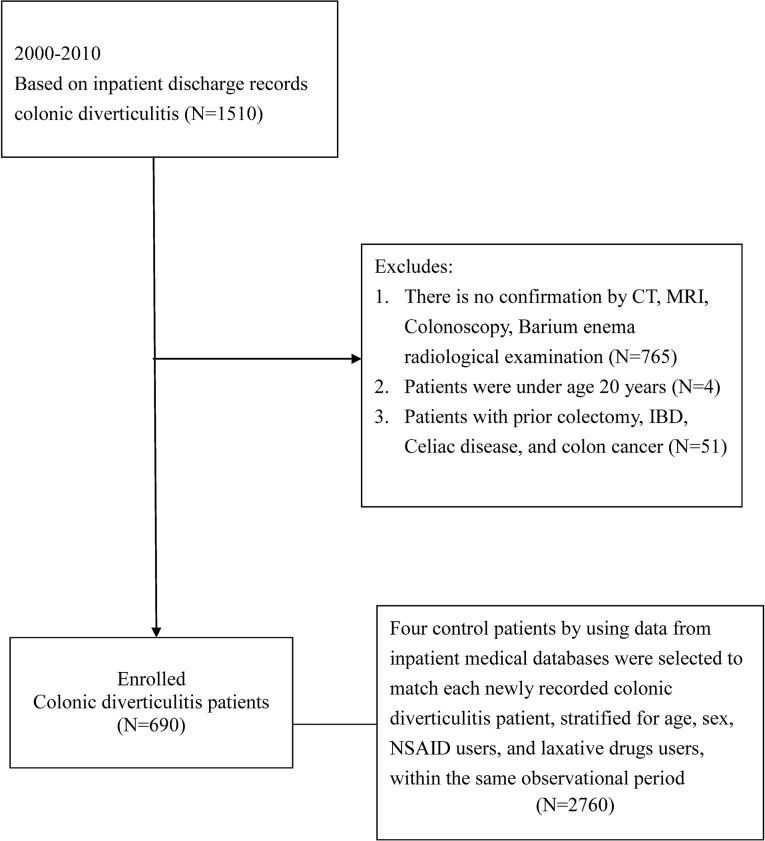
We conducted a population-based, nested case-control study. Data were retrospectively collected from the National Health Insurance Research Database. The study cohort comprised patients diagnosed with diverticulitis, identified using inpatient discharge records using International Classification of Diseases, Ninth Revision, Clinical Modification (ICD-9-CM) codes (562.11 and 562.13), and those who were administered one or more prescriptions for corticosteroids for systemic use. Control patients were matched to cases by age, sex, NSAID use, laxative drug use, and index date. We enrolled 690 patients with colonic diverticulitis and 2760 in the control group. The adjusted odds ratios (ORs) and 95% confidence intervals (CIs) were estimated using conditional logistic regression.
Compared with steroid nonusers, the adjusted ORs were 0.60 (95% CI = 0.35-1.06) and 0.80 (95% CI = 0.64-1.008) in current steroid users and previous steroid users, respectively. In addition, the adjusted ORs were 0.55 (95% CI = 0.31-0.98), 0.57 (95% CI = 0.31-0.98), and 0.44 (95% CI = 0.22-0.86) for steroid use duration more than half time by an exposure period of 90 days, 180 days, and 365 days before the claim date of colonic diverticulitis, respectively.
The results indicated that long-term steroid use within one year is associated with lower risk of colonic diverticulitis.
憩室炎的病理生理学尚不清楚。诸如缺乏运动、便秘、肥胖、吸烟以及使用非甾体抗炎药(NSAIDs)等因素与憩室病风险增加有关。旨在评估长期使用类固醇的患者患结肠憩室炎的风险是否增加。
我们开展了一项基于人群的巢式病例对照研究。数据从国民健康保险研究数据库中回顾性收集。研究队列包括使用国际疾病分类第九版临床修订本(ICD-9-CM)编码(562.11和562.13)通过住院出院记录确诊为憩室炎的患者,以及接受过一种或多种全身性皮质类固醇处方治疗的患者。对照患者按年龄、性别、NSAIDs使用情况、泻药使用情况和索引日期与病例进行匹配。我们纳入了690例结肠憩室炎患者和2760例对照组患者。使用条件逻辑回归估计调整后的比值比(OR)和95%置信区间(CI)。
与未使用类固醇的患者相比,当前使用类固醇的患者和既往使用类固醇的患者调整后的OR分别为0.60(95%CI = 0.35 - 1.06)和0.80(95%CI = 0.64 - 1.008)。此外,在结肠憩室炎索赔日期前90天、180天和365天的暴露期内,类固醇使用持续时间超过一半时间的调整后OR分别为0.55(95%CI = 0.31 - 0.98)、0.57(95%CI = 0.31 - 0.98)和0.44(95%CI = 0.22 - 0.86)。
结果表明,一年内长期使用类固醇与结肠憩室炎风险较低相关。