Rafiei Anahita, Mian Afsar Ali, Döring Claudia, Metodieva Anna, Oancea Claudia, Thalheimer Frederic B, Hansmann Martin Leo, Ottmann Oliver Gerhard, Ruthardt Martin
Department of Hematology, Goethe University Hospital, Frankfurt, Germany.
Dr. Senckenberg Institute of Pathology, Goethe University Hospital, Frankfurt, Germany.
PLoS Genet. 2015 Apr 28;11(4):e1005144. doi: 10.1371/journal.pgen.1005144. eCollection 2015 Apr.
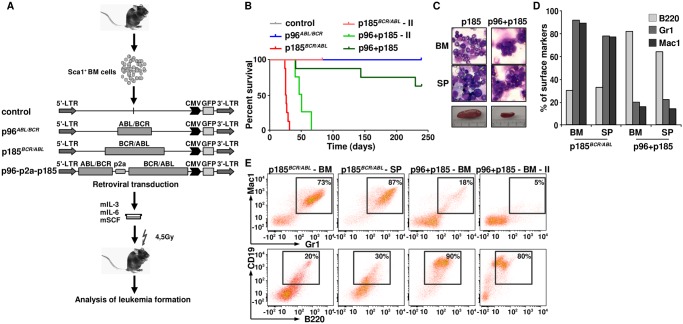
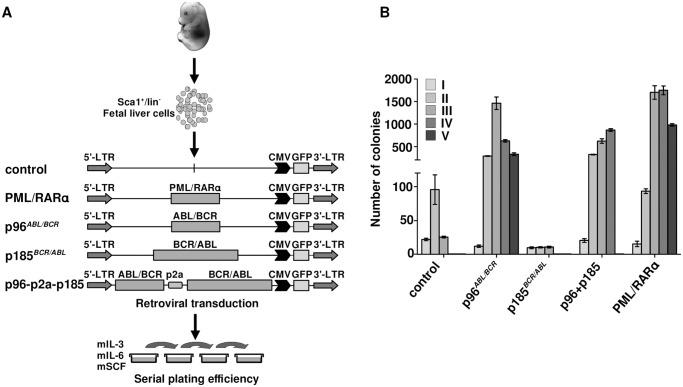
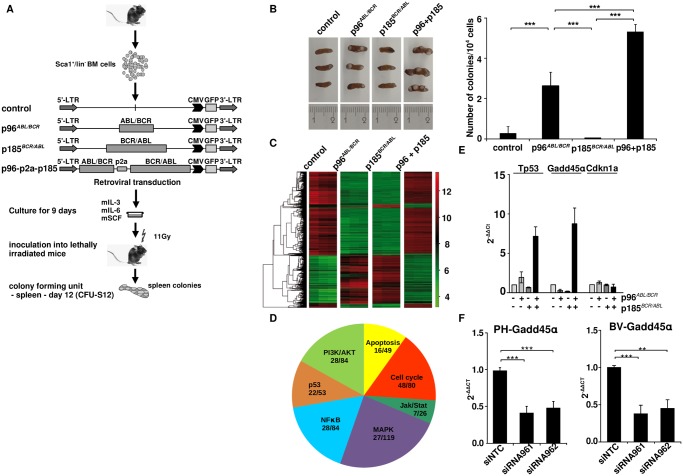
The hallmark of Philadelphia chromosome positive (Ph(+)) leukemia is the BCR/ABL kinase, which is successfully targeted by selective ATP competitors. However, inhibition of BCR/ABL alone is unable to eradicate Ph(+) leukemia. The t(9;22) is a reciprocal translocation which encodes not only for the der22 (Philadelphia chromosome) related BCR/ABL, but also for der9 related ABL/BCR fusion proteins, which can be detected in 65% of patients with chronic myeloid leukemia (CML) and 100% of patients with Ph+ acute lymphatic leukemia (ALL). ABL/BCRs are oncogenes able to influence the lineage commitment of hematopoietic progenitors. Aim of this study was to further disclose the role of p96(ABL/BCR) for the pathogenesis of Ph(+) ALL. The co-expression of p96(ABL/BCR) enhanced the kinase activity and as a consequence, the transformation potential of p185(BCR/ABL). Targeting p96(ABL/BCR) by RNAi inhibited growth of Ph(+) ALL cell lines and Ph(+) ALL patient-derived long-term cultures (PD-LTCs). Our in vitro and in vivo stem cell studies further revealed a functional hierarchy of p96(ABL/BCR) and p185(BCR/AB)L in hematopoietic stem cells. Co-expression of p96(ABL/BCR) abolished the capacity of p185(BCR/ABL) to induce a CML-like disease and led to the induction of ALL. Taken together our here presented data reveal an important role of p96(ABL/BCR) for the pathogenesis of Ph(+) ALL.
费城染色体阳性(Ph(+))白血病的标志是BCR/ABL激酶,它可被选择性ATP竞争剂成功靶向。然而,仅抑制BCR/ABL并不能根除Ph(+)白血病。t(9;22)是一种相互易位,它不仅编码与der22(费城染色体)相关的BCR/ABL,还编码与der9相关的ABL/BCR融合蛋白,在65%的慢性髓性白血病(CML)患者和100%的Ph+急性淋巴细胞白血病(ALL)患者中可检测到。ABL/BCRs是能够影响造血祖细胞谱系定向的致癌基因。本研究的目的是进一步揭示p96(ABL/BCR)在Ph(+) ALL发病机制中的作用。p96(ABL/BCR)的共表达增强了激酶活性,结果增强了p185(BCR/ABL)的转化潜能。通过RNAi靶向p96(ABL/BCR)可抑制Ph(+) ALL细胞系和Ph(+) ALL患者来源的长期培养物(PD-LTCs)的生长。我们的体外和体内干细胞研究进一步揭示了p96(ABL/BCR)和p185(BCR/AB)L在造血干细胞中的功能层级。p96(ABL/BCR)的共表达消除了p185(BCR/ABL)诱导CML样疾病的能力,并导致ALL的诱导。综上所述,我们在此呈现的数据揭示了p96(ABL/BCR)在Ph(+) ALL发病机制中的重要作用。