Molden Rosalynn C, Bhanu Natarajan V, LeRoy Gary, Arnaudo Anna M, Garcia Benjamin A
Department of Chemistry, Princeton University, Princeton, NJ 08544 USA.
Department of Biochemistry and Biophysics, Epigenetics Program, Perelman School of Medicine, University of Pennsylvania, Room 9-124, 3400 Civic Center Blvd., Bldg. 421, Philadelphia, PA 19104 USA.
Epigenetics Chromatin. 2015 Apr 22;8:15. doi: 10.1186/s13072-015-0006-8. eCollection 2015.
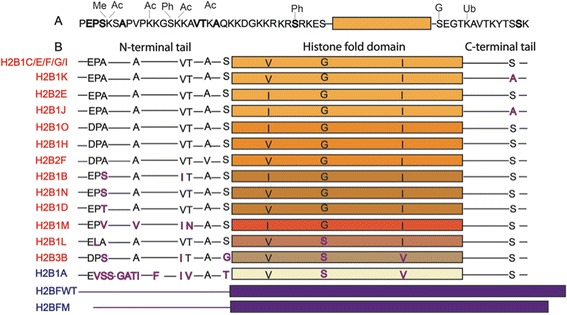
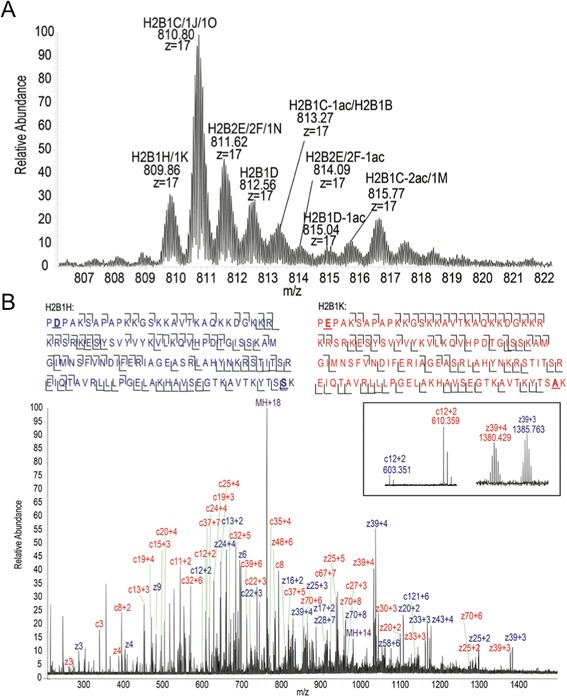
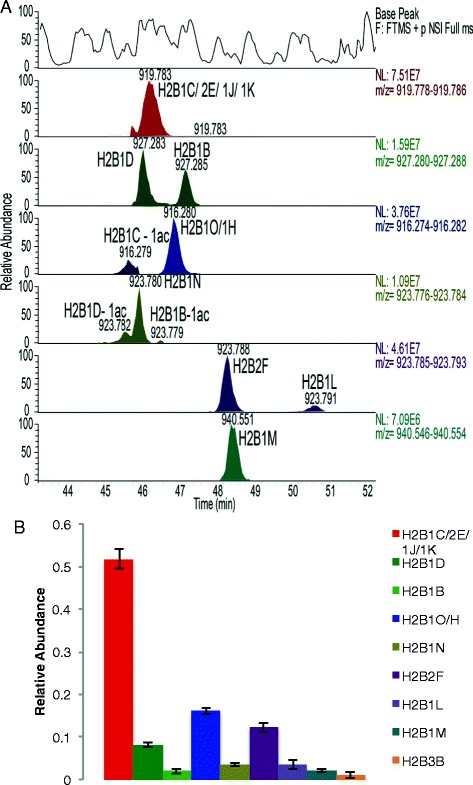
Histone isoforms and their post-translational modifications (PTMs) play an important role in the control of many chromatin-related processes including transcription and DNA damage. Variants of histones H2A and H3 have been studied in depth and have been found to have distinct functions. Although 13 somatic histone H2B isoforms have been identified by various biochemical and mass spectrometric (MS) approaches, the distinct roles of these isoforms within human cells are as yet unknown. Here, we have developed quantitative MS techniques to characterize isoform-specific H2B expression across the cell cycle, in differentiated myogenic cells, and in different cancer cell lines to illuminate potential functional roles.
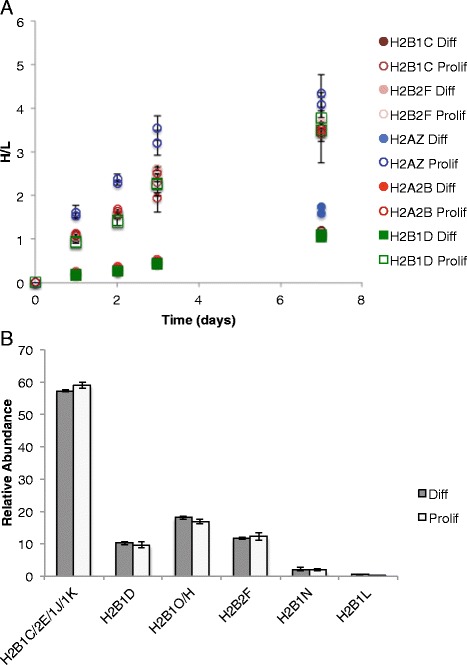
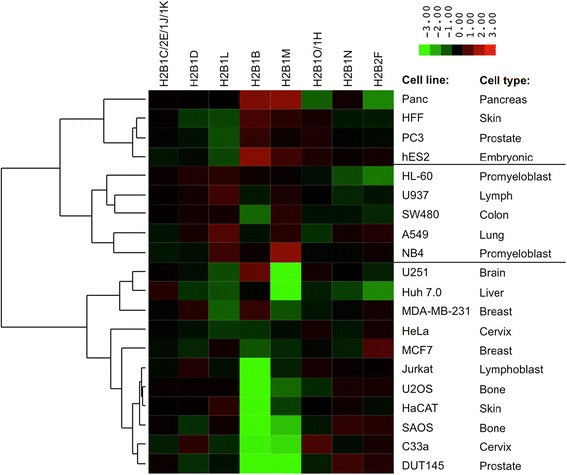
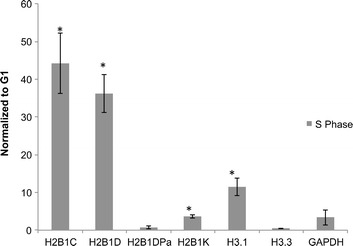
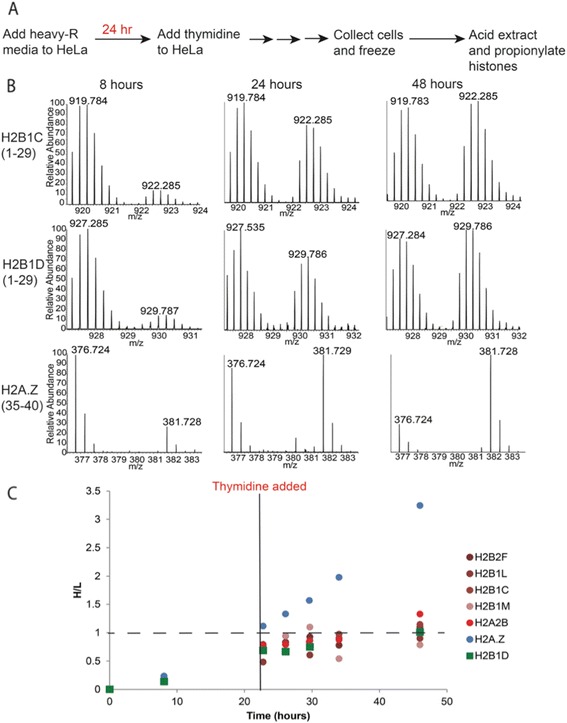
Using the MS strategies that we developed, we identified differences in H2B isoform levels between different cancer cell types, suggesting cancer or tissue-specific H2B isoform regulation. In particular, we found large variations in the levels of isoforms H2B1B and H2B1M across the panel of cell lines. We also found that, while individual H2B isoforms do not differ in their acetylation levels, trends in the acetylation on all H2B isoforms correlated with acetylation on other histone family members in the cancer cell line panel. We also used the MS strategies to study H2B protein expression across the cell cycle and determined that H2B isoforms that are alternatively spliced to carry a polyadenylation signal rather than the standard histone downstream element are expressed independently of the cell cycle. However, the level of protein produced from the polyadenylated transcripts does not contribute significantly to the total pool of H2B isoforms translated across the cell cycle or in non-cycling myogenic cells.
Our results show that H2B isoforms are expressed at varying levels in different cells, suggesting isoform-specific, and possibly cell-type-specific, H2B gene regulation. The bottom-up mass spectrometry technique we developed for H2B quantification is compatible with the current standard histone H3 and H4 bottom-up 'one-pot' analysis platform so that H2B isoforms and their modifications can be studied in future experiments at the same time as histone H3 and H4 modifications. Therefore, we have expanded the histone landscape that can be interrogated in future experiments.
组蛋白异构体及其翻译后修饰(PTM)在控制许多与染色质相关的过程(包括转录和DNA损伤)中发挥着重要作用。组蛋白H2A和H3的变体已得到深入研究,并发现具有不同的功能。尽管已通过各种生化和质谱(MS)方法鉴定出13种体细胞组蛋白H2B异构体,但这些异构体在人类细胞中的独特作用尚不清楚。在此,我们开发了定量MS技术,以表征细胞周期、分化的成肌细胞和不同癌细胞系中异构体特异性的H2B表达,从而阐明其潜在的功能作用。
使用我们开发的MS策略,我们鉴定出不同癌细胞类型之间H2B异构体水平的差异,表明存在癌症或组织特异性的H2B异构体调控。特别是,我们发现异构体H2B1B和H2B1M在所有细胞系中的水平存在很大差异。我们还发现,虽然单个H2B异构体的乙酰化水平没有差异,但癌细胞系组中所有H2B异构体的乙酰化趋势与其他组蛋白家族成员的乙酰化相关。我们还使用MS策略研究了细胞周期中H2B蛋白的表达,并确定了通过可变剪接携带聚腺苷酸化信号而非标准组蛋白下游元件的H2B异构体的表达与细胞周期无关。然而,从聚腺苷酸化转录本产生的蛋白质水平对整个细胞周期或非循环成肌细胞中翻译的H2B异构体的总量贡献不大。
我们的结果表明,H2B异构体在不同细胞中的表达水平不同,表明存在异构体特异性,可能还有细胞类型特异性的H2B基因调控。我们开发的用于H2B定量的自下而上质谱技术与当前标准的组蛋白H3和H4自下而上“一锅法”分析平台兼容,因此在未来实验中可以同时研究H2B异构体及其修饰与组蛋白H3和H4修饰。因此,我们扩展了未来实验中可研究的组蛋白范围。