Savio Domenico, Sinclair Lucas, Ijaz Umer Z, Parajka Juraj, Reischer Georg H, Stadler Philipp, Blaschke Alfred P, Blöschl Günter, Mach Robert L, Kirschner Alexander K T, Farnleitner Andreas H, Eiler Alexander
Centre for Water Resource Systems (CWRS), Vienna University of Technology, Vienna, Austria.
Research Group Environmental Microbiology and Molecular Ecology, Institute of Chemical Engineering, Vienna University of Technology, Vienna, Austria.
Environ Microbiol. 2015 Dec;17(12):4994-5007. doi: 10.1111/1462-2920.12886. Epub 2015 Jun 11.
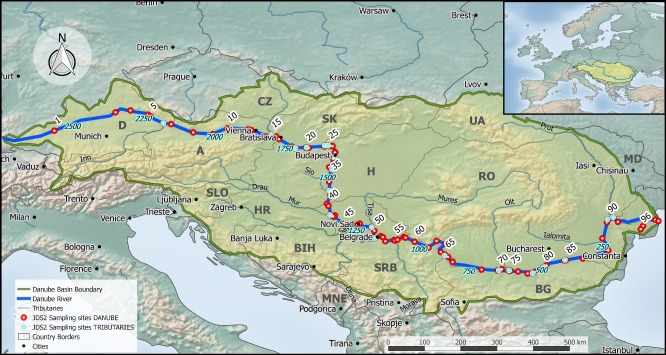
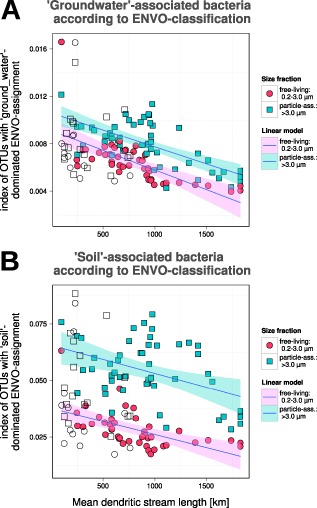
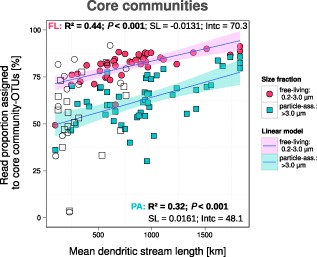
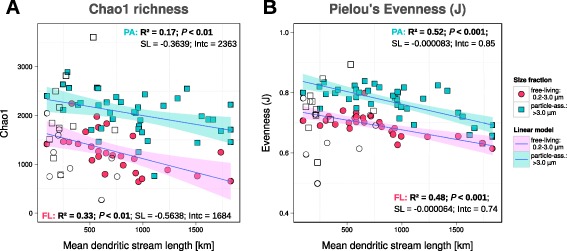
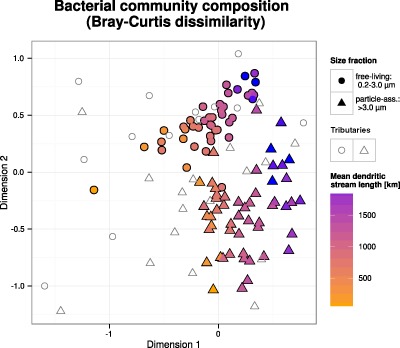
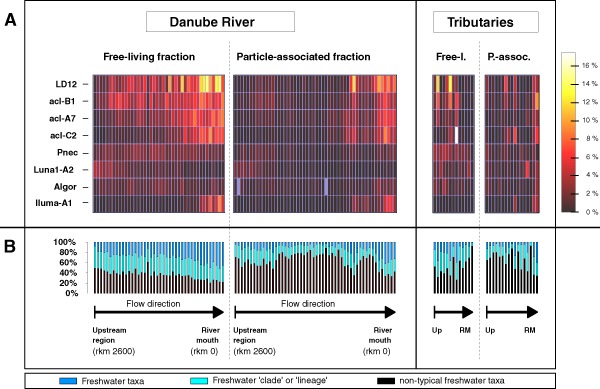
The bacterioplankton diversity in large rivers has thus far been under-sampled despite the importance of streams and rivers as components of continental landscapes. Here, we present a comprehensive dataset detailing the bacterioplankton diversity along the midstream of the Danube River and its tributaries. Using 16S rRNA-gene amplicon sequencing, our analysis revealed that bacterial richness and evenness gradually declined downriver in both the free-living and particle-associated bacterial communities. These shifts were also supported by beta diversity analysis, where the effects of tributaries were negligible in regards to the overall variation. In addition, the river was largely dominated by bacteria that are commonly observed in freshwaters. Dominated by the acI lineage, the freshwater SAR11 (LD12) and the Polynucleobacter group, typical freshwater taxa increased in proportion downriver and were accompanied by a decrease in soil and groundwater-affiliated bacteria. Based on views of the meta-community and River Continuum Concept, we interpret the observed taxonomic patterns and accompanying changes in alpha and beta diversity with the intention of laying the foundation for a unified concept for river bacterioplankton diversity.
尽管溪流和河流作为大陆景观的组成部分非常重要,但迄今为止,大型河流中的浮游细菌多样性采样不足。在此,我们展示了一个全面的数据集,详细说明了多瑙河中游及其支流沿线的浮游细菌多样性。通过16S rRNA基因扩增子测序,我们的分析表明,在自由生活和与颗粒相关的细菌群落中,细菌丰富度和均匀度均沿下游逐渐下降。这些变化也得到了β多样性分析的支持,其中支流对总体变化的影响可忽略不计。此外,该河流主要由淡水中常见的细菌主导。典型的淡水分类群以acI谱系、淡水SAR11(LD12)和多核杆菌属为主,沿下游比例增加,同时与土壤和地下水相关的细菌减少。基于元群落和河流连续体概念的观点,我们解释了观察到的分类模式以及α和β多样性的伴随变化,旨在为河流浮游细菌多样性的统一概念奠定基础。