Rayner Rachael E, Savill John, Hafner Louise M, Huygens Flavia
School of Biomedical Sciences, Queensland University of Technology, Brisbane, Australia; Institute of Health and Biomedical Innovation, Queensland University of Technology, Brisbane, Australia.
Public Health Microbiology Laboratory, Queensland Health Forensic and Scientific Services, Brisbane, Australia.
PLoS One. 2015 Apr 29;10(4):e0121870. doi: 10.1371/journal.pone.0121870. eCollection 2015.
Globally, over 800 000 children under five die each year from infectious diseases caused by Streptococcus pneumoniae. To understand genetic relatedness between isolates, study transmission routes, assess the impact of human interventions e.g. vaccines, and determine infection sources, genotyping methods are required. The 'gold standard' genotyping method, Multi-Locus Sequence Typing (MLST), is useful for long-term and global studies. Another genotyping method, Multi-Locus Variable Number of Tandem Repeat Analysis (MLVA), has emerged as a more discriminatory, inexpensive and faster technique; however there is no universally accepted method and it is currently suitable for short-term and localised epidemiology studies. Currently Australia has no national MLST database, nor has it adopted any MLVA method for short-term or localised studies. This study aims to improve S. pneumoniae genotyping methods by modifying the existing MLVA techniques to be more discriminatory, faster, cheaper and technically less demanding than previously published MLVA methods and MLST.
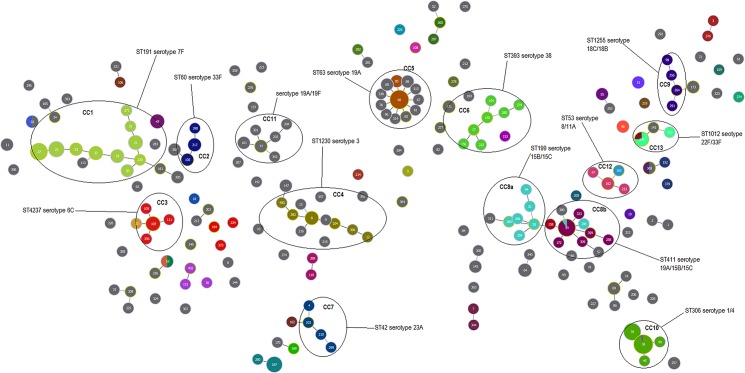
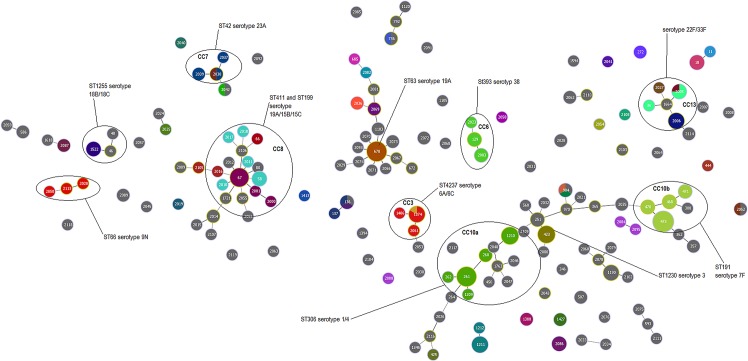
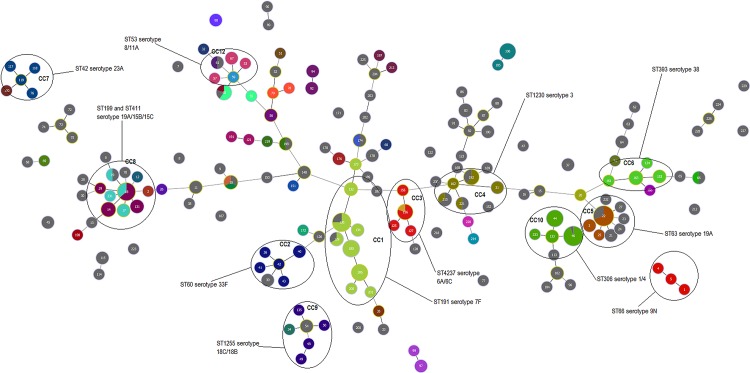
Four different MLVA protocols, including a modified method, were applied to 317 isolates of serotyped invasive S. pneumoniae isolated from sterile body sites of Queensland children under 15 years from 2007-2012. MLST was applied to 202 isolates for comparison.
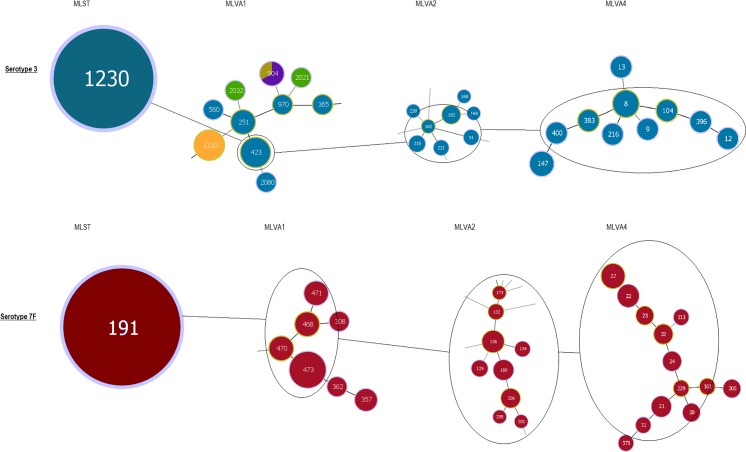
The modified MLVA4 is significantly more discriminatory than the 'gold standard' MLST method. MLVA4 has similar discrimination compared to other MLVA techniques in this study). The failure to amplify particular loci in previous MLVA methods were minimised in MLVA4. Failure to amplify BOX-13 and Spneu19 were found to be serotype specific.
We have modified a highly discriminatory MLVA technique for genotyping Queensland invasive S. pneumoniae. MLVA4 has the ability to enhance our understanding of the pneumococcal epidemiology and the changing genetics of the pneumococcus in localised and short-term studies.
在全球范围内,每年有超过80万5岁以下儿童死于肺炎链球菌引起的传染病。为了了解分离株之间的遗传相关性、研究传播途径、评估人类干预措施(如疫苗)的影响以及确定感染源,需要采用基因分型方法。“金标准”基因分型方法——多位点序列分型(MLST),对长期和全球研究很有用。另一种基因分型方法——多位点可变数目串联重复序列分析(MLVA),已成为一种更具鉴别力、成本更低且速度更快的技术;然而,目前尚无普遍接受的方法,它目前适用于短期和局部流行病学研究。目前澳大利亚没有国家MLST数据库,也未采用任何MLVA方法进行短期或局部研究。本研究旨在通过改进现有的MLVA技术,使其比先前发表的MLVA方法和MLST更具鉴别力、更快、更便宜且技术要求更低,从而改进肺炎链球菌基因分型方法。
将包括一种改良方法在内的四种不同的MLVA方案应用于2007年至2012年从昆士兰15岁以下儿童无菌身体部位分离出的317株血清型侵袭性肺炎链球菌分离株。将MLST应用于202株分离株进行比较。
改良后的MLVA4比“金标准”MLST方法具有显著更高的鉴别力。与本研究中的其他MLVA技术相比,MLVA4具有相似的鉴别力。在MLVA方法中,先前无法扩增特定基因座的情况在MLVA4中降至最低。发现无法扩增BOX-13和Spneu19是血清型特异性的。
我们改进了一种用于昆士兰侵袭性肺炎链球菌基因分型的高鉴别力MLVA技术。MLVA4有能力增强我们对肺炎球菌流行病学以及局部和短期研究中肺炎球菌不断变化的遗传学的理解。