Yoshida Ken, Yamazaki Hideya, Nakamura Satoaki, Masui Koji, Kotsuma Tadayuki, Akiyama Hironori, Tanaka Eiichi, Yoshikawa Nobuhiko, Uesugi Yasuo, Shimbo Taiju, Narumi Yoshifumi, Yoshioka Yasuo
Department of Radiology, Osaka Medical College, Takatsuki, Japan.
Department of Radiology, Kyoto Prefectural University of Medicine, Kyoto, Japan.
J Gynecol Oncol. 2015 Jul;26(3):179-84. doi: 10.3802/jgo.2015.26.3.179. Epub 2015 Apr 29.
To assess actual rates of late vaginal stenosis and identify predisposing factors for complications among patients with previously untreated cervical cancer following high-dose-rate brachytherapy.
We performed longitudinal analyses of 57 patients using the modified Dische score at 6, 12, 18, 24, 36, and 60 months after treatment, which consisted of 15 interstitial brachytherapys and 42 conventional intracavitary brachytherapys, with a median follow-up time of 36 months (range, 6 to 144 months).
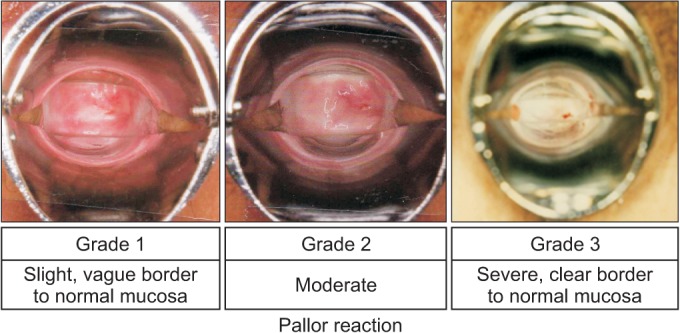
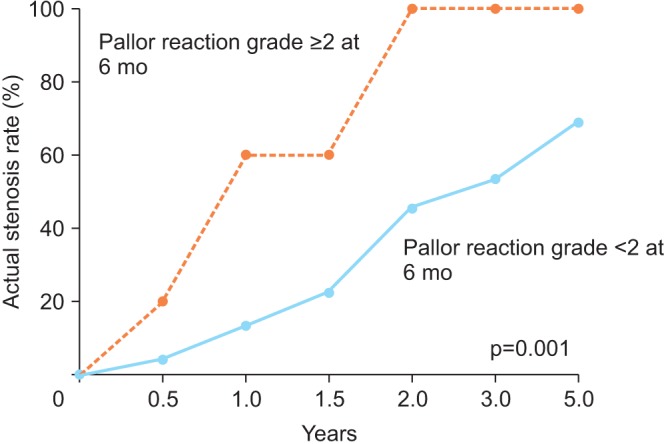
More than half of the patients developed grade 1 (mild) vaginal stenosis within the first year of follow-up, and grade 2 (97.5%, moderate) to grade 3 (severe) stenosis gradually increased with time. Actual stenosis rates for grade 1, 2, and 3 were 97.5% (95% confidence interval [CI], 92.7 to 97.5), 60.7% (95% CI, 42.2 to 79.3), and 7.4% (95% CI, 0 to 18.4) at 3 years after treatment. Pallor reaction grade 2-3 at 6 months was only a statistically significant predisposing factor for grade 2-3 late vaginal stenosis 3 years or later with a hazard ratio of 3.48 (95% CI, 1.32 to 9.19; p=0.018) by a multivariate Cox proportional hazard model. Patients with grade 0-1 pallor reaction at 6 months showed a grade ≥2 vaginal stenosis rate of 53%, whereas the grade 2-3 pallor reaction group achieved a grade ≥2 vaginal stenosis rate at 3 years at 100% (p=0.001).
High-dose-rate brachytherapy was associated with high incidence of late vaginal stenosis. Pallor reaction grade 2-3 at 6 months was predictive of late grade 2-3 vaginal stenosis at 3 years after treatment. These findings should prove helpful for patient counseling and preventive intervention.
评估高剂量率近距离放射治疗后未经治疗的宫颈癌患者晚期阴道狭窄的实际发生率,并确定并发症的诱发因素。
我们对57例患者进行了纵向分析,在治疗后6、12、18、24、36和60个月使用改良的迪斯评分,其中包括15例组织间近距离放射治疗和42例传统腔内近距离放射治疗,中位随访时间为36个月(范围6至144个月)。
超过一半的患者在随访的第一年内出现1级(轻度)阴道狭窄,2级(97.5%,中度)至3级(重度)狭窄随时间逐渐增加。治疗后3年,1级、2级和3级的实际狭窄率分别为97.5%(95%置信区间[CI],92.7至97.5)、60.7%(95%CI,42.2至79.3)和7.4%(95%CI,0至18.4)。6个月时苍白反应2 - 3级是3年或更晚发生2 - 3级晚期阴道狭窄的唯一具有统计学意义的诱发因素,多因素Cox比例风险模型显示风险比为3.48(95%CI,1.32至9.19;p = 0.018)。6个月时苍白反应0 - 1级的患者阴道狭窄≥2级的发生率为53%,而苍白反应2 - 3级组在3年时阴道狭窄≥2级的发生率为100%(p = 0.001)。
高剂量率近距离放射治疗与晚期阴道狭窄的高发生率相关。6个月时苍白反应2 - 3级可预测治疗后3年发生的晚期2 - 3级阴道狭窄。这些发现应有助于患者咨询和预防性干预。