Williamson Rosalind C, Cowell Christopher A M, Reville Thomas, Roper James A, Rendall Thomas C S, Bass Mark D
School of Biochemistry and University of Bristol, University Walk, Bristol BS8 1TD, United Kingdom.
Department of Engineering, University of Bristol, University Walk, Bristol BS8 1TD, United Kingdom.
J Biol Chem. 2015 Jun 19;290(25):15437-15449. doi: 10.1074/jbc.M115.640367. Epub 2015 Apr 29.
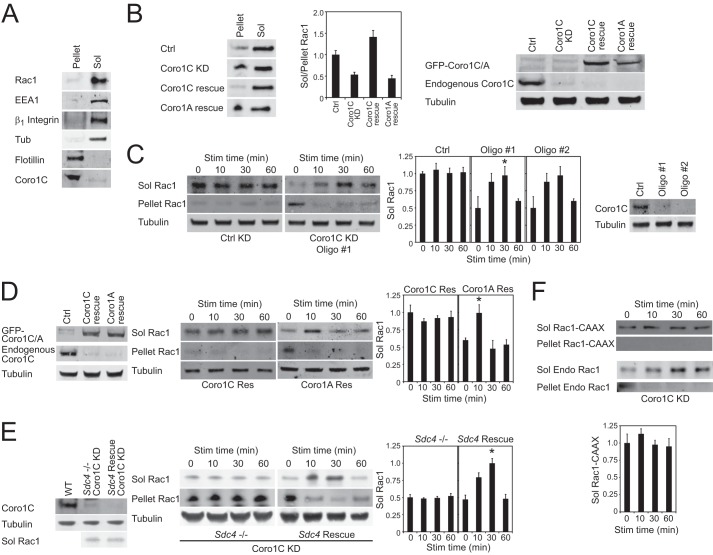
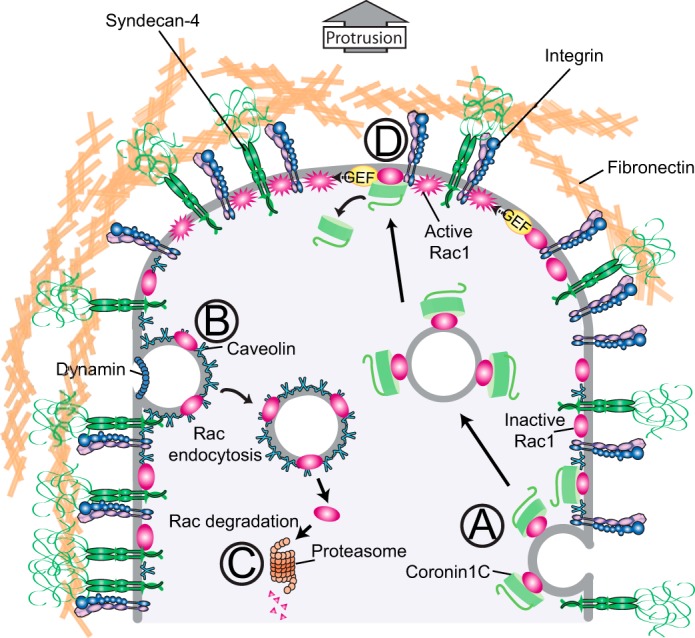
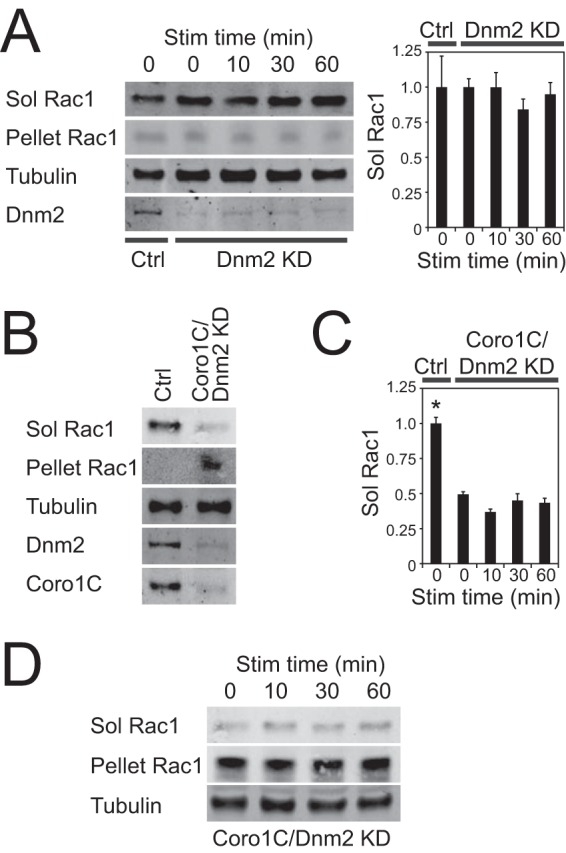
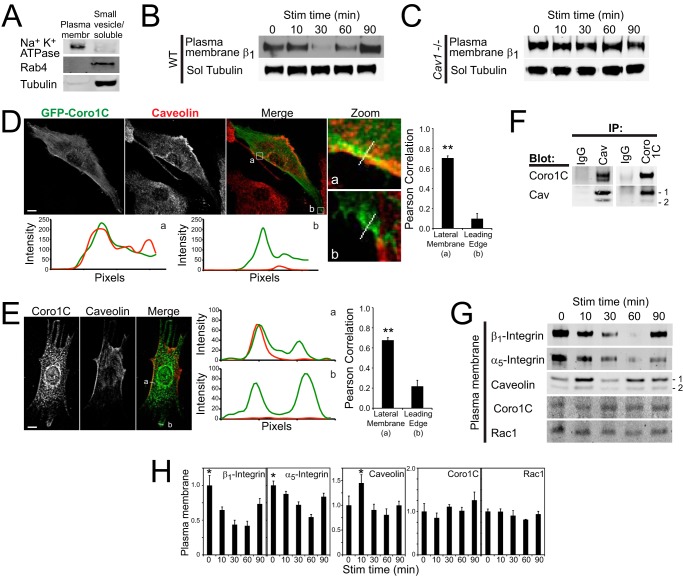
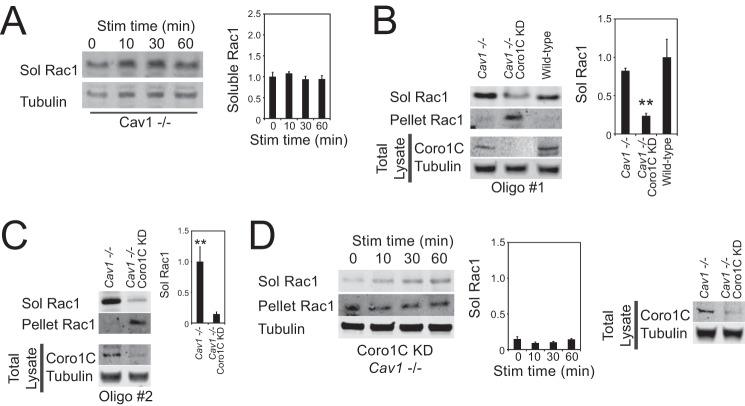
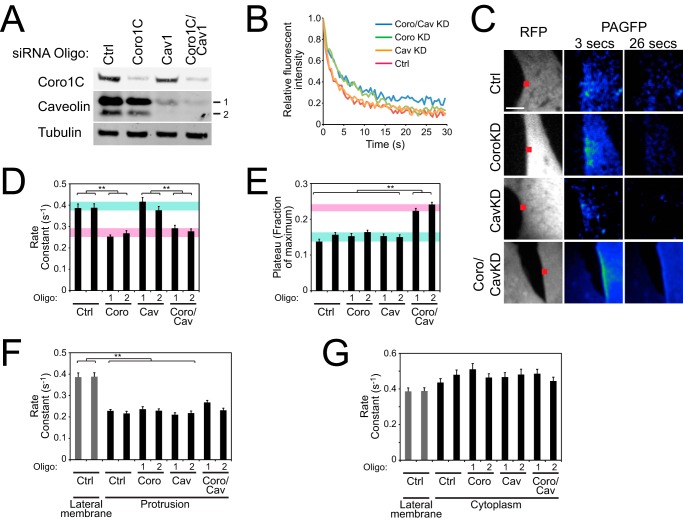
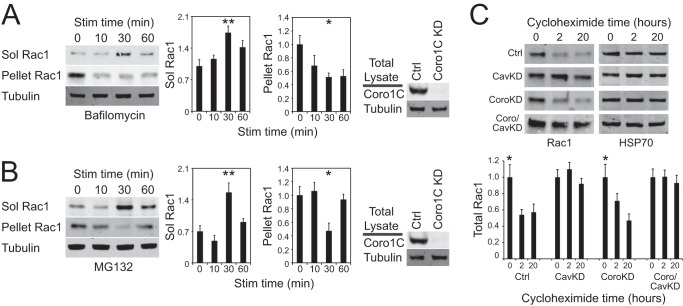
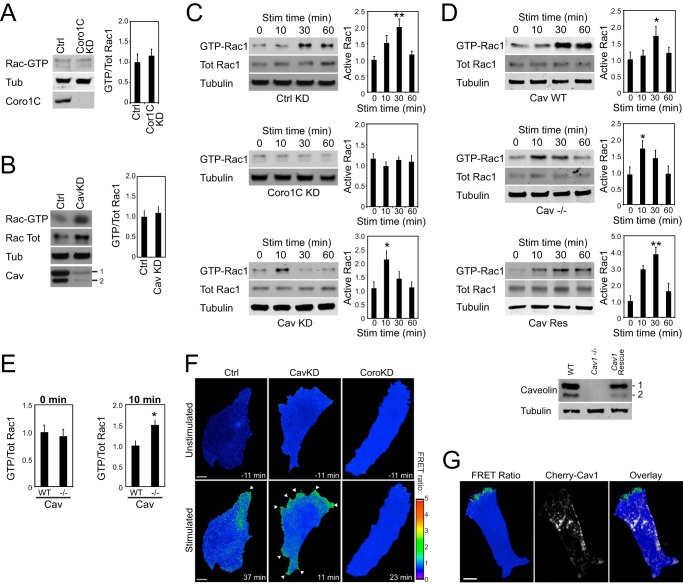
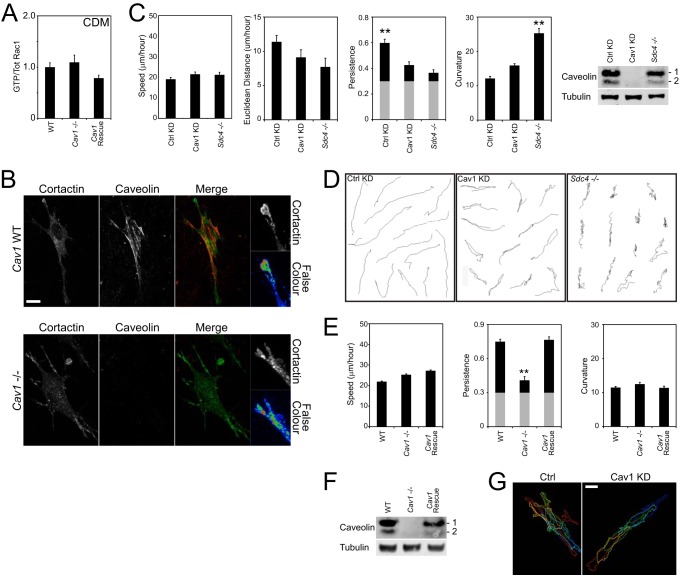
Sustained directional fibroblast migration requires both polarized activation of the protrusive signal, Rac1, and redistribution of inactive Rac1 from the rear of the cell so that it can be redistributed or degraded. In this work, we determine how alternative endocytic mechanisms dictate the fate of Rac1 in response to the extracellular matrix environment. We discover that both coronin-1C and caveolin retrieve Rac1 from similar locations at the rear and sides of the cell. We find that coronin-1C-mediated extraction, which is responsible for Rac1 recycling, is a constitutive process that maintains Rac1 protein levels within the cell. In the absence of coronin-1C, the effect of caveolin-mediated endocytosis, which targets Rac1 for proteasomal degradation, becomes apparent. Unlike constitutive coronin-1C-mediated trafficking, caveolin-mediated Rac1 endocytosis is induced by engagement of the fibronectin receptor syndecan-4. Such an inducible endocytic/degradation mechanism would predict that, in the presence of fibronectin, caveolin defines regions of the cell that are resistant to Rac1 activation but, in the absence of fibronectin leaves more of the membrane susceptible to Rac1 activation and protrusion. Indeed, we demonstrate that fibronectin-stimulated activation of Rac1 is accelerated in the absence of caveolin and that, when caveolin is knocked down, polarization of active Rac1 is lost in FRET experiments and culminates in shunting migration in a fibrous fibronectin matrix. Although the concept of polarized Rac1 activity in response to chemoattractants has always been apparent, our understanding of the balance between recycling and degradation explains how polarity can be maintained when the chemotactic gradient has faded.
成纤维细胞持续的定向迁移既需要突出信号Rac1的极化激活,也需要非活性Rac1从细胞后部重新分布,以便其能够重新分布或降解。在这项研究中,我们确定了内吞机制如何决定Rac1在细胞外基质环境中的命运。我们发现冠蛋白-1C和小窝蛋白都能从细胞后部和侧面的相似位置回收Rac1。我们发现,负责Rac1循环利用的冠蛋白-1C介导的提取是一个维持细胞内Rac1蛋白水平的组成性过程。在没有冠蛋白-1C的情况下,以Rac1为蛋白酶体降解靶点的小窝蛋白介导的内吞作用的效果变得明显。与组成性的冠蛋白-1C介导的运输不同,小窝蛋白介导的Rac1内吞作用是由纤连蛋白受体syndecan-4的结合诱导的。这样一种可诱导的内吞/降解机制预示着,在纤连蛋白存在的情况下,小窝蛋白定义了细胞中对Rac1激活有抗性的区域,但在没有纤连蛋白的情况下,更多的细胞膜对Rac1激活和突出更敏感。事实上,我们证明在没有小窝蛋白的情况下,纤连蛋白刺激的Rac1激活会加速,并且当小窝蛋白被敲低时,在FRET实验中活性Rac1的极化会丧失,并最终导致在纤维状纤连蛋白基质中的旁路迁移。尽管响应趋化因子的极化Rac1活性的概念一直很明显,但我们对循环利用和降解之间平衡的理解解释了在趋化梯度消失时如何维持极性。