Cameron Jan, Rendell Peter G, Ski Chantal F, Kure Christina E, McLennan Skye N, Rose Nathan S, Prior David L, Thompson David R
Centre for the Heart and Mind, Mary MacKillop Institute for Health Research, Australian Catholic University, Level 5, 215 Spring Street, Melbourne, VIC, 3000, Australia.
Cognition and Emotion Research Centre, School of Psychology, Australian Catholic University, 115 Victoria Parade, Melbourne, VIC, 3065, Australia.
Trials. 2015 Apr 29;16:196. doi: 10.1186/s13063-015-0721-2.
Cognitive impairment is seen in up to three quarters of heart failure (HF) patients and has a significant negative impact on patients' health outcomes. Prospective memory, which is defined as memory to carry out future intentions, is important for functional independence in older adults and involves application of multiple cognitive processes that are often impaired in HF patients. The objective of this study is to examine the effects of prospective memory training on patients' engagement in HF self-care and health outcomes, carer strain and quality of life.
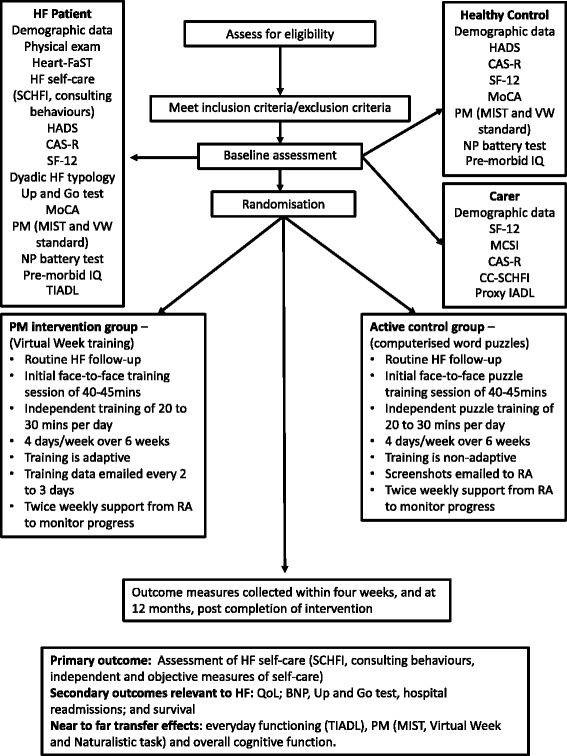
METHODS/DESIGN: The proposed study is a randomised, controlled trial in which 200 patients diagnosed with HF, and their carers will be recruited from 3 major hospitals across Melbourne. Eligible patients with HF will be randomised to receive either: 1) The Virtual Week Training Program - a computerised prospective memory (PM) training program (intervention) or 2) non-adaptive computer-based word puzzles (active control). HF patients' baseline cognitive function will be compared to a healthy control group (n = 60) living independently in the community. Patients will undergo a comprehensive assessment of PM, neuropsychological functioning, self-care, physical, and emotional functioning. Assessments will take place at baseline, 4 weeks and 12 months following intervention. Carers will complete measures assessing quality of life, strain, perceived control in the management of the patients' HF symptoms, and ratings of the patients' level of engagement in HF self-care behaviours.
If the Virtual Week Training Program is effective in improving: 1) prospective memory; 2) self-care behaviours, and 3) wellbeing in HF patients, this study will enhance our understanding of impaired cognitive processes in HF and potentially is a mechanism to reduce healthcare costs.
Australian New Zealand Clinical Trials Registry #366376; 27 May 2014. https://www.anzctr.org.au/Trial/Registration/TrialReview.aspx?id=366376&isClinicalTrial=False .
高达四分之三的心力衰竭(HF)患者存在认知障碍,这对患者的健康结局有显著负面影响。前瞻性记忆被定义为执行未来意图的记忆,对老年人的功能独立性很重要,并且涉及多种认知过程的应用,而这些认知过程在HF患者中常常受损。本研究的目的是检验前瞻性记忆训练对患者参与HF自我护理及健康结局、照顾者负担和生活质量的影响。
方法/设计:拟进行的研究是一项随机对照试验,将从墨尔本的3家主要医院招募200名被诊断为HF的患者及其照顾者。符合条件的HF患者将被随机分为两组,分别接受:1)虚拟周训练计划——一个计算机化的前瞻性记忆(PM)训练计划(干预组);或2)非适应性计算机文字拼图游戏(积极对照组)。将HF患者的基线认知功能与社区中独立生活的健康对照组(n = 60)进行比较。患者将接受PM、神经心理功能、自我护理、身体和情绪功能的全面评估。评估将在干预后的基线、4周和12个月进行。照顾者将完成评估生活质量、负担、对患者HF症状管理的感知控制以及患者参与HF自我护理行为水平评分的量表。
如果虚拟周训练计划在改善以下方面有效:1)前瞻性记忆;2)自我护理行为;以及3)HF患者的幸福感,那么本研究将增进我们对HF中受损认知过程的理解,并且可能是一种降低医疗成本的机制。
澳大利亚新西兰临床试验注册中心#366376;2014年5月27日。https://www.anzctr.org.au/Trial/Registration/TrialReview.aspx?id=366376&isClinicalTrial=False 。