Gajos Grzegorz, Konieczynska Malgorzata, Zalewski Jaroslaw, Undas Anetta
Department of Coronary Disease and Heart Failure, Institute of Cardiology, Jagiellonian University Medical College, 80 Pradnicka str, 31-202, Krakow, Poland.
John Paul II Hospital, Krakow, Poland.
Cardiovasc Diabetol. 2015 May 1;14:44. doi: 10.1186/s12933-015-0207-2.
To investigate the effect of low blood glucose on thrombin generation and fibrin clot properties in type 2 diabetes (T2DM).
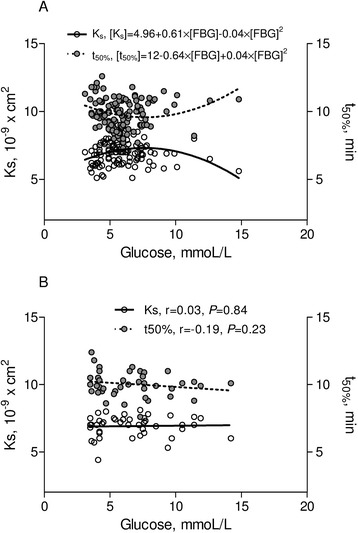
In 165 patients with T2DM and high cardiovascular risk, we measured ex vivo plasma fibrin clot permeation [Ks], turbidity and efficiency of fibrinolysis including clot lysis time [t50%], together with thrombin generation and platelet activation markers in relation to fasting blood glucose.
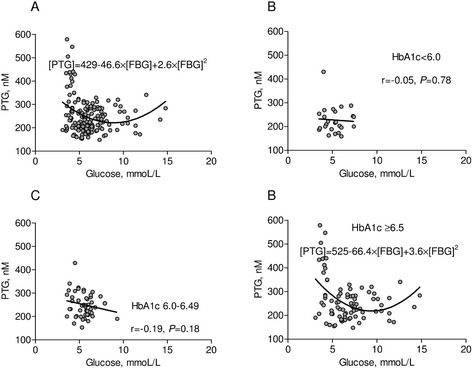
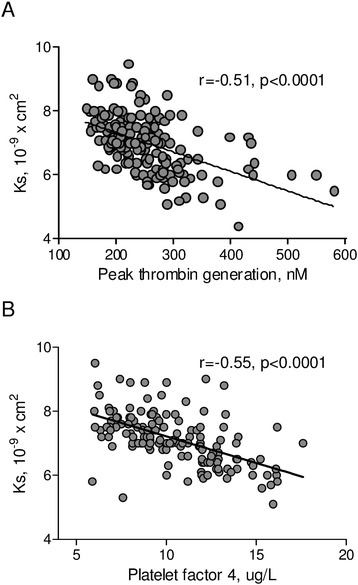
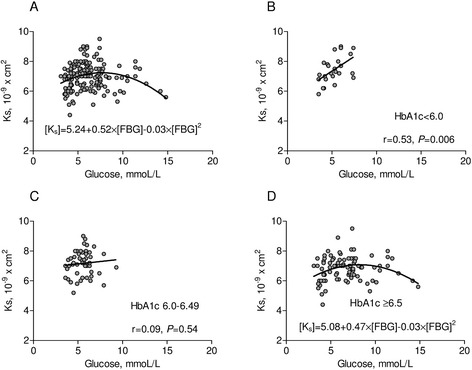
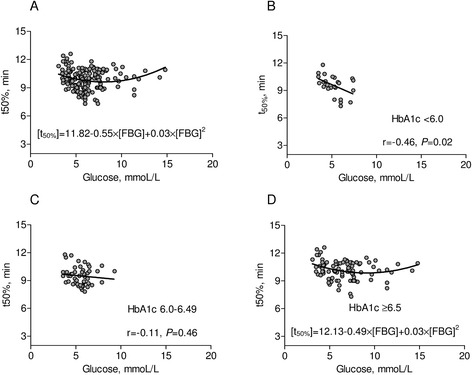
As compared to patients in medium (4.5-6.0 mmol/l, n = 52) and higher (>6.0 mmol/l, n = 75) glucose group, subjects with low glycemia (<4.5 mmol/l, n = 38) had lower Ks by 11% (p < 0.001) and 8% (p = 0.01), respectively, prolonged t50% by 10% (p < 0.001) and 7% (p = 0.016), respectively, and higher peak thrombin generation by 21% and 16%, respectively (p < 0.001 for both). There were no significant differences in Ks and t50% between patients in medium and higher glucose group. In the whole group, a J-shape relationship was observed between glycemia and the following factors: peak thrombin generation, Ks and t50%. Only in patients with HbA1c < 6.0% (42 mmol/mol) (n = 26) fasting glucose positively correlated with Ks (r = 0.53, P = 0.006) and inversely with t50% (r = -0.46, P = 0.02). By multiple regression analysis, after adjustment for age, fibrinogen, HbA1c, insulin treatment and T2DM duration, fasting glycemia was the independent predictor of Ks (F = 6.6, df = 2, P = 0.002), t50% (F = 8.0, df = 2, P < 0.001) and peak thrombin generation (F = 13.5, df = 2, P < 0.0001).
In T2DM patients fasting glycemia <4.5 mmol/l is associated with enhanced thrombin formation and formation of denser fibrin clots displaying lower lysability, especially when strict glycemia control was achieved (HbA1c<6.0%).
研究低血糖对2型糖尿病(T2DM)患者凝血酶生成及纤维蛋白凝块特性的影响。
在165例心血管疾病高危的T2DM患者中,我们检测了离体血浆纤维蛋白凝块渗透性[Ks]、浊度及纤维蛋白溶解效率,包括凝块溶解时间[t50%],同时检测了凝血酶生成及血小板活化标志物,并分析其与空腹血糖的关系。
与血糖水平处于中等范围(4.5 - 6.0 mmol/l,n = 52)及较高范围(>6.0 mmol/l,n = 75)的患者相比,低血糖患者(<4.5 mmol/l,n = 38)的Ks分别降低了11%(p < 0.001)和8%(p = 0.01),t50%分别延长了10%(p < 0.001)和7%(p = 0.016),凝血酶生成峰值分别升高了21%和16%(两者p均<0.001)。血糖中等范围组与较高范围组患者的Ks及t50%无显著差异。在整个研究组中,血糖与以下因素之间呈J形关系:凝血酶生成峰值、Ks及t50%。仅在糖化血红蛋白(HbA1c)<6.0%(42 mmol/mol)的患者(n = 26)中,空腹血糖与Ks呈正相关(r = 0.53,P = 0.006),与t50%呈负相关(r = -0.46,P = 0.02)。多元回归分析显示,在调整年龄、纤维蛋白原、HbA1c、胰岛素治疗及T2DM病程后,空腹血糖是Ks(F = 6.6,自由度 = 2,P = 0.002)、t50%(F = 8.0,自由度 = 2,P < 0.001)及凝血酶生成峰值(F = 13.5,自由度 = 2,P < 0.0001)的独立预测因素。
在T2DM患者中,空腹血糖<4.5 mmol/l与凝血酶生成增加及形成更致密、溶解能力更低的纤维蛋白凝块相关,尤其是在实现严格血糖控制(HbA1c<6.0%)时。