Zhou Pu, Yang Feifei, Wang Jinyu, Mao Richeng, Qi Xun, Huang Yuxian, Zhang Jiming
From the Department of Infectious Diseases, Huashan Hospital, Shanghai Medical College (PZ, FY, JW, RM, YH, JZ); Department of Viral Hepatitis, Shanghai Public Health Clinical Center, Fudan University, Shanghai, China (XQ, YH).
Medicine (Baltimore). 2015 May;94(17):e730. doi: 10.1097/MD.0000000000000730.
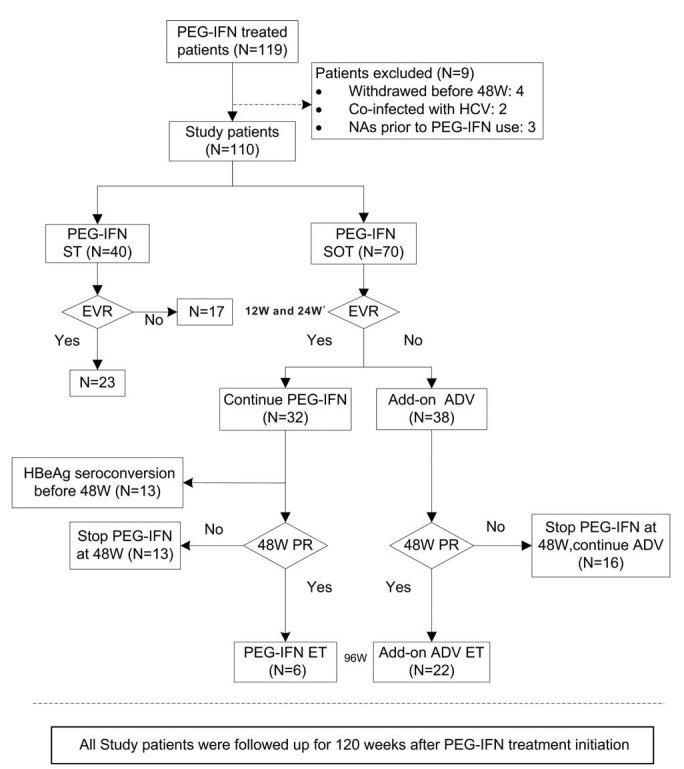
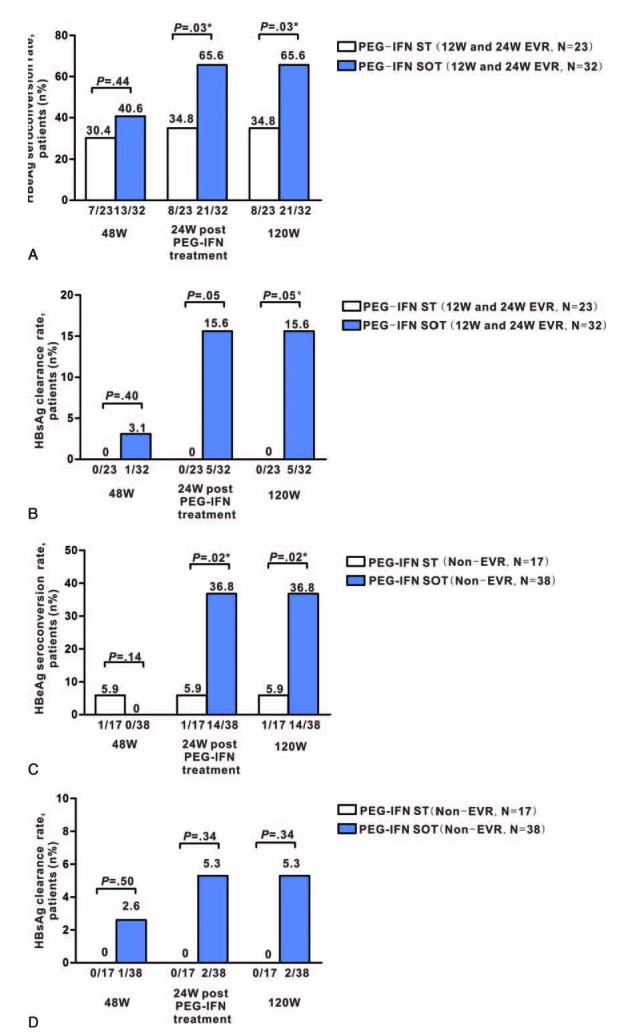
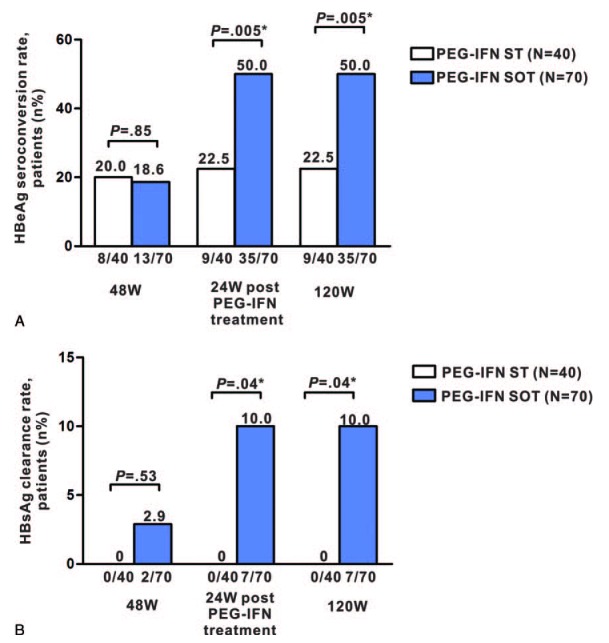
Current pegylated interferon-α (PEG-IFN) treatment for chronic hepatitis B (CHB) e-antigen (HBeAg)-positive patients are suboptimal, and effective ways of improving PEG-IFN treatment efficacy are needed.This retrospective cohort study compared the efficacy of a PEG-IFN stepwise optimization treatment (PEG-IFN SOT) strategy with that of a 48-week PEG-IFN standard therapy (PEG-IFN ST) in HBeAg-positive CHB patients.A total of 110 patients were included in our study. Of these, 70 received the PEG-IFN SOT and 40 received the PEG-IFN ST (control group). We based the decision whether to add adefovir and/or extend the PEG-IFN-based treatment to 96 weeks on the patients' 12-week or 24-week early virological response (12W EVR, at least a 2 log10 reduction in HBV DNA copies/mL at week 12; 24W EVR, at least 1 log10 reduction in HBsAg IU/mL or HBsAg <1500 IU/mL at week 24) and their 48-week partial response (48W PR, 1.0 ≤HBeAg ≤10.0 S/CO or HBeAg >10.0 S/CO but HBsAg <1000 IU/mL).The HBeAg seroconversion rate 24 weeks post-PEG-IFN treatment was significantly higher in the PEG-IFN SOT than the PEG-IFN ST group (50% vs 22.5%, P = 0.005). The HBsAg clearance rates in the PEG-IFN SOT and ST groups were 10% and 0% (P = 0.04), respectively. Receiving PEG-IFN SOT (OR = 0.26, P = 0.01), ALT × ULN at baseline (OR = 0.74, P = 0.003), and achieving 12 and 24W EVR (OR = 0.29, P = 0.03) were independent factors associated with HBeAg seroconversion.PEG-IFN SOT is a promising strategy for achieving high rates of serological response in HBeAg-positive CHB patients.
目前聚乙二醇化干扰素-α(PEG-IFN)治疗慢性乙型肝炎(CHB)e抗原(HBeAg)阳性患者的效果欠佳,因此需要有效的方法来提高PEG-IFN的治疗效果。这项回顾性队列研究比较了PEG-IFN逐步优化治疗(PEG-IFN SOT)策略与48周PEG-IFN标准治疗(PEG-IFN ST)对HBeAg阳性CHB患者的疗效。我们的研究共纳入110例患者。其中,70例接受PEG-IFN SOT,40例接受PEG-IFN ST(对照组)。我们根据患者的12周或24周早期病毒学应答(12周早期病毒学应答,即第12周时HBV DNA拷贝数/mL至少降低2 log10;24周早期病毒学应答,即第24周时HBsAg IU/mL至少降低1 log10或HBsAg <1500 IU/mL)以及他们的48周部分应答(48周部分应答,即1.0≤HBeAg≤10.0 S/CO或HBeAg>10.0 S/CO但HBsAg <1000 IU/mL)来决定是否加用阿德福韦和/或将基于PEG-IFN的治疗延长至96周。PEG-IFN治疗24周后的HBeAg血清学转换率在PEG-IFN SOT组显著高于PEG-IFN ST组(50%对22.5%,P = 0.005)。PEG-IFN SOT组和ST组的HBsAg清除率分别为10%和0%(P = 0.04)。接受PEG-IFN SOT(比值比[OR]=0.26,P = 0.01)、基线时ALT×正常上限(ULN)(OR = 0.74,P = 0.003)以及实现12周和24周早期病毒学应答(OR = 0.29,P = 0.03)是与HBeAg血清学转换相关的独立因素。PEG-IFN SOT是一种在HBeAg阳性CHB患者中实现高血清学应答率的有前景的策略。