Kleszczewski Tomasz, Buzun Leszek, Lisowska Anna, Modzelewska Beata
Department of Biophysics, Medical University of Bialystok, ul. Mickiewicza 2A, 15-222, Białystok, Poland.
Department of Cardiac Surgery, Medical University of Białystok, ul. M. Skłodowskiej-Curie 24A, 15-276, Białystok, Poland.
Heart Vessels. 2016 Apr;31(4):616-21. doi: 10.1007/s00380-015-0684-y. Epub 2015 May 5.
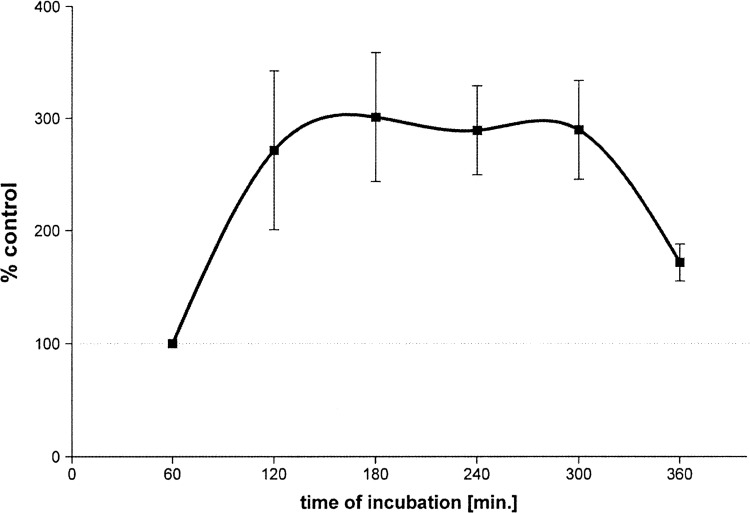
The aim of the present study was to examine how, under in vitro conditions, the human left internal thoracic artery (LITA) reacts to contractile agonist:potassium chloride (KCL) as a function of time, as well as to examine whether a change in the LITA reactivity can correlate with the occurrence of the refractory vascular spasm (RVS). Distal segments of LITA obtained from 33 patients aged 38-73, at the time of routine coronary artery surgical revascularization (CABG). Contractile response to 80 mmol K(+) was recorded under isometric conditions. In 16 (48,5 %) LITA segments, contractile reaction to K(+) after experiments ranging 1-10 h were registered. No contractile response even after 10 h of incubation was observed in 17 (51.5 %) LITA segments. Between 120 and 300 min after the beginning of the experiment, the reaction was maximum and amounted up to 300 % control reaction, then decreased. First, with respect to in vitro research isolated by LITA rings, while analyzing the results of the research, one should take into consideration the possibility that during the research, the functional state of the tissues changes and in particular its sensitivity to depolarization of the cell membrane. Second, the change in the sensitivity to depolarization of the cell membrane of the smooth muscles' LITA might be the potential mechanism causing the occurrence of the postoperative spasm after the CABG treatment.
本研究的目的是探讨在体外条件下,人左内乳动脉(LITA)如何随时间对收缩激动剂氯化钾(KCL)作出反应,以及研究LITA反应性的变化是否与难治性血管痉挛(RVS)的发生相关。LITA的远端节段取自33例年龄在38 - 73岁的患者,取材于常规冠状动脉外科血运重建术(CABG)时。在等长条件下记录对80 mmol K⁺的收缩反应。在16个(48.5%)LITA节段中,记录了实验1 - 10小时后对K⁺的收缩反应。在17个(51.5%)LITA节段中,即使孵育10小时后也未观察到收缩反应。在实验开始后的120至300分钟之间,反应最大,达到对照反应的300%,然后下降。首先,关于用LITA环进行的体外研究,在分析研究结果时,应考虑到在研究过程中组织功能状态发生变化,特别是其对细胞膜去极化敏感性变化的可能性。其次,LITA平滑肌细胞膜去极化敏感性的变化可能是CABG治疗后术后痉挛发生的潜在机制。