de Vries Schultink Aurelia H M, Zwart Wilbert, Linn Sabine C, Beijnen Jos H, Huitema Alwin D R
Department of Pharmacy and Pharmacology, Antoni van Leeuwenhoek-The Netherlands Cancer Institute, Louwesweg 6, 1066 EC, Amsterdam, The Netherlands.
Clin Pharmacokinet. 2015 Aug;54(8):797-810. doi: 10.1007/s40262-015-0273-3.
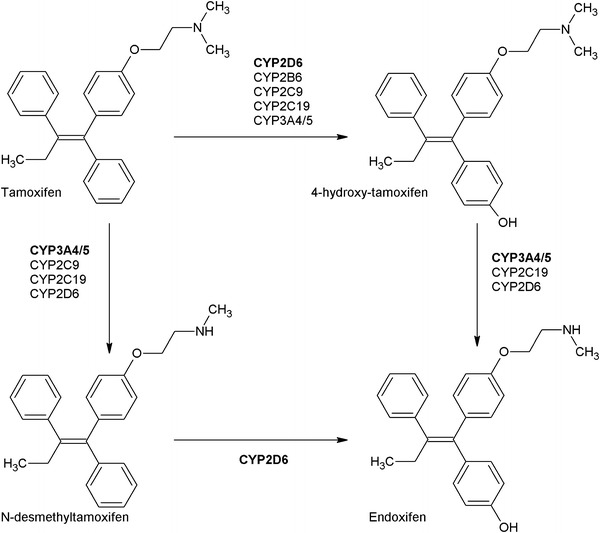
The antiestrogenic drug tamoxifen is widely used in the treatment of estrogen receptor-α-positive breast cancer and substantially decreases recurrence and mortality rates. However, high interindividual variability in response is observed, calling for a personalized approach to tamoxifen treatment. Tamoxifen is bioactivated by cytochrome P450 (CYP) enzymes such as CYP2B6, CYP2C9, CYP2C19, CYP2D6 and CYP3A4/5, resulting in the formation of active metabolites, including 4-hydroxy-tamoxifen and endoxifen. Therefore, polymorphisms in the genes encoding these enzymes are proposed to influence tamoxifen and active tamoxifen metabolites in the serum and consequently affect patient response rates. To tailor tamoxifen treatment, multiple studies have been performed to clarify the influence of polymorphisms on its pharmacokinetics and pharmacodynamics. Nevertheless, personalized treatment of tamoxifen based on genotyping has not yet met consensus. This article critically reviews the published data on the effect of various genetic polymorphisms on the pharmacokinetics and pharmacodynamics of tamoxifen, and reviews the clinical implications of its findings. For each CYP enzyme, the influence of polymorphisms on pharmacokinetic and pharmacodynamic outcome measures is described throughout this review. No clear effects on pharmacokinetics and pharmacodynamics were seen for various polymorphisms in the CYP encoding genes CYP2B6, CYP2C9, CYP2C19 and CYP3A4/5. For CYP2D6, there was a clear gene-exposure effect that was able to partially explain the interindividual variability in plasma concentrations of the pharmacologically most active metabolite endoxifen; however, a clear exposure-response effect remained controversial. These controversial findings and the partial contribution of genotype in explaining interindividual variability in plasma concentrations of, in particular, endoxifen, imply that tailored tamoxifen treatment may not be fully realized through pharmacogenetics of metabolizing enzymes alone.
抗雌激素药物他莫昔芬广泛用于治疗雌激素受体α阳性乳腺癌,可显著降低复发率和死亡率。然而,观察到个体间反应存在高度变异性,这就需要采用个性化的他莫昔芬治疗方法。他莫昔芬通过细胞色素P450(CYP)酶如CYP2B6、CYP2C9、CYP2C19、CYP2D6和CYP3A4/5进行生物活化,从而形成活性代谢产物,包括4-羟基他莫昔芬和内昔芬。因此,编码这些酶的基因中的多态性被认为会影响血清中的他莫昔芬和活性他莫昔芬代谢产物,进而影响患者的反应率。为了优化他莫昔芬治疗,已经进行了多项研究以阐明多态性对其药代动力学和药效学的影响。然而,基于基因分型的他莫昔芬个性化治疗尚未达成共识。本文批判性地回顾了已发表的关于各种基因多态性对他莫昔芬药代动力学和药效学影响的数据,并综述了其研究结果的临床意义。在本综述中,针对每种CYP酶,描述了多态性对药代动力学和药效学结果指标的影响。在编码基因CYP2B6、CYP2C9、CYP2C19和CYP3A4/5中的各种多态性对药代动力学和药效学未观察到明显影响。对于CYP2D6,存在明显的基因-暴露效应,这能够部分解释药理活性最强的代谢产物内昔芬血浆浓度的个体间变异性;然而,明确的暴露-反应效应仍存在争议。这些有争议的研究结果以及基因型在解释尤其是内昔芬血浆浓度个体间变异性方面的部分作用表明,仅通过代谢酶的药物遗传学可能无法完全实现他莫昔芬的个性化治疗。