Gorini Alessandra, Marzorati Chiara, Casiraghi Monica, Spaggiari Lorenzo, Pravettoni Gabriella
University of Milan, Department of Health Science, Milan, Italy.
JMIR Res Protoc. 2015 May 4;4(2):e52. doi: 10.2196/resprot.4251.
Thoracic surgery appears to be the treatment of choice for many lung cancers. Nevertheless, depending on the type of surgery, the chest area may be painful for several weeks to months after surgery. This painful state has multiple physical and psychological implications, including respiratory failure, inability to clear secretions by coughing, and even anxiety and depression that have negative effects on recovery.
The aim of this study is to evaluate the effect of a neurofeedback-based intervention on controlling acute post-surgery pain and improving long-term recovery in patients who undergo thoracotomy for lung resection for non-small cell lung cancer (NSCLC) at an academic oncologic hospital.
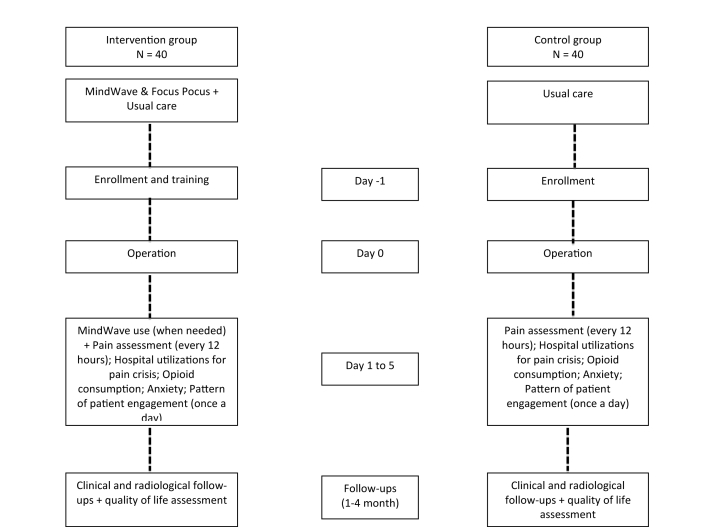
This study will be based on a 2-parallel group randomized controlled trial design, intervention versus usual care, with multiple in-hospital assessments and 2 clinical, radiological, and quality of life follow-ups. Participants will be randomized to either the intervention group receiving a neurofeedback-based relaxation training and usual care, or to a control group receiving only usual care. Pain intensity is the primary outcome and will be assessed using the Numeric Pain Rating Scale (NRS) in the days following the operation. Secondary outcomes will include the effect of the intervention on hospital utilization for pain crisis, daily opioid consumption, anxiety, patient engagement, blood test and chest x-ray results, and long-term clinical, radiological, and quality of life evaluations. Outcome measures will be repeatedly taken during hospitalization, while follow-up assessments will coincide with the follow-up visits. Pain intensity will be assessed by mixed model repeated analysis. Effect sizes will be calculated as mean group differences with standard deviations.
We expect to have results for this study before the end of 2016.
The proposed innovative, neurofeedback- and relaxation-based approach to support post-surgery pain management could lead to significant improvements in patient short and long-term outcomes.
胸外科手术似乎是许多肺癌的首选治疗方法。然而,根据手术类型的不同,术后胸部区域可能会疼痛数周甚至数月。这种疼痛状态会产生多种生理和心理影响,包括呼吸衰竭、无法通过咳嗽清除分泌物,甚至焦虑和抑郁,这些都会对康复产生负面影响。
本研究旨在评估基于神经反馈的干预措施对控制学术肿瘤医院接受非小细胞肺癌(NSCLC)肺切除开胸手术患者术后急性疼痛及改善长期康复的效果。
本研究将采用两组平行随机对照试验设计,即干预组与常规治疗组,进行多次住院评估以及两次临床、影像学和生活质量随访。参与者将被随机分为干预组,接受基于神经反馈的放松训练和常规治疗,或对照组,仅接受常规治疗。疼痛强度是主要结局指标,将在术后数天使用数字疼痛评分量表(NRS)进行评估。次要结局指标将包括干预措施对疼痛危机住院治疗、每日阿片类药物消耗量、焦虑、患者参与度、血液检查和胸部X光检查结果的影响,以及长期临床、影像学和生活质量评估。结局指标将在住院期间反复测量,而随访评估将与随访就诊时间一致。疼痛强度将通过混合模型重复分析进行评估。效应大小将计算为组间平均差异与标准差。
我们预计在2016年底前得出本研究结果。
所提出的基于神经反馈和放松的创新方法来支持术后疼痛管理,可能会显著改善患者的短期和长期结局。