Dunet Vincent, Barras Heloise, Boulanger Xavier, Monney Pierre, Qanadli Salah D, Meuli Reto, Schwitter Juerg, Beigelman-Aubry Catherine
Department of Radiology, Division of Radiodiagnostics and interventional Radiology, Lausanne University Hospital, Lausanne, Switzerland.
Cardiac MR Center, Lausanne University Hospital, Lausanne, Switzerland.
Med Sci Monit. 2015 May 6;21:1288-96. doi: 10.12659/MSM.893599.
Cardiac magnetic resonance (CMR) is increasingly used to assess heart diseases. Relevant non-cardiac diseases may also be incidentally found on CMR images. The aim of this study was to determine the prevalence and nature of incidental extra-cardiac findings (IEF) and their clinical impact in non-selected patients referred for CMR.
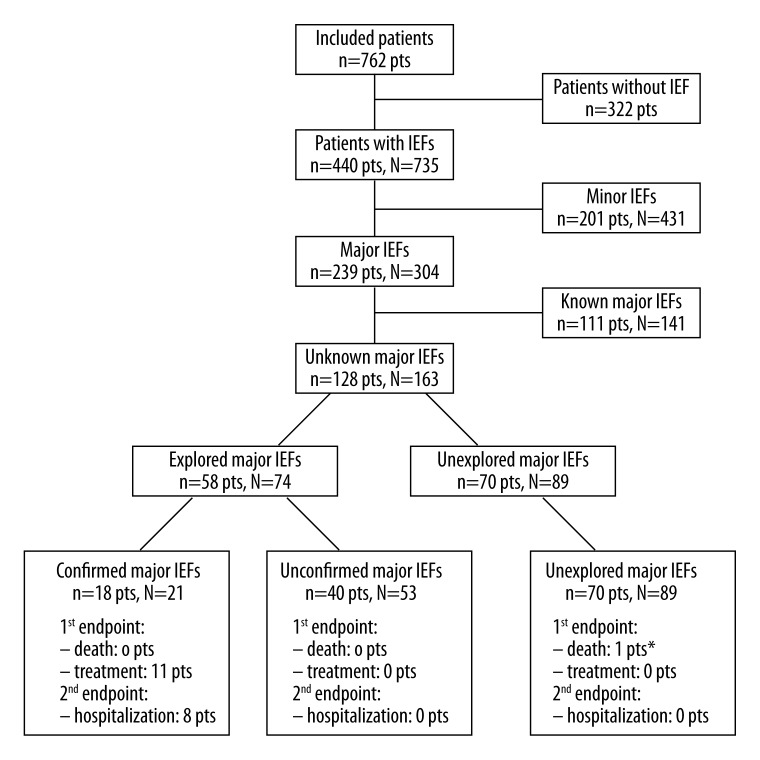
MATERIAL/METHODS: MR images of 762 consecutive patients (515 men, age: 56±18 years) referred for CMR were prospectively interpreted by 2 radiologists blinded for any previous imaging study. IEFs were classified as major when requiring treatment, follow-up, or further investigation. Clinical follow-up was performed by checking hospital information records and by calling referring physicians. The 2 endpoints were: 1) non-cardiac death and new treatment related to major IEFs, and 2) hospitalization related to major IEFs during follow-up.
Major IEFs were proven in 129 patients (18.6% of the study population), 14% of those being unknown before CMR. During 15±6 month follow-up, treatment of confirmed major IEFs was initiated in 1.4%, and no non-cardiac deaths occurred. Hospitalization occurred in 8 patients (1.0% of the study population) with confirmed major IEFs and none occurred in the remaining 110 patients with unconfirmed/unexplored major IEFs (p<0.001).
Screening for major IEFs in a population referred for routine CMR changed management in 1.4% of patients. Major IEFs unknown before CMR but without further exploration, however, carried a favorable prognosis over a follow-up period of 15 months.
心脏磁共振成像(CMR)越来越多地用于评估心脏病。CMR图像上也可能偶然发现相关的非心脏疾病。本研究的目的是确定偶然发现的心脏外异常(IEF)的患病率和性质及其对接受CMR检查的非特定患者的临床影响。
材料/方法:762例连续接受CMR检查的患者(515名男性,年龄:56±18岁)的MR图像由2名对之前任何影像学检查不知情的放射科医生进行前瞻性解读。当IEF需要治疗、随访或进一步检查时,被分类为重大异常。通过检查医院信息记录和联系转诊医生进行临床随访。两个终点分别为:1)与重大IEF相关的非心脏死亡和新治疗;2)随访期间与重大IEF相关的住院治疗。
129例患者(占研究人群的18.6%)被证实存在重大IEF,其中14%在CMR检查前未知。在15±6个月的随访期间,1.4%的确诊重大IEF患者开始接受治疗,未发生非心脏死亡。8例确诊重大IEF的患者(占研究人群的1.0%)出现住院治疗,其余110例未确诊/未探查重大IEF的患者均未住院(p<0.001)。
在接受常规CMR检查的人群中筛查重大IEF使1.4%的患者的治疗方案发生了改变。然而,CMR检查前未知但未进一步探查的重大IEF在15个月的随访期内预后良好。