Qi Xun, Yuan Yonghui, Xu Ke, Zhong Hongshan, Zhang Zhen, Zhai Huan, Guan Gefei, Yu Guibo
Department of Radiology, The First Affiliated Hospital of China Medical University, Shenyang, China; Key Laboratory of Diagnostic Imaging and Interventional Radiology of Liaoning Province, The First Affiliated Hospital of China Medical University, Shenyang, China.
Hospital infection management office, Liaoning Cancer Hospital & Institute, Shenyang, China.
PLoS One. 2015 May 5;10(5):e0125323. doi: 10.1371/journal.pone.0125323. eCollection 2015.
Peripheral artery disease (PAD), which is caused by atherosclerosis, results in progressive narrowing and occlusion of the peripheral arteries and inhibits blood flow to the lower extremities. Therapeutic angiogenesis is a promising strategy for treating ischemia caused by PAD. Nitric oxide (NO) has been shown to be a key mediator of angiogenesis. It has been demonstrated that β-cyclodextrincan stimulate vessel growth in rabbit corneas. In this study, we assessed the mechanism of action and therapeutic potential of a new angiogenic molecule, (2-hydroxypropyl)-β-cyclodextrin (2HP-β-CD).
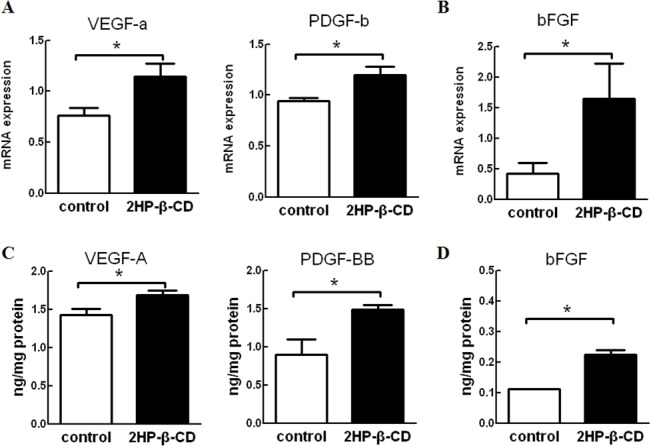
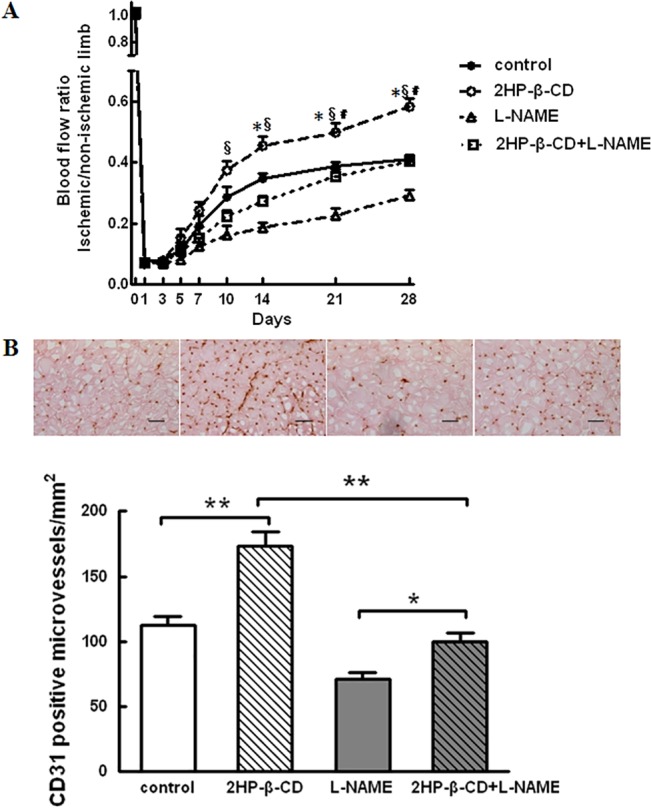
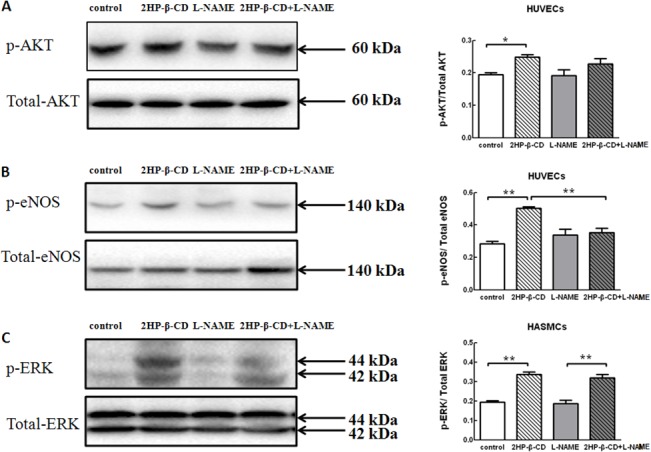
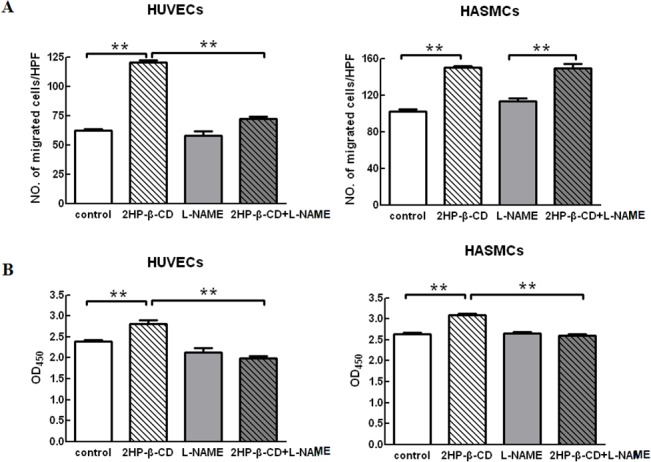
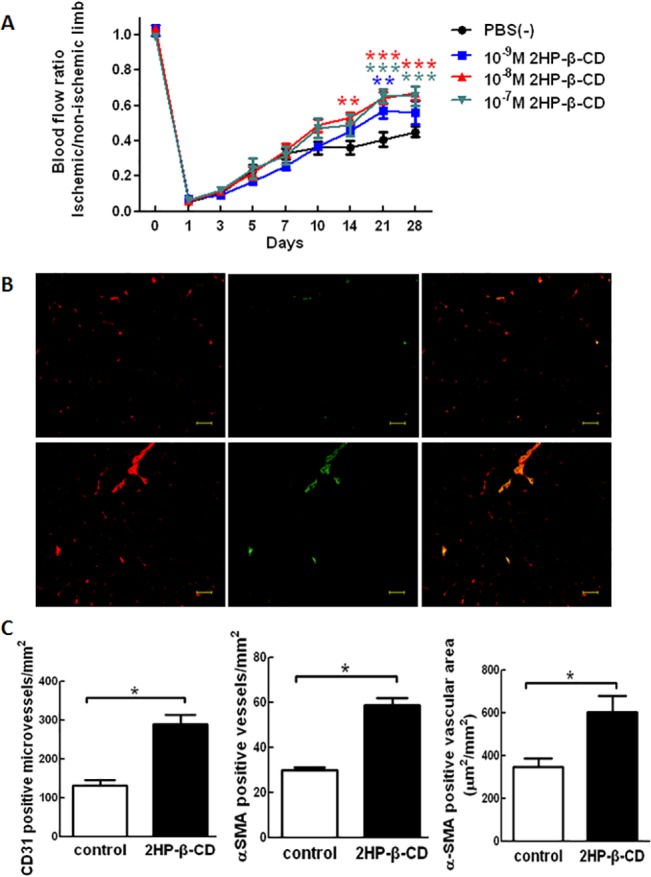
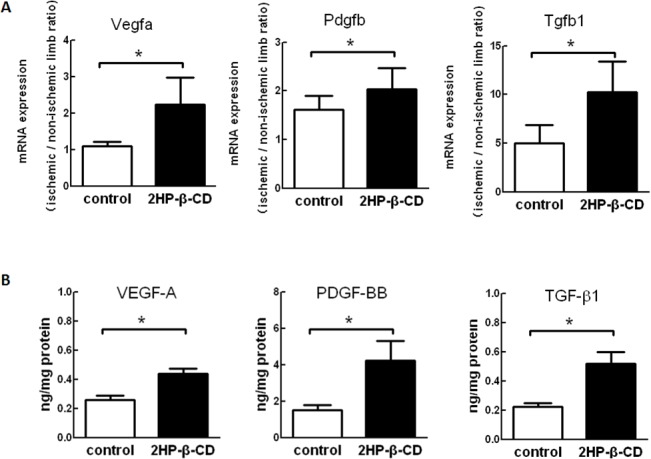
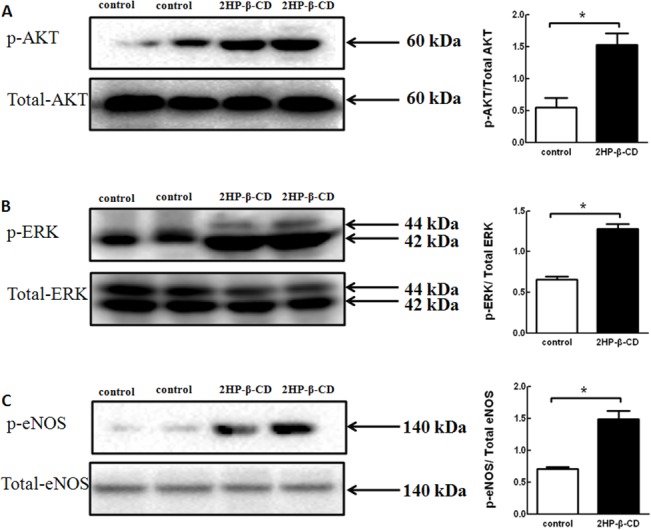
2HP-β-CD significantly increased vascular endothelial growth factor A (VEGF-A) and platelet-derived growth factor BB (PDGF-BB) peptides in human umbilical vein endothelial cells (HUVECs) and also increased basic fibroblast growth factor (bFGF) peptide in human aortic smooth muscle cells (HASMCs). 2HP-β-CD stimulated both proliferation and migration of HUVECs in an endothelial nitric oxide synthase (eNOS)/NO-dependent manner, whereas NO was found to be involved in proliferation, but not migration, of HASMCs. In a unilateral hindlimb ischemia model in mice, 2HP-β-CD injections not only promoted blood flow recovery and increased microvessel densities in ischemic muscle, but also promoted coverage of the vessels with smooth muscle cells, thus stabilizing the vessels. Administration of 2HP-β-CD increased the expression of several angiogenic factors, including VEGF-A, PDGF-BB and transforming growth factor beta-1 (TGF-β1) in ischemic muscle. Injections of 2HP-β-CD also stimulated protein kinase B and extracellular regulated protein kinases (ERK), leading to an increase in phosphorylation of eNOS in ischemic muscle. Treatment with the NOS inhibitor, Nω-nitro-L-arginine methyl ester (L-NAME), showed that stimulation of blood flow induced by 2HP-β-CD was partially dependent on NO.
Therapeutic angiogenesis by 2HP-β-CD may be beneficial to patients with PAD.
外周动脉疾病(PAD)由动脉粥样硬化引起,导致外周动脉逐渐狭窄和闭塞,阻碍下肢血液流动。治疗性血管生成是治疗PAD所致缺血的一种有前景的策略。一氧化氮(NO)已被证明是血管生成的关键介质。已证实β-环糊精可刺激兔角膜血管生长。在本研究中,我们评估了一种新型血管生成分子(2-羟丙基)-β-环糊精(2HP-β-CD)的作用机制和治疗潜力。
2HP-β-CD显著增加人脐静脉内皮细胞(HUVECs)中血管内皮生长因子A(VEGF-A)和血小板衍生生长因子BB(PDGF-BB)肽的含量,同时增加人主动脉平滑肌细胞(HASMCs)中碱性成纤维细胞生长因子(bFGF)肽的含量。2HP-β-CD以内皮型一氧化氮合酶(eNOS)/NO依赖的方式刺激HUVECs的增殖和迁移,而NO参与HASMCs的增殖,但不参与其迁移。在小鼠单侧后肢缺血模型中,注射2HP-β-CD不仅促进血流恢复,增加缺血肌肉中的微血管密度,还促进血管平滑肌细胞覆盖,从而稳定血管。给予2HP-β-CD可增加缺血肌肉中包括VEGF-A、PDGF-BB和转化生长因子β1(TGF-β1)在内的多种血管生成因子的表达。注射2HP-β-CD还刺激蛋白激酶B和细胞外调节蛋白激酶(ERK),导致缺血肌肉中eNOS磷酸化增加。用一氧化氮合酶抑制剂Nω-硝基-L-精氨酸甲酯(L-NAME)治疗表明,2HP-β-CD诱导的血流刺激部分依赖于NO。
2HP-β-CD介导的治疗性血管生成可能对PAD患者有益。