Kurashima Yosuke, Kiyono Hiroshi, Kunisawa Jun
Laboratory of Vaccine Materials, National Institute of Biomedical Innovation, Osaka 567-0085, Japan ; Division of Mucosal Immunology, Department of Microbiology and Immunology, The Institute of Medical Science, The University of Tokyo, Tokyo 108-8639, Japan ; Core Research for Evolutional Science and Technology, Japan Science and Technology Agency, Tokyo 102-0075, Japan.
Division of Mucosal Immunology, Department of Microbiology and Immunology, The Institute of Medical Science, The University of Tokyo, Tokyo 108-8639, Japan ; Core Research for Evolutional Science and Technology, Japan Science and Technology Agency, Tokyo 102-0075, Japan ; International Research and Development Center for Mucosal Vaccines, The Institute of Medical Science, The University of Tokyo, Tokyo 108-8639, Japan.
Mediators Inflamm. 2015;2015:427125. doi: 10.1155/2015/427125. Epub 2015 Apr 7.
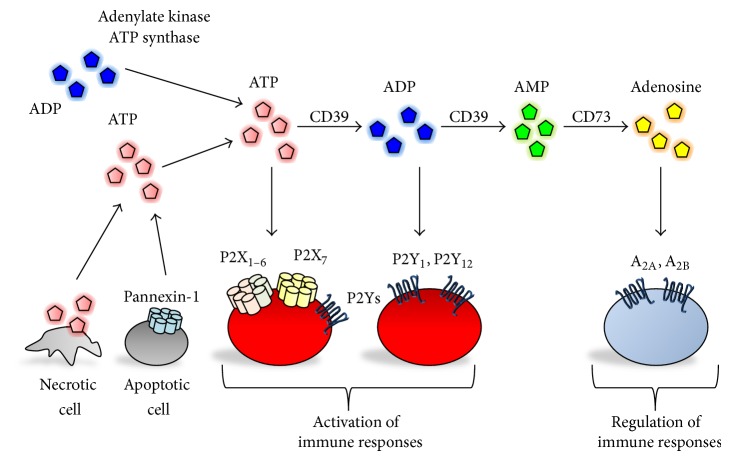
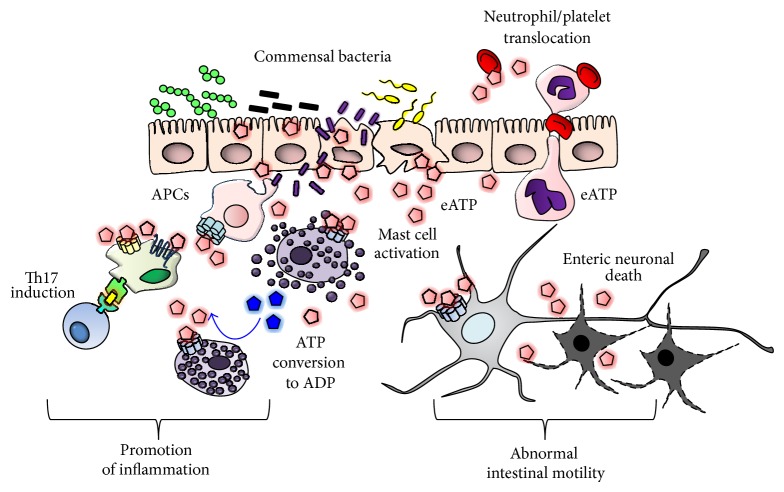
Purinergic mediators such as adenosine 5'-triphosphate (ATP) are released into the extracellular compartment from damaged tissues and activated immune cells. They are then recognized by multiple purinergic P2X and P2Y receptors. Release and recognition of extracellular ATP are associated with both the development and the resolution of inflammation and infection. Accumulating evidence has recently suggested the potential of purinergic receptors as novel targets for drugs for treating intestinal disorders, including intestinal inflammation and irritable bowel syndrome. In this review, we highlight recent findings regarding the pathophysiological role of purinergic mediators in the development of intestinal inflammation.
诸如5'-三磷酸腺苷(ATP)等嘌呤能介质从受损组织和活化的免疫细胞释放到细胞外区室。然后它们被多种嘌呤能P2X和P2Y受体识别。细胞外ATP的释放和识别与炎症和感染的发生及消退均相关。最近越来越多的证据表明嘌呤能受体作为治疗肠道疾病(包括肠道炎症和肠易激综合征)药物新靶点的潜力。在本综述中,我们重点介绍了嘌呤能介质在肠道炎症发生中的病理生理作用的最新研究结果。