Department of Pharmacology, School of Medicine, Shiraz University of Medical Sciences, Shiraz, Iran ; Department of Neuroscience, School of Advanced Medical Sciences and Technologies, Shiraz University of Medical Sciences, Shiraz, Iran.
Department of Pharmacology, School of Medicine, Shiraz University of Medical Sciences, Shiraz, Iran.
Iran J Basic Med Sci. 2015 Mar;18(3):240-6.
The neuroprotective effect of lithium has been attributed to its therapeutic action. However, the role of glial cells particularly astrocytes, and the possible interactions between neurons and astrocytes in neuroprotective effects of lithium have been disregarded. Thus, the aim of this study was to evaluate the direct effects of lithium on brain derived neurotrophic factor (BDNF) and glial cell line derived neurotrophic factor (GDNF) in rat primary neuronal, astrocytes, and mixed neuro-astroglial cultures to assess the possible effects of lithium on astrocytes and neuro-astroglia interactions.
Rat primary astrocyte, neuronal and mixed neuro-astrocyte cultures were prepared from cortices of 18-day embryos. Cell cultures were exposed to lithium (1 mM) or vehicle for 1 day (acute) or 7 days (chronic). BDNF and GDNF mRNA and protein levels were determined by RT-PCR and ELISA, respectively.
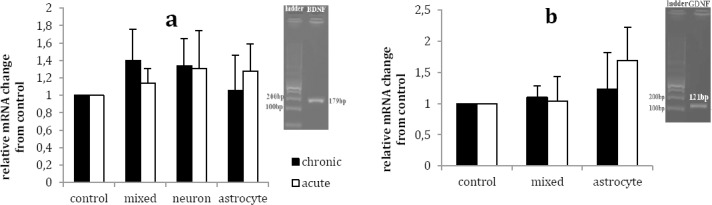
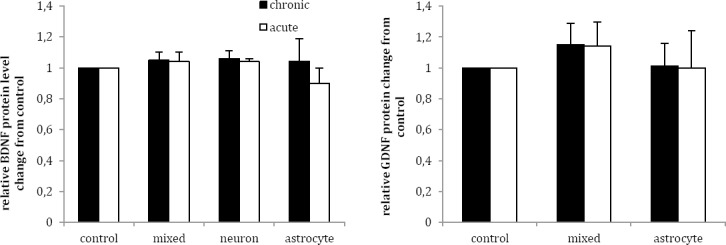
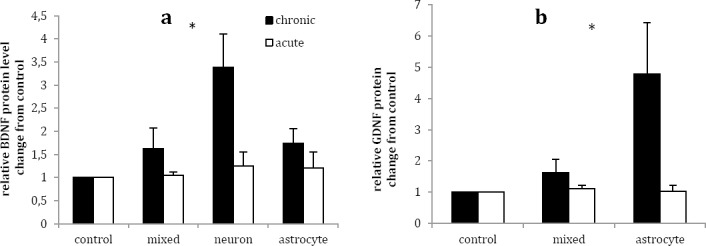
Chronic but not acute lithium treatment increased intracellular BDNF and GDNF protein levels in rat primary neuronal and astrocyte cultures, respectively (P<0.05). However, chronic lithium treatment had no significant effect on intracellular BDNF protein level in astrocyte and mixed neuron-astrocyte cultures or GDNF protein levels in mixed neuron-astrocyte culture. Furthermore, acute and chronic lithium treatment had no significant effect on mRNA and extracellular BDNF and GDNF protein levels in three studied cultures.
Present study showed that chronic lithium treatment affected neurotrophins both in neurons and astrocytes in a cell-type specific manner with no effect on neuron-astrocyte interactions. The findings of this study also highlighted the importance of astrocytes as drug targets involved in the neuroprotective action of lithium.
锂的神经保护作用归因于其治疗作用。然而,神经胶质细胞(尤其是星形胶质细胞)的作用,以及神经元和星形胶质细胞之间的可能相互作用,在锂的神经保护作用中被忽视了。因此,本研究的目的是评估锂对原代培养大鼠神经元、星形胶质细胞和混合神经胶质细胞中脑源性神经营养因子(BDNF)和胶质细胞系源性神经营养因子(GDNF)的直接影响,以评估锂对星形胶质细胞和神经胶质相互作用的可能影响。
原代星形胶质细胞、神经元和混合神经胶质细胞培养物是从 18 天大的胚胎皮层中制备的。细胞培养物用锂(1mM)或载体处理 1 天(急性)或 7 天(慢性)。通过 RT-PCR 和 ELISA 分别测定 BDNF 和 GDNF mRNA 和蛋白水平。
慢性而非急性锂处理分别增加了大鼠原代神经元和星形胶质细胞内的 BDNF 和 GDNF 蛋白水平(P<0.05)。然而,慢性锂处理对星形胶质细胞和混合神经元-星形胶质细胞培养物中内源性 BDNF 蛋白水平或混合神经元-星形胶质细胞培养物中 GDNF 蛋白水平没有显著影响。此外,急性和慢性锂处理对三种研究培养物中的内源性 BDNF 和 GDNF 蛋白水平及细胞外 BDNF 和 GDNF 蛋白水平均无显著影响。
本研究表明,慢性锂处理以细胞类型特异性的方式影响神经元和星形胶质细胞中的神经营养因子,而对神经元-星形胶质细胞相互作用没有影响。本研究的结果还强调了星形胶质细胞作为涉及锂神经保护作用的药物靶点的重要性。