Dorr Casey, Wu Baolin, Guan Weihua, Muthusamy Amutha, Sanghavi Kinjal, Schladt David P, Maltzman Jonathan S, Scherer Steven E, Brott Marcia J, Matas Arthur J, Jacobson Pamala A, Oetting William S, Israni Ajay K
Minneapolis Medical Research Foundation, Minneapolis, Minnesota, United States of America; Department of Medicine, Hennepin County Medical Center, University of Minnesota, Minneapolis, Minnesota, United States of America.
Division of Biostatistics, University of Minnesota, Minneapolis, Minnesota, United States of America.
PLoS One. 2015 May 6;10(5):e0125045. doi: 10.1371/journal.pone.0125045. eCollection 2015.
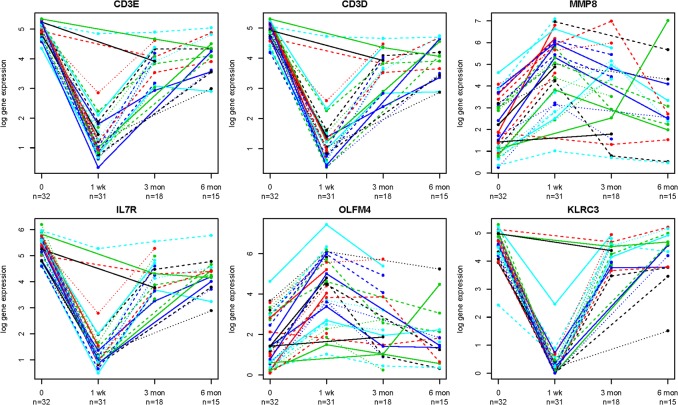
We performed RNA sequencing (RNAseq) on peripheral blood mononuclear cells (PBMCs) to identify differentially expressed gene transcripts (DEGs) after kidney transplantation and after the start of immunosuppressive drugs. RNAseq is superior to microarray to determine DEGs because it's not limited to available probes, has increased sensitivity, and detects alternative and previously unknown transcripts. DEGs were determined in 32 adult kidney recipients, without clinical acute rejection (AR), treated with antibody induction, calcineurin inhibitor, mycophenolate, with and without steroids. Blood was obtained pre-transplant (baseline), week 1, months 3 and 6 post-transplant. PBMCs were isolated, RNA extracted and gene expression measured using RNAseq. Principal components (PCs) were computed using a surrogate variable approach. DEGs post-transplant were identified by controlling false discovery rate (FDR) at < 0.01 with at least a 2 fold change in expression from pre-transplant. The top 5 DEGs with higher levels of transcripts in blood at week 1 were TOMM40L, TMEM205, OLFM4, MMP8, and OSBPL9 compared to baseline. The top 5 DEGs with lower levels at week 1 post-transplant were IL7R, KLRC3, CD3E, CD3D, and KLRC2 (Striking Image) compared to baseline. The top pathways from genes with lower levels at 1 week post-transplant compared to baseline, were T cell receptor signaling and iCOS-iCOSL signaling while the top pathways from genes with higher levels than baseline were axonal guidance signaling and LXR/RXR activation. Gene expression signatures at month 3 were similar to week 1. DEGs at 6 months post-transplant create a different gene signature than week 1 or month 3 post-transplant. RNAseq analysis identified more DEGs with lower than higher levels in blood compared to baseline at week 1 and month 3. The number of DEGs decreased with time post-transplant. Further investigations to determine the specific lymphocyte(s) responsible for differential gene expression may be important in selecting and personalizing immune suppressant drugs and may lead to targeted therapies.
我们对外周血单核细胞(PBMC)进行了RNA测序(RNAseq),以鉴定肾移植后及开始使用免疫抑制药物后的差异表达基因转录本(DEG)。RNAseq在确定DEG方面优于微阵列,因为它不限于可用探针,灵敏度更高,并且能检测到可变的和先前未知的转录本。在32名未发生临床急性排斥反应(AR)的成年肾移植受者中确定了DEG,这些受者接受抗体诱导、钙调神经磷酸酶抑制剂、霉酚酸酯治疗,使用或不使用类固醇。在移植前(基线)、移植后第1周、第3个月和第6个月采集血液。分离PBMC,提取RNA并使用RNAseq测量基因表达。使用替代变量方法计算主成分(PC)。通过将错误发现率(FDR)控制在<0.01且与移植前相比表达至少有2倍变化来鉴定移植后的DEG。与基线相比,移植后第1周血液中转录本水平较高的前5个DEG是TOMM40L、TMEM205、OLFM4、MMP8和OSBPL9。与基线相比,移植后第1周水平较低的前5个DEG是IL7R、KLRC3、CD3E、CD3D和KLRC2(显著图像)。与基线相比,移植后第1周水平较低的基因的主要通路是T细胞受体信号传导和iCOS-iCOSL信号传导,而水平高于基线的基因的主要通路是轴突导向信号传导和LXR/RXR激活。第3个月的基因表达特征与第1周相似。移植后6个月的DEG产生的基因特征与移植后第1周或第3个月不同。RNAseq分析在第1周和第3个月时鉴定出与基线相比血液中水平较低的DEG比水平较高的更多。DEG的数量随移植后时间减少。进一步研究确定负责差异基因表达的特定淋巴细胞可能对选择和个性化免疫抑制药物很重要,并可能导致靶向治疗。