Burns D M, Forstrom J M, Friday K E, Howard G A, Roos B A
Research Service, American Lake Department of Veterans Affairs Medical Center, Tacoma, WA 98493.
Proc Natl Acad Sci U S A. 1989 Dec;86(23):9519-23. doi: 10.1073/pnas.86.23.9519.
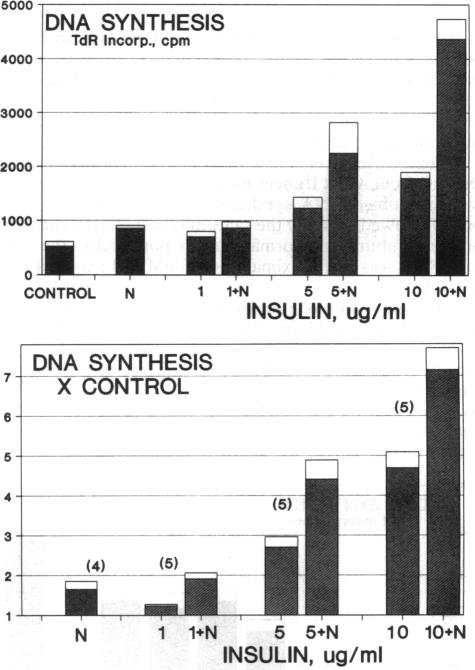
The parafollicular-cell (C-cell) hormone calcitonin (CT) can preserve or even augment skeletal mass by inhibiting osteoclast-mediated bone resorption. The possibility of an additional anabolic skeletal influence has also been raised: C cells might, via CT or other secretory products, affect osteoblast-mediated bone formation. The 57-residue amino-terminal procalcitonin cleavage peptide, N-proCT, has recently been identified in human and rat C cells, where it is made and secreted in equimolar amounts with CT. The coelaboration of N-proCT and CT and N-proCT's sequence conservation during evolution prompted us to investigate the potential skeletal bioactivity of N-proCT. We found that synthetic human N-proCT, at nanomolar concentrations, stimulated proliferation of normal and neoplastic human osteoblasts. At maximally effective doses, human N-proCT caused more than a 100% increase above the control rate of DNA synthesis, an effect comparable to the maximal growth effect of insulin, a potent mitogen for osteoblasts. Human N-proCT exerted a similar maximal mitogenic effect in chicken osteoblast cultures but at 1000-fold greater concentrations than in human bone-cell cultures. The bone-cell action of N-proCT was potentiated with insulin with a greater than 200% increase in DNA synthesis at high insulin concentrations. In sharp contrast to these findings for N-proCT, the other bioactive C-cell peptides, CT and somatostatin, showed no mitogenic effects in human or chicken osteoblast cultures. Our results indicate that the action of N-proCT on cultured bone cells is separate from and potentiated by insulin, a known growth factor. Unlike insulin and related growth factors such as insulin-like growth factor I, N-proCT is not mitogenic in skin fibroblast cultures. We propose that N-proCT is a C-cell hormone that promotes bone formation via stimulatory actions on osteoblasts and preosteoblasts.
甲状腺滤泡旁细胞(C细胞)分泌的激素降钙素(CT)可通过抑制破骨细胞介导的骨吸收来维持甚至增加骨量。此外,还有一种促进骨骼合成代谢的可能性:C细胞可能通过CT或其他分泌产物影响成骨细胞介导的骨形成。最近在人和大鼠的C细胞中发现了由57个氨基酸组成的氨基末端前降钙素裂解肽,即N-proCT,它与CT以等摩尔量合成并分泌。N-proCT与CT的共同合成以及N-proCT在进化过程中的序列保守性促使我们研究N-proCT潜在的骨骼生物活性。我们发现,纳摩尔浓度的合成人N-proCT可刺激正常和肿瘤性人成骨细胞的增殖。在最大有效剂量下,人N-proCT使DNA合成速率比对照增加了100%以上,这一效果与胰岛素(一种对成骨细胞有强大促有丝分裂作用的物质)的最大生长效应相当。人N-proCT在鸡成骨细胞培养物中也发挥了类似的最大促有丝分裂作用,但所需浓度比人骨细胞培养物高1000倍。在高胰岛素浓度下,胰岛素可增强N-proCT对骨细胞的作用,使DNA合成增加200%以上。与N-proCT的这些发现形成鲜明对比的是,其他具有生物活性的C细胞肽,即CT和生长抑素,在人或鸡成骨细胞培养物中均未显示出促有丝分裂作用。我们的结果表明,N-proCT对培养骨细胞的作用与胰岛素(一种已知的生长因子)不同,且可被胰岛素增强。与胰岛素及相关生长因子如胰岛素样生长因子I不同,N-proCT在皮肤成纤维细胞培养物中没有促有丝分裂作用。我们提出,N-proCT是一种C细胞激素,通过对成骨细胞和前成骨细胞的刺激作用促进骨形成。