Martin Niels D, Kepler Chris, Zubair Muhammad, Sayadipour Amirali, Cohen Murray, Weinstein Michael
Department of Surgery, Division of Traumatology, Surgical Critical Care and Emergency Surgery, Perelman School of Medicine at the University of Pennsylvania, Philadelphia, Pennsylvania, USA.
Department of Orthopedics, Rothman Institute at Thomas Jefferson University, Philadelphia, Pennsylvania, USA.
J Emerg Trauma Shock. 2015 Apr-Jun;8(2):94-8. doi: 10.4103/0974-2700.155507.
Acute spinal cord injury (SCI) is often treated with induced hypertension to enhance spinal cord perfusion. The optimal mean arterial pressure (MAP) likely varies between patients. Arbitrary goals are often set, frequently requiring vasopressors to achieve, with no clear evidence supporting this practice. We hypothesize that increased MAP goals and episodes of relative hypotension do not affect hospital outcome.
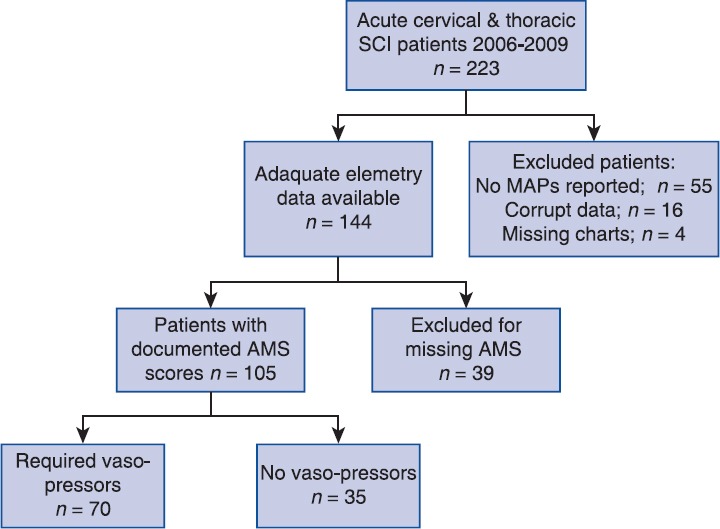
All cervical and thoracic SCI patients treated at a level one trauma and regional SCI center over at 2.5-year period were retrospectively reviewed. Lowest and average hourly MAP was recorded for the first 72 h of hospitalization, allowing for quantification of mean MAP and the total number of episodic relative hypotensive events. These data were further compared to daily American spinal injury association motor score (AMS), which was used to determine the severity of SCI and improvement/decline during hospitalization. Patient's data were finally analyzed at theoretic MAP set points.
One hundred and five patients had complete data during the study period. At higher theoretic MAP set points (85 and 90), increased number of relative hypotensive episodes correlated with lower admission AMS (85 mmHg: <10 episodes, AMS 66.2; >50 episodes, 22.0; P < 0.001) and the need for vasopressors (P < 0.03) but showed no statistical change in AMS by hospital discharge. The need for vasopressors correlated with the number of hypotensive episodes and inversely related to admission AMS at all theoretic MAP goal set points but was not correlated with the change in AMS during the hospitalization.
The frequency of relative hypotension and the need for vasopressors are progressively related to more severe SCI, as denoted by lower admission AMS. However, episodes of hypotension and the need for vasopressors did not affect the change in AMS during the acute hospitalization, regardless of theoretic MAP goal set-point. Arbitrarily elevated MAP goals may not be efficacious.
急性脊髓损伤(SCI)常采用诱导性高血压治疗以增强脊髓灌注。最佳平均动脉压(MAP)可能因患者而异。通常设定随意的目标,常常需要使用血管升压药来实现,且没有明确证据支持这种做法。我们假设提高MAP目标和相对低血压发作不会影响住院结局。
回顾性分析在一家一级创伤和地区性SCI中心接受治疗的所有颈椎和胸椎SCI患者,治疗时间跨度为2.5年。记录住院前72小时的最低和平均每小时MAP,以便量化平均MAP和发作性相对低血压事件的总数。这些数据进一步与每日美国脊髓损伤协会运动评分(AMS)进行比较,该评分用于确定SCI的严重程度以及住院期间的改善/下降情况。最后在理论MAP设定点分析患者数据。
105例患者在研究期间有完整数据。在较高的理论MAP设定点(85和90),相对低血压发作次数增加与较低的入院AMS相关(85 mmHg:发作次数<10次,AMS为66.2;发作次数>50次,AMS为22.0;P<0.001)以及使用血管升压药的需求相关(P<0.03),但出院时AMS无统计学变化。在所有理论MAP目标设定点,使用血管升压药的需求与低血压发作次数相关,与入院AMS呈负相关,但与住院期间AMS的变化无关。
相对低血压的频率和使用血管升压药的需求与更严重的SCI逐渐相关,如较低的入院AMS所示。然而,低血压发作和使用血管升压药的需求在急性住院期间不影响AMS的变化,无论理论MAP目标设定点如何。随意提高MAP目标可能无效。