Khandekar Rajiv, Al-Motowa Saeed, Alkatan Hind M, Karaoui Mohammed, Ortiz Anne
Department of Research, King Khaled Eye Specialist Hospital, Riyadh, Saudi Arabia.
Middle East Afr J Ophthalmol. 2015 Apr-Jun;22(2):198-202. doi: 10.4103/0974-9233.154397.
We present the incidence and determinants of endophthalmitis between July 2010 and June 2012 at King Khaled Eye Specialist Hospital, Riyadh, Saudi Arabia. On its basis, we recommended recommendations to strengthen the infection prevention and control strategies.
This is a retrospective review of health records type of study. The details of cases reported having endophthalmitis among those operated in 2 years of study period were studied. The incidence of endophthalmitis was calculated for different eye surgeries and epidemiological variables. The causative organisms in vitreous tap were reviewed. The visual outcomes 6 weeks following intervention/treatment of endophthalmmitis were also studied.
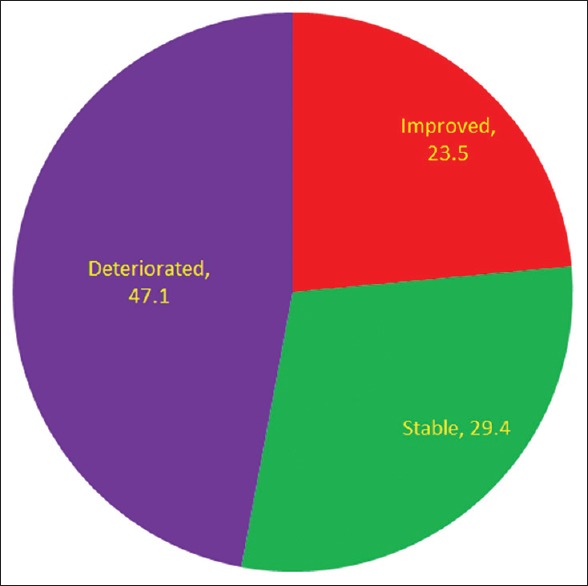
Of the 22,554 cases operated, 17 developed endophthalmitis. The incidence was 0.08% (95% confidence interval [CI] 0.04-0.11). The incidence of endophthlamitis among cataract surgeries was 0.12% (95% CI 0.04-0.21). Five specimens did not show any bacteria or fungus. Staphylococcus epidermis (3 cases) was the main pathogen identified. In 8 (47%) eyes, vision deteriorated in spite of treatment. In 5 (29%) eyes, it became stable and in 4 (23.5%) eyes, it improved following treatment. Signs of infection were noted in 1(st) week, 3 weeks and 12 weeks in 4, 6 and 5 eyes respectively. Late presentation of infection (6 months postoperatively) was reported in two eyes.
A vigilant infection control unit in a large eye hospital helps in monitoring endophthalmitis related catastrophes and suggests timely preventive measures to reduce the occurrence and appropriate measures to limit visual disabilities following eye surgery related endophthalmitis.
我们呈现了2010年7月至2012年6月期间沙特阿拉伯利雅得国王哈立德眼科专科医院眼内炎的发病率及相关决定因素。在此基础上,我们提出了加强感染预防与控制策略的建议。
这是一项对健康记录的回顾性研究。对研究期间2年内接受手术的患者中报告发生眼内炎的病例细节进行了研究。计算了不同眼科手术及流行病学变量的眼内炎发病率。回顾了玻璃体穿刺液中的致病微生物。还研究了眼内炎干预/治疗6周后的视力结果。
在22554例手术病例中,17例发生了眼内炎。发病率为0.08%(95%置信区间[CI]0.04 - 0.11)。白内障手术中眼内炎的发病率为0.12%(95%CI 0.04 - 0.21)。5份标本未显示任何细菌或真菌。鉴定出的主要病原体为表皮葡萄球菌(3例)。8只(47%)眼睛尽管接受了治疗但视力仍恶化。5只(29%)眼睛视力稳定,4只(23.5%)眼睛治疗后视力改善。分别在第1周、第3周和第12周有4只、6只和5只眼睛出现感染迹象。有两只眼睛报告了感染的晚期表现(术后6个月)。
大型眼科医院中一个警惕的感染控制部门有助于监测与眼内炎相关的灾难性事件,并提出及时的预防措施以减少其发生,以及采取适当措施限制与眼科手术相关的眼内炎后的视力残疾。