Caskey Fergus J, Stel Vianda S, Elliott Robert F, Jager Kitty J, Covic Adrian, Cusumano Ana, Geue Claudia, Kramer Anneke, Stengel Benedicte, MacLeod Alison M
ERA-EDTA Registry, Department of Medical Informatics, Academic Medical Center , Amsterdam , The Netherlands.
HERU, University of Aberdeen , Aberdeen , UK.
NDT Plus. 2010 Feb;3(1):28-36. doi: 10.1093/ndtplus/sfp146. Epub 2009 Oct 19.
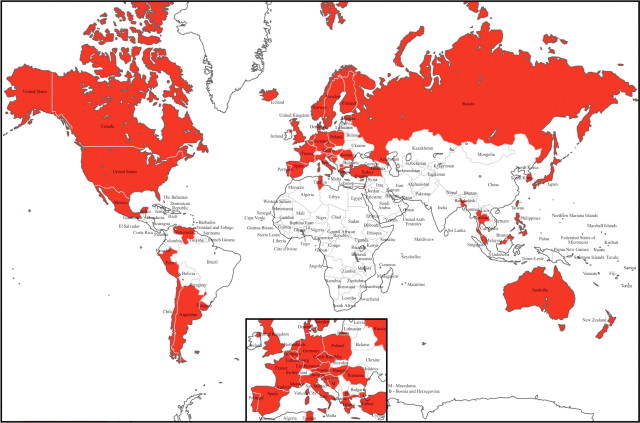
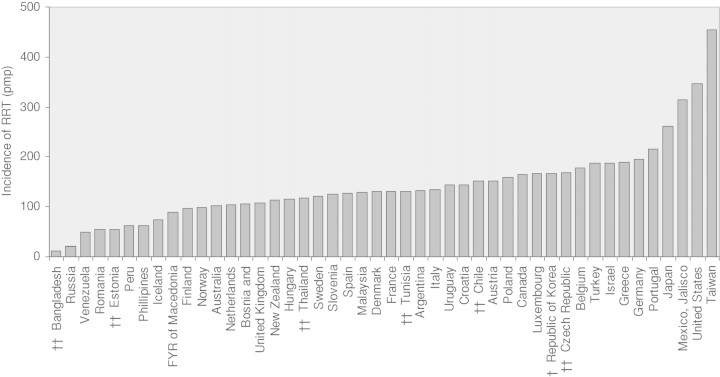
Rates of initiation of renal replacement therapy (RRT), use of home modalities of treatment and patient outcomes vary considerably between countries. This paper reports the methods and baseline characteristics of countries participating in the EVEREST study (n = 46), a global collaboration examining the association between medical and non-medical factors and RRT incidence, modality mix and survival. Numbers of incident and prevalent patients were collected for current (2003-05) and historic (1983-85, 1988-90, 1993-95 and 1998-2000) periods stratified, where available, by age, gender, treatment modality and cause of end stage renal disease (diabetic versus non-diabetic). General population age and health indicators and national-level macroeconomic data were collected from secondary data sources. National experts provided primary data on renal service funding, resources and organization. The median (inter quartile range) RRT incidence per million of the population (pmp) was 130 pmp (102-167 pmp). The general population life expectancy at 60 was 22.1 years (19.7-23.1 years) and 6.9% had diabetes mellitus (5.4-9.0%). Healthcare spending as a percentage of gross domestic product was 8.1% (5.6-9.3%). Countries averaged nine dialysis facilities pmp (4-12 pmp), with 69.0% (43.9-99.0%) owned by the public or private not-for-profit sector. The number of nephrologists ranged from 0.5 to 48 pmp (median 12 pmp). The heterogeneity of EVEREST countries will enable modelling to examine the independent association between medical and non-medical factors on RRT epidemiology.
各国在开始肾脏替代治疗(RRT)的比率、家庭治疗方式的使用情况以及患者预后方面存在很大差异。本文报告了参与珠穆朗玛峰研究(EVEREST研究,n = 46)的各国的方法和基线特征,该研究是一项全球合作项目,旨在研究医学和非医学因素与RRT发病率、治疗方式组合及生存率之间的关联。收集了当前时期(2003 - 2005年)以及历史时期(1983 - 1985年、1988 - 1990年、1993 - 1995年和1998 - 2000年)的新发和现患患者数量,并按年龄、性别、治疗方式和终末期肾病病因(糖尿病与非糖尿病)进行分层(如可获取相关数据)。从二手数据源收集了一般人群的年龄和健康指标以及国家级宏观经济数据。各国专家提供了关于肾脏服务资金、资源和组织的原始数据。每百万人口(pmp)的RRT发病率中位数(四分位间距)为130 pmp(102 - 167 pmp)。60岁时的一般人群预期寿命为22.1岁(19.7 - 23.1岁),6.9%的人患有糖尿病(5.4 - 9.0%)。医疗保健支出占国内生产总值的百分比为8.1%(5.6 - 9.3%)。各国平均每百万人口有9个透析设施(4 - 12 pmp),其中69.0%(43.9 - 99.0%)由公共或私人非营利部门所有。肾病学家的数量从每百万人口0.5人至48人不等(中位数为12人)。珠穆朗玛峰研究中各国的异质性将有助于进行建模,以研究医学和非医学因素与RRT流行病学之间的独立关联。