Cusack Jeremy J, Dickman Amy J, Rowcliffe J Marcus, Carbone Chris, Macdonald David W, Coulson Tim
Department of Zoology, University of Oxford, Oxford, United Kingdom; Institute of Zoology, Zoological Society of London, London, United Kingdom.
Department of Zoology, The Recanati-Kaplan Centre, Wildlife Conservation Research Unit, University of Oxford, Oxford, United Kingdom.
PLoS One. 2015 May 7;10(5):e0126373. doi: 10.1371/journal.pone.0126373. eCollection 2015.
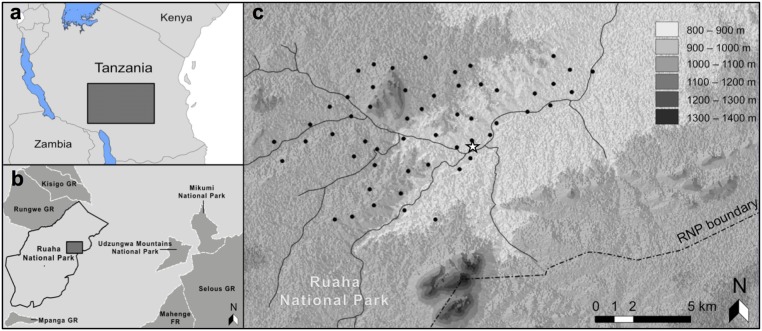
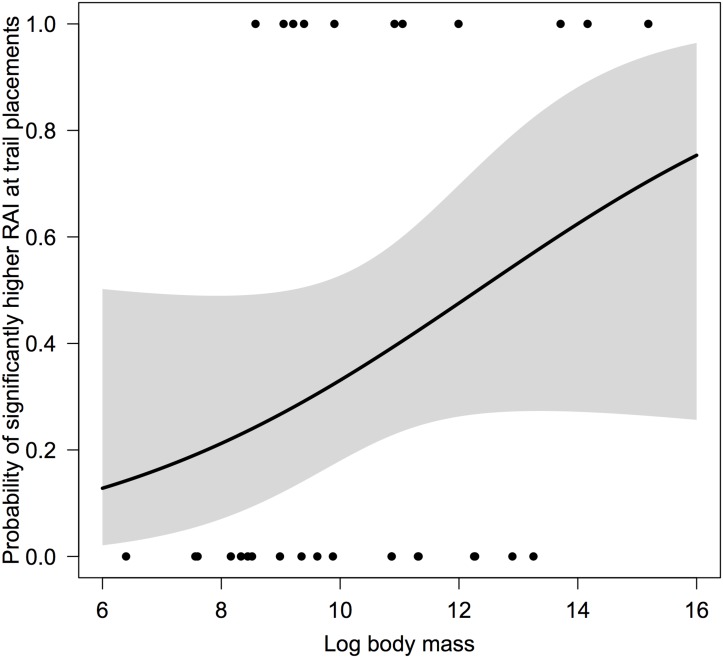
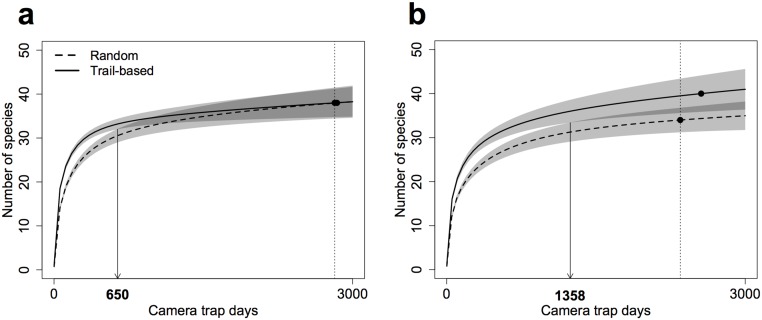
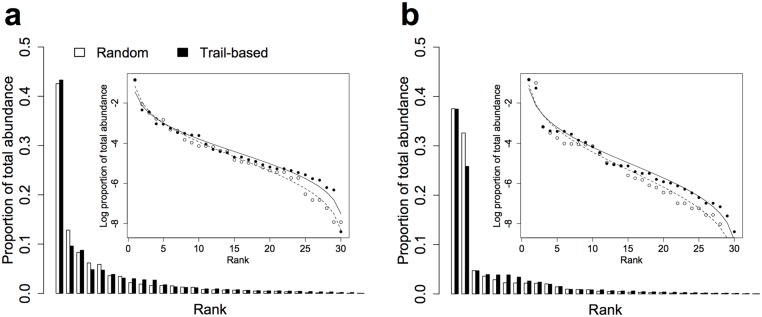
Camera trap surveys exclusively targeting features of the landscape that increase the probability of photographing one or several focal species are commonly used to draw inferences on the richness, composition and structure of entire mammal communities. However, these studies ignore expected biases in species detection arising from sampling only a limited set of potential habitat features. In this study, we test the influence of camera trap placement strategy on community-level inferences by carrying out two spatially and temporally concurrent surveys of medium to large terrestrial mammal species within Tanzania's Ruaha National Park, employing either strictly game trail-based or strictly random camera placements. We compared the richness, composition and structure of the two observed communities, and evaluated what makes a species significantly more likely to be caught at trail placements. Observed communities differed marginally in their richness and composition, although differences were more noticeable during the wet season and for low levels of sampling effort. Lognormal models provided the best fit to rank abundance distributions describing the structure of all observed communities, regardless of survey type or season. Despite this, carnivore species were more likely to be detected at trail placements relative to random ones during the dry season, as were larger bodied species during the wet season. Our findings suggest that, given adequate sampling effort (> 1400 camera trap nights), placement strategy is unlikely to affect inferences made at the community level. However, surveys should consider more carefully their choice of placement strategy when targeting specific taxonomic or trophic groups.
专门针对能增加拍摄一种或几种目标物种概率的景观特征进行的相机陷阱调查,通常用于推断整个哺乳动物群落的丰富度、组成和结构。然而,这些研究忽略了仅对有限的一组潜在栖息地特征进行采样所产生的物种检测中预期的偏差。在本研究中,我们通过在坦桑尼亚鲁阿哈国家公园内对中型至大型陆生哺乳动物物种进行两次空间和时间上同步的调查,采用严格基于兽道或严格随机的相机放置方式,来测试相机陷阱放置策略对群落水平推断的影响。我们比较了两个观察到的群落的丰富度、组成和结构,并评估了哪些因素使得一个物种在兽道放置点被捕获的可能性显著更高。观察到的群落的丰富度和组成略有不同,尽管在雨季和低采样强度时差异更明显。对数正态模型最适合描述所有观察到的群落结构的秩丰度分布,无论调查类型或季节如何。尽管如此,在旱季,食肉动物物种相对于随机放置点在兽道放置点被检测到的可能性更高,在雨季体型较大的物种也是如此。我们的研究结果表明,在有足够的采样强度(>1400个相机陷阱夜)的情况下,放置策略不太可能影响在群落水平上做出的推断。然而,当针对特定的分类群或营养级组时,调查应更仔细地考虑其放置策略的选择。