Tenthani Lyson, Haas Andreas D, Egger Matthias, Van Oosterhout Joep J, Jahn Andreas, Chimbwandira Frank, Tal Kali, Myer Landon, Estill Janne, Keiser Olivia
*Department of HIV and AIDS, Ministry of Health, Lilongwe, Malawi; †Institute of Social and Preventive Medicine, University of Bern, Bern, Switzerland; ‡International Training and Education Centre for Health/Department for Global Health, University of Washington, Seattle, WA; §Dignitas International, Zomba, Malawi; ‖Department of Medicine, College of Medicine, University of Malawi, Blantyre, Malawi; ¶International Training and Education Centre for Health Malawi, Lilongwe, Malawi; #Division of Epidemiology and Biostatistics, School of Public Health and Family Medicine, University of Cape Town, Cape Town, South Africa; and **International Training and Education Center for Health Malawi, Lilongwe, Malawi.
J Acquir Immune Defic Syndr. 2015 Aug 15;69(5):610-4. doi: 10.1097/QAI.0000000000000669.
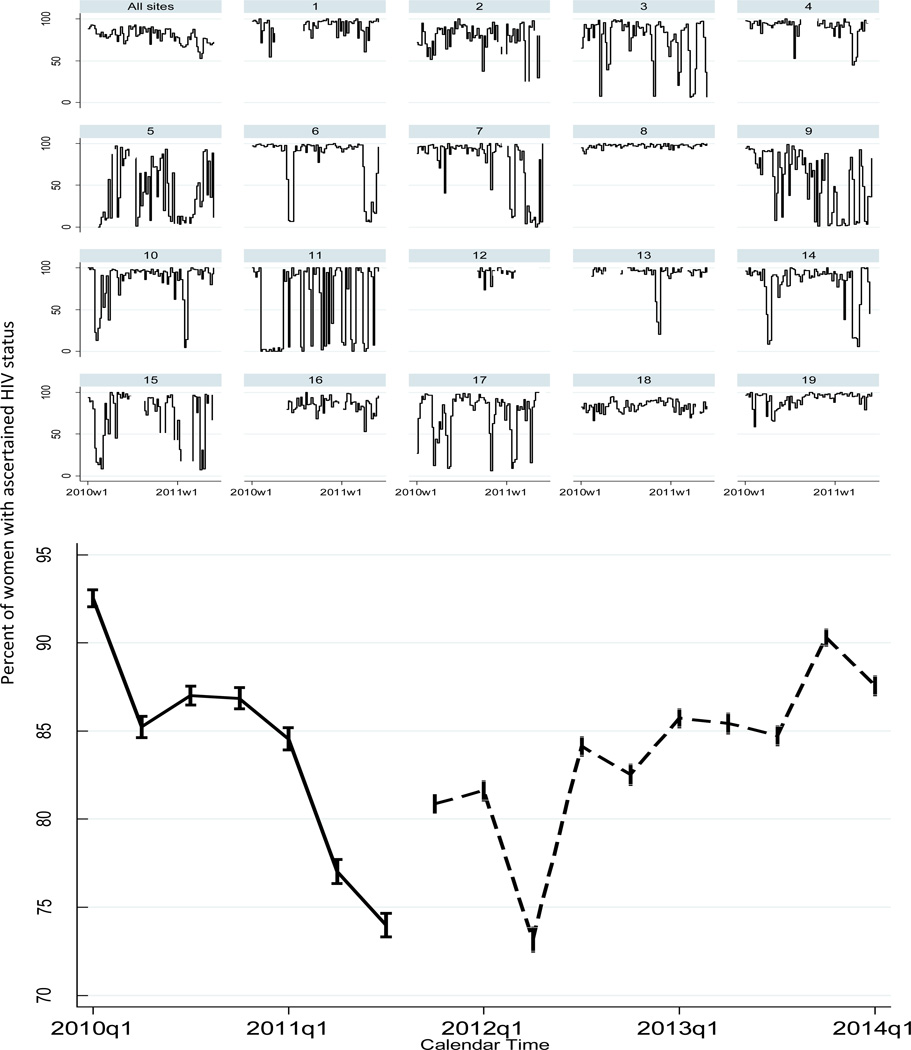
Malawi adopted the Option B+ strategy in 2011. Its success in reducing mother-to-child transmission depends on coverage and timing of HIV testing. We assessed HIV status ascertainment and its predictors during pregnancy. HIV status ascertainment was 82.3% (95% confidence interval: 80.2 to 85.9) in the pre-Option B+ period and 85.7% (95% confidence interval: 83.4 to 88.0) in the Option B+ period. Higher HIV ascertainment was independently associated with higher age, attending antenatal care more than once, and registration in 2010. The observed high variability of HIV ascertainment between sites (50.6%-97.7%) and over time suggests that HIV test kit shortages and insufficient numbers of staff posed major barriers to reducing mother-to-child transmission.
马拉维于2011年采用了“B+方案”策略。其在减少母婴传播方面的成功取决于艾滋病毒检测的覆盖率和时机。我们评估了孕期艾滋病毒感染状况的确定情况及其预测因素。在“B+方案”实施前阶段,艾滋病毒感染状况的确定率为82.3%(95%置信区间:80.2至85.9),在“B+方案”阶段为85.7%(95%置信区间:83.4至88.0)。艾滋病毒感染状况确定率较高与年龄较大、不止一次接受产前护理以及在2010年登记独立相关。各地点之间(50.6%-97.7%)以及不同时间艾滋病毒感染状况确定率存在明显差异,这表明艾滋病毒检测试剂盒短缺和工作人员数量不足是减少母婴传播的主要障碍。