Tokunaga O, Fan J L, Watanabe T
Department of Pathology, Saga Medical School, Nabeshima-Machi, Japan.
Am J Pathol. 1989 Dec;135(6):967-76.
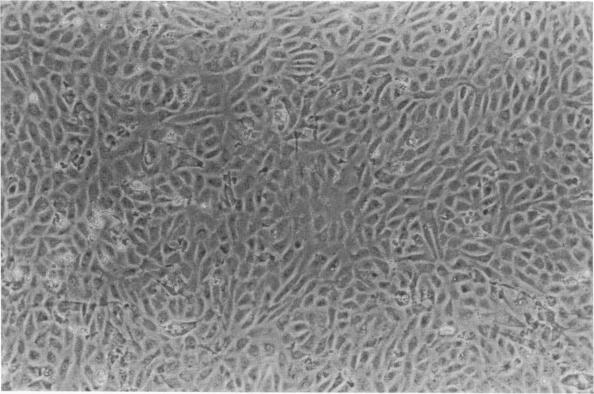
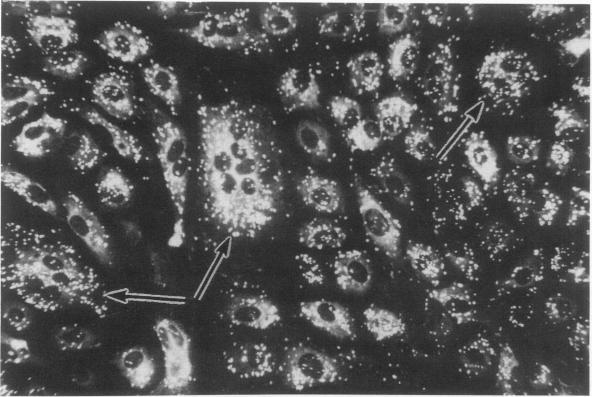
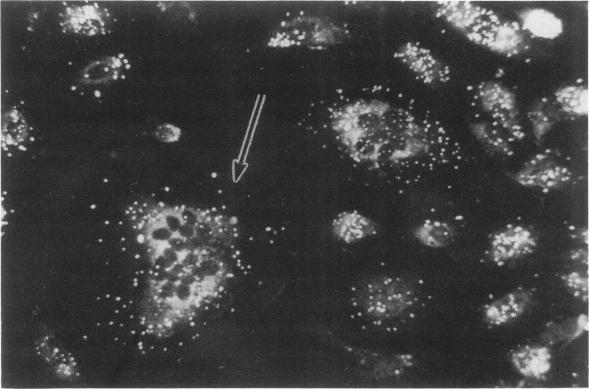
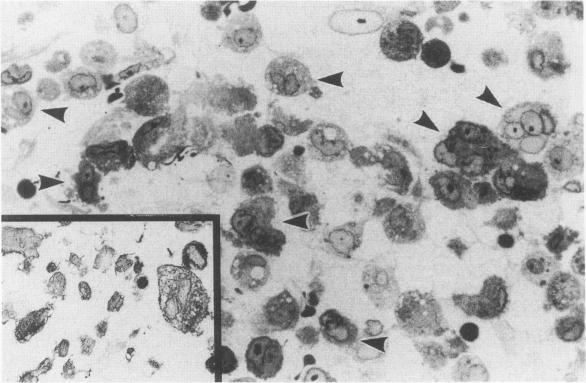
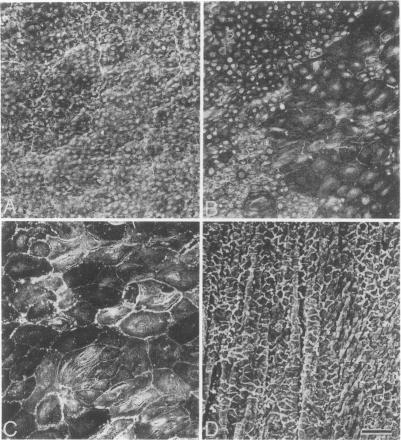
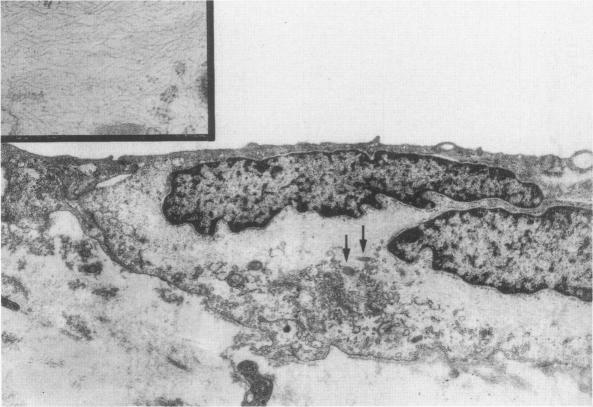
Endothelial cells were cultured from human aortas and inferior venae cavae of autopsied subjects ranging in age from infancy to 85 years. Endothelial cells in 32 of more than 100 attempted cultures were pure enough for evaluation. Emerged endothelial cells in primary culture were classified into two types: typical endothelium and variant endothelium. Typical endothelial cells were small, round to polygonal shaped, and were arranged uniformly. Their diameter ranged from 50 to 70 microns. Variant endothelial cells were larger, ranging from 100 to 200 microns in diameter, and giant endothelial cells measuring more than 250 microns in diameter were scattered among them. Variant endothelial cells were usually multinucleated and possessed endothelium-specific markers of vWF and Weibel-Palade bodies. No incorporation of [3H]thymidine was found in the nuclei of cultured variant endothelial cells. Although most cultured endothelial cells were of the typical type, variant endothelial cells were interspersed throughout the culture. The ratio of variant endothelial cells to typical cells correlated well with the severity of atherosclerosis, but less so with aging. The number of variant endothelial cells in cultures from inferior venae cavae was slight and constant throughout all age groups. The presence of multinucleated endothelial cells in in vivo aortas was confirmed by both scanning and transmission electron microscopy. They sometimes existed in colonies in the aortas from elderly subjects with intimal-thickened or advanced atherosclerotic lesions. These results indicate that variant endothelial cells were present in vivo and their ratio in primary culture reflected the in vivo population. It is likely that these cells were formed by adhesion of adjacent typical endothelial cells and that this process was affected more by atherosclerosis than by aging. Although it is not clear if the multinucleated variant cells were formed before the formation of atherosclerotic plaque or after the plaque formation, they will contribute to further development of atherosclerotic lesions, which in turn cause malfunction of the cell membrane. We suggest that there is a cyclic effect of these processes for multiplication of the variant endothelial cells and advancement of atherosclerotic lesions.
从年龄从婴儿期到85岁的尸检对象的人主动脉和下腔静脉中培养内皮细胞。在100多次尝试培养中,有32次培养出的内皮细胞纯度足以进行评估。原代培养中出现的内皮细胞分为两种类型:典型内皮细胞和变异内皮细胞。典型内皮细胞体积小,呈圆形至多边形,排列均匀。其直径范围为50至70微米。变异内皮细胞较大,直径范围为100至200微米,直径超过250微米的巨大内皮细胞散在于其中。变异内皮细胞通常为多核,并具有内皮特异性标志物vWF和魏-帕小体。在培养的变异内皮细胞核中未发现[3H]胸腺嘧啶核苷的掺入。虽然大多数培养的内皮细胞为典型类型,但变异内皮细胞散布于整个培养物中。变异内皮细胞与典型细胞的比例与动脉粥样硬化的严重程度密切相关,但与衰老的相关性较小。下腔静脉培养物中变异内皮细胞的数量在所有年龄组中都很少且恒定。通过扫描电子显微镜和透射电子显微镜均证实了体内主动脉中存在多核内皮细胞。它们有时存在于患有内膜增厚或晚期动脉粥样硬化病变的老年受试者主动脉中的菌落中。这些结果表明,变异内皮细胞存在于体内,其在原代培养中的比例反映了体内的细胞群体。这些细胞可能是由相邻的典型内皮细胞粘附形成的,并且这个过程受动脉粥样硬化的影响比受衰老的影响更大。虽然尚不清楚多核变异细胞是在动脉粥样硬化斑块形成之前还是之后形成的,但它们将有助于动脉粥样硬化病变的进一步发展,进而导致细胞膜功能障碍。我们认为这些过程对于变异内皮细胞的增殖和动脉粥样硬化病变的进展存在循环效应。