Stanika Ruslan I, Flucher Bernhard E, Obermair Gerald J
Division of Physiology, Department of Physiology and Medical Physics, Medical University Innsbruck, Fritz-Pregl-Str. 3, 6020 Innsbruck, Austria.
Curr Mol Pharmacol. 2015;8(1):95-101. doi: 10.2174/1874467208666150507103716.
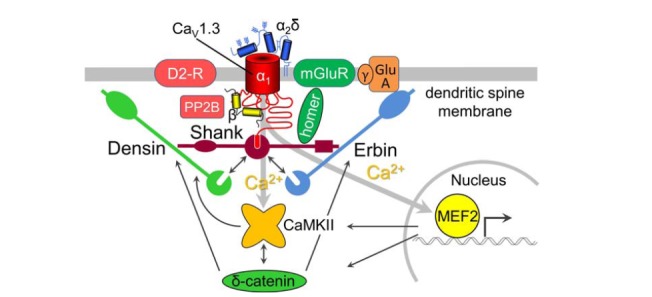
Alterations in dendritic spine morphology and postsynaptic structure are a hallmark of neurological disorders. Particularly spine pruning of striatal medium spiny neurons and aberrant rewiring of corticostriatal synapses have been associated with the pathology of Parkinson's disease and LDOPA induced dyskinesia, respectively. Owing to its low activation threshold the neuronal L-type calcium channel CaV1.3 is particularly critical in the control of neuronal excitability and thus in the calcium-dependent regulation of neuronal functions. CaV1.3 channels are located in dendritic spines and contain a C-terminal class 1 PDZ domain-binding sequence. Until today the postsynaptic PDZ domain proteins shank, densin-180, and erbin have been shown to interact with CaV1.3 channels and to modulate their current properties. Interestingly experimental evidence suggests an involvement of all three PDZ proteins as well as CaV1.3 itself in regulating dendritic and postsynaptic morphology. Here we briefly review the importance of CaV1.3 and its proposed interactions with PDZ proteins for the stability of dendritic spines. With a special focus on the pathology associated with Parkinson's disease, we discuss the hypothesis that CaV1.3 L-type calcium channels may be critical modulators of dendritic spine stability.
树突棘形态和突触后结构的改变是神经系统疾病的一个标志。特别是纹状体中等棘状神经元的树突棘修剪以及皮质纹状体突触的异常重新布线,分别与帕金森病和左旋多巴诱导的运动障碍的病理过程相关。由于其低激活阈值,神经元L型钙通道CaV1.3在控制神经元兴奋性以及因此在神经元功能的钙依赖性调节中尤为关键。CaV1.3通道位于树突棘中,并包含一个C端1类PDZ结构域结合序列。直到现在,突触后PDZ结构域蛋白柄蛋白、致密素-180和埃宾蛋白已被证明与CaV1.3通道相互作用并调节其电流特性。有趣的是,实验证据表明这三种PDZ蛋白以及CaV1.3本身都参与调节树突和突触后形态。在这里,我们简要回顾CaV1.3及其与PDZ蛋白的拟议相互作用对树突棘稳定性的重要性。特别关注与帕金森病相关的病理,我们讨论CaV1.3 L型钙通道可能是树突棘稳定性关键调节因子的假说。