División de Neurociencias, Instituto de Fisiología Celular, Universidad Nacional Autónoma de México, AP 70-253, 04510, México DF, México.
Acta Neuropathol Commun. 2015 May 14;3:27. doi: 10.1186/s40478-015-0205-3.
Several data suggest that excitotoxicity due to excessive glutamatergic neurotransmission may be an important factor in the mechanisms of motor neuron (MN) death occurring in amyotrophic lateral sclerosis (ALS). We have previously shown that the overactivation of the Ca(2+)-permeable α-amino-3-hydroxy-5-methyl-4-isoxazole propionate (AMPA) glutamate receptor type, through the continuous infusion of AMPA in the lumbar spinal cord of adult rats during several days, results in progressive rear limb paralysis and bilateral MN degeneration. Because it has been shown that energy failure and oxidative stress are involved in MN degeneration, in both ALS and experimental models of spinal MN degeneration, including excitotoxicity, in this work we tested the protective effect of the energy substrates pyruvate and β-hydroxybutyrate (βHB) and the antioxidants glutathione ethyl ester (GEE) and ascorbate in this chronic AMPA-induced neurodegeneration.
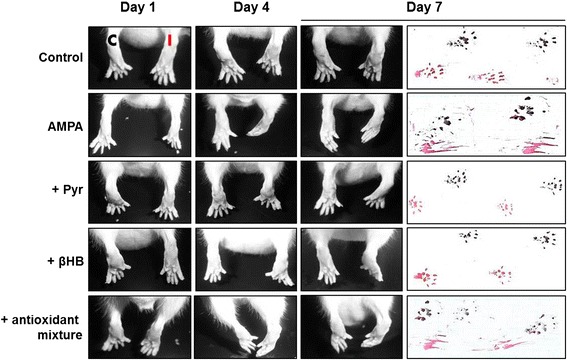
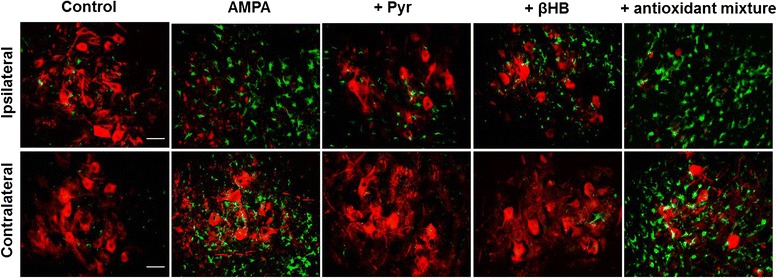
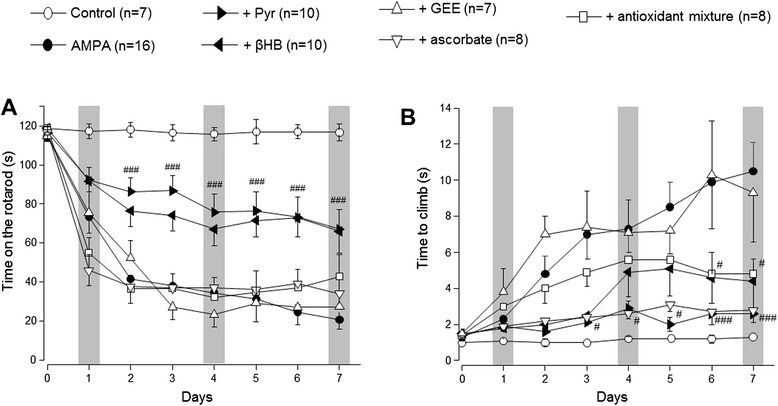
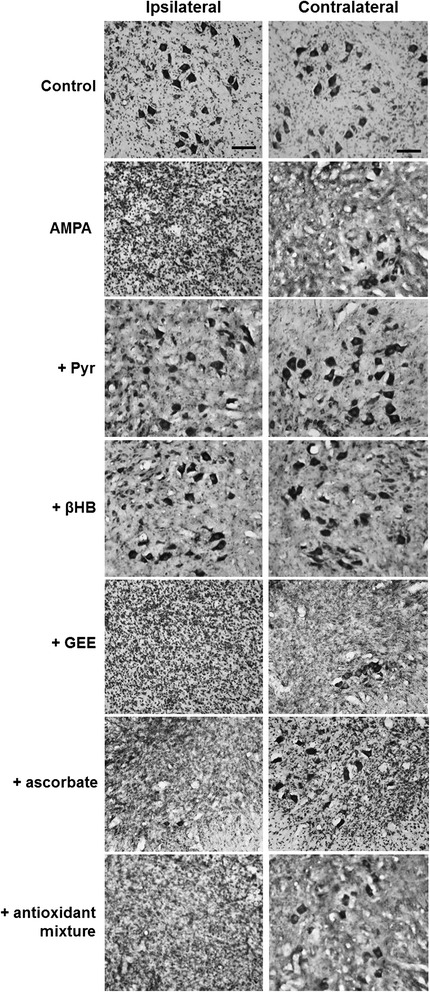
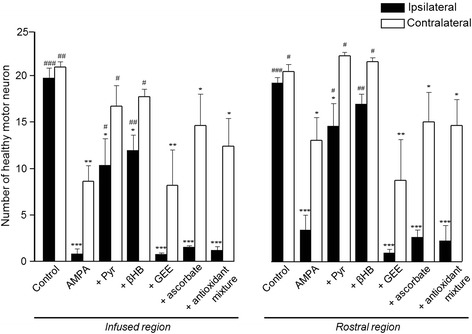
AMPA infusion induced remarkable progressive motor deficits, assessed by two motor tasks, that by day seven reach bilateral rear limb paralysis. These effects correlate with the death of >80% of lumbar spinal MNs in the infused and the neighbor spinal cord segments, as well as with notable astrogliosis in the ventral horns, detected by glial fibrillary acidic protein immunohistochemistry. Co-infusion with pyruvate or βHB notably prevented the motor deficits and paralysis, decreased MN loss to <25% and completely prevented the induction of astrogliosis. In contrast, the antioxidants tested were ineffective regarding all parameters analyzed.
Chronic progressive excitotoxicity due to AMPA receptors overactivation results in MN death and astrogliosis, with consequent motor deficits and paralysis. Because of the notable protection against these effects exerted by pyruvate and βHB, which are well established mitochondrial energy substrates, we conclude that deficits in mitochondrial energy metabolism are an important factor in the mechanisms of this slowly developed excitotoxic MN death, while the lack of protective effect of the antioxidants indicates that oxidative stress seems to be less significant factor. Because excitotoxicity may be involved in MN degeneration in ALS, these findings suggest possible preventive or therapeutic strategies for the disease.
多项数据表明,由于谷氨酸能神经传递过度而导致的兴奋毒性可能是肌萎缩侧索硬化症(ALS)中运动神经元(MN)死亡的重要机制。我们之前已经表明,通过在成年大鼠的腰骶脊髓中连续几天输注 AMPA,过度激活 Ca(2+)-通透性 α-氨基-3-羟基-5-甲基-4-异恶唑丙酸(AMPA)谷氨酸受体类型,会导致进行性后肢瘫痪和双侧 MN 变性。因为已经表明能量衰竭和氧化应激与 MN 变性有关,无论是在 ALS 还是在包括兴奋毒性在内的脊髓 MN 变性的实验模型中,所以在这项工作中,我们测试了能量底物丙酮酸盐和 β-羟丁酸(βHB)以及抗氧化剂谷胱甘肽乙酯(GEE)和抗坏血酸对这种慢性 AMPA 诱导的神经退行性变的保护作用。
AMPA 输注诱导了显著的进行性运动缺陷,通过两项运动任务进行评估,到第 7 天达到双侧后肢瘫痪。这些影响与在输注和相邻脊髓节段中 >80%的腰髓 MN 死亡以及胶质纤维酸性蛋白免疫组织化学检测到的腹角中的明显星形胶质增生相关。与丙酮酸或 βHB 共同输注显著预防了运动缺陷和瘫痪,将 MN 损失减少到 <25%,并完全防止了星形胶质增生的诱导。相比之下,测试的抗氧化剂在所有分析参数方面均无效。
由于 AMPA 受体过度激活导致的慢性进行性兴奋毒性导致 MN 死亡和星形胶质增生,从而导致运动缺陷和瘫痪。由于丙酮酸和 βHB 对这些作用有显著的保护作用,而丙酮酸和 βHB 是公认的线粒体能量底物,我们得出结论,线粒体能量代谢的缺陷是这种缓慢发展的兴奋毒性 MN 死亡机制中的一个重要因素,而抗氧化剂缺乏保护作用表明氧化应激似乎不是一个重要因素。因为兴奋毒性可能与 ALS 中的 MN 变性有关,这些发现为该疾病提供了可能的预防或治疗策略。