Rastogi Rakhi, Budhiraja Virendra, Bansal Kshitij
Department of Anatomy, L.N. Medical College and J.K. Hospital, Sector-C Sarvdharm, Kolar Road, Bhopal, India.
Department of Pediatrics, Subharti Medical College, Meerut, India.
ISRN Anat. 2013 Sep 26;2013:501813. doi: 10.5402/2013/501813. eCollection 2013.
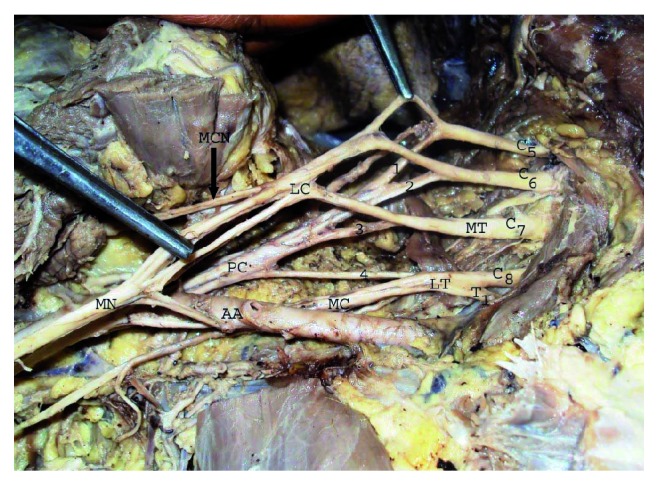
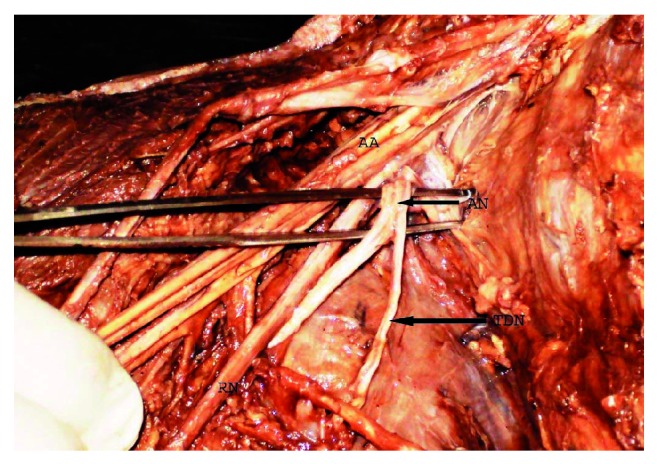
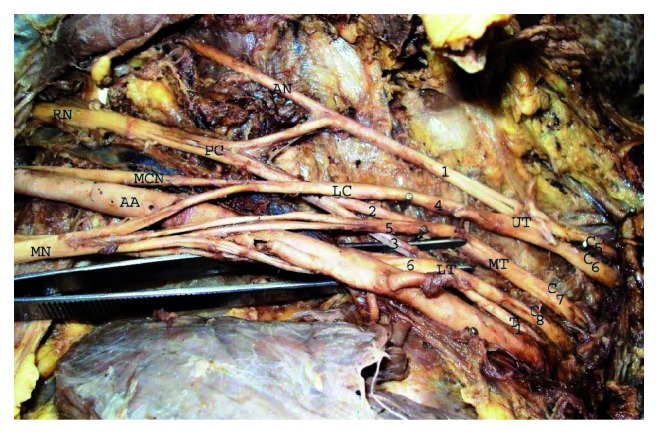
Background. Knowledge of anatomical variations of posterior cord and its branches is important not only for the administration of anaesthetic blocks but also for surgical approaches to the neck, axilla, and upper arm. The present study aimed to record the prevalence of such variations with embryological explanation and clinical implication. Material and Method. 37 formalin-preserved cadavers, that is, 74 upper extremities from the Indian population, constituted the material for the study. Cadavers were dissected during routine anatomy classes for medical undergraduate. Dissection includes surgical incision in the axilla, followed by retraction of various muscles, to observe and record the formation and branching pattern of posterior cord of brachial plexus. Results. Posterior cord was formed by union of posterior division of C5 and C6 roots with posterior division of middle and lower trunk (there was no upper trunk) in 16.2% of upper extremities. Posterior cord of brachial plexus was present lateral to the second part of axillary artery in 18.9% of upper extremities. Axillary nerve was taking origin from posterior division of upper trunk in 10.8% upper extremities and thoracodorsal nerve arising from axillary nerve in 22.9% upper extremities. Conclusion. It is important to be aware of such variations while planning a surgery in the region of axilla as these nerves are more liable to be injured during surgical procedures.
背景。了解后束及其分支的解剖变异不仅对于麻醉阻滞的实施很重要,而且对于颈部、腋窝和上臂的手术入路也很重要。本研究旨在记录此类变异的发生率,并给出胚胎学解释和临床意义。材料与方法。37具用福尔马林保存的尸体,即来自印度人群的74条上肢,构成了研究材料。尸体在医学本科常规解剖课期间进行解剖。解剖包括在腋窝做外科切口,然后牵开各种肌肉,以观察和记录臂丛后束的形成和分支模式。结果。在16.2%的上肢中,后束由C5和C6神经根的后股与中、下干(无上干)的后股联合形成。在18.9%的上肢中,臂丛后束位于腋动脉第二段的外侧。在10.8%的上肢中,腋神经发自上干的后股,在22.9%的上肢中,胸背神经发自腋神经。结论。在计划腋窝区域的手术时,了解此类变异很重要,因为这些神经在手术过程中更容易受到损伤。