Ojo Joseph O, Rezaie Payam, Gabbott Paul L, Stewart Michael G
Department of Life Sciences, The Open University Walton Hall, UK ; Department of Neuropathology, Roskamp Institute Sarasota, FL, USA.
Department of Life Sciences, The Open University Walton Hall, UK.
Front Aging Neurosci. 2015 Apr 29;7:57. doi: 10.3389/fnagi.2015.00057. eCollection 2015.
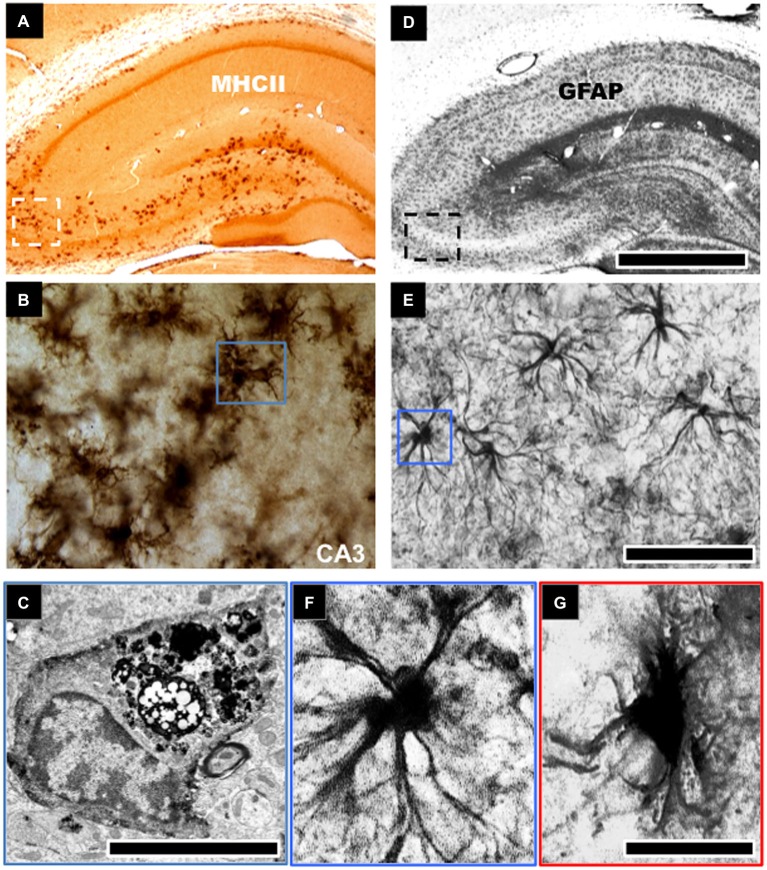
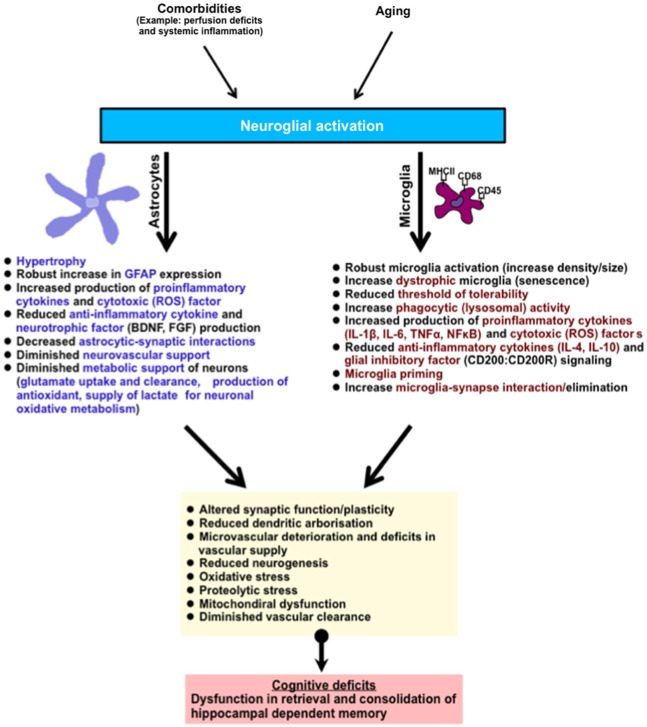
Aging is one of the greatest risk factors for the development of sporadic age-related neurodegenerative diseases and neuroinflammation is a common feature of this disease phenotype. In the immunoprivileged brain, neuroglial cells, which mediate neuroinflammatory responses, are influenced by the physiological factors in the microenvironment of the central nervous system (CNS). These physiological factors include but are not limited to cell-to-cell communication involving cell adhesion molecules, neuronal electrical activity and neurotransmitter and neuromodulator action. However, despite this dynamic control of neuroglial activity, in the healthy aged brain there is an alteration in the underlying neuroinflammatory response notably seen in the hippocampus, typified by astrocyte/microglia activation and increased pro-inflammatory cytokine production and signaling. These changes may occur without any overt concurrent pathology, however, they typically correlate with deteriorations in hippocamapal or cognitive function. In this review we examine two important phenomenons, firstly the relationship between age-related brain deterioration (focusing on hippocampal function) and underlying neuroglial response(s), and secondly how the latter affects molecular and cellular processes within the hippocampus that makes it vulnerable to age-related cognitive decline.
衰老乃是散发性年龄相关性神经退行性疾病发生发展的最大风险因素之一,神经炎症是这种疾病表型的一个共同特征。在免疫特惠的大脑中,介导神经炎症反应的神经胶质细胞会受到中枢神经系统(CNS)微环境中的生理因素影响。这些生理因素包括但不限于涉及细胞黏附分子的细胞间通讯、神经元电活动以及神经递质和神经调质的作用。然而,尽管对神经胶质细胞活动存在这种动态控制,但在健康的老年大脑中,潜在的神经炎症反应会发生改变,这在海马体中尤为明显,其典型特征是星形胶质细胞/小胶质细胞激活以及促炎细胞因子产生和信号传导增加。这些变化可能在没有任何明显并发病理的情况下发生,然而,它们通常与海马体功能或认知功能的恶化相关。在本综述中,我们探讨两个重要现象,其一为年龄相关性脑功能衰退(着重于海马体功能)与潜在神经胶质细胞反应之间的关系,其二为后者如何影响海马体内的分子和细胞过程,从而使其易患年龄相关性认知衰退。