Jazaeri Mina, Pakdek Farzaneh, Rezaei-Soufi Loghman, Abdolsamadi Hamidreza, Rafieian Nasrin
Assistant Professor, Department of Oral Medicine, Hamadan University of Medical Sciences, Hamadan, Iran.
Assistant Professor, Department of Oral Medicine, Tabriz University of Medical Sciences, Tabriz, Iran.
J Dent Res Dent Clin Dent Prospects. 2015 Winter;9(1):44-8. doi: 10.15171/joddd.2015.009. Epub 2015 Mar 4.
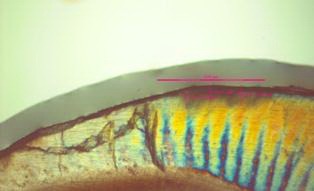
Background and aims. Anticariogenic effects of different mouthrinses have been shown previously. In this in vitro study the anticariogenic effects of polyphenol extract of green tea with 0.05% fluoride, 0.2% chlorhexidine and fluoride-chlorhexidine were compared. Materials and methods. This in vitro study was performed on 50 maxillary premolars in 5 groups: 1) normal saline; 2) a 10% solution of green tea polyphenol extract; 3) 0.05% fluoride; 4) 0.2% chlorhexidine; and 5) fluoride-chlorhexidine. Each tooth was placed in a tube which contained a cariogenic solution. Every day the teeth were washed (depending on the experimental groups) with 5 mL of mouthrinse solution. The depth of the caries was measured under a polarized light microscope. Data were analyzed using SPSS 13.0 with Kolmogorov-Smirnov, one-way ANOVA and Tukey tests. Results. The mean and standard deviation (in µm) of caries depth were 194±16.43, 175±17.94, 142±9.34, 155±13.27, and 144±8.57 in groups 1 to 5, respectively, with significant differences between the groups (P<0.001). Tukey test showed that although there was no significant difference in the depth of caries in groups 1 and 2 (P>0.001), they were significantlyless than those in groups 3 to 5 (P<0.001). There was no significant difference between decay depth of groups 3, 4 and 5 (P>0.001). Conclusion. The anticariogenic effect of fluoride-chlorhexidine was the highest among the groups. Although green tea showed higher cariostatic effects than normal saline, in comparison with other mouthrinses, it is less effective. More re-search is strongly recommended for clinical use of green tea as an anticariogenic agent.
背景与目的。先前已证实不同漱口水的防龋效果。在本体外研究中,比较了含0.05%氟化物、0.2%氯己定的绿茶多酚提取物以及氟化物 - 氯己定的防龋效果。材料与方法。本体外研究对5组共50颗上颌前磨牙进行:1)生理盐水;2)10%绿茶多酚提取物溶液;3)0.05%氟化物;4)0.2%氯己定;5)氟化物 - 氯己定。每颗牙齿置于装有致龋溶液的试管中。每天根据实验组用5 mL漱口水溶液冲洗牙齿。在偏光显微镜下测量龋损深度。使用SPSS 13.0软件,通过Kolmogorov - Smirnov检验、单因素方差分析和Tukey检验对数据进行分析。结果。第1至5组龋损深度的平均值及标准差(单位:µm)分别为194±16.43、175±17.94、142±9.34、155±13.27和144±8.57,组间差异有统计学意义(P<0.001)。Tukey检验表明,虽然第1组和第2组龋损深度无显著差异(P>0.001),但它们显著低于第3至5组(P<0.001)。第3、4和5组的龋损深度无显著差异(P>0.001)。结论。在各实验组中,氟化物 - 氯己定的防龋效果最佳。虽然绿茶显示出比生理盐水更高的抑龋效果,但与其他漱口水相比,其效果较差。强烈建议对绿茶作为防龋剂的临床应用进行更多研究。