Streja Elani, Miller Jessica E, Wu Chunsen, Bech Bodil H, Pedersen Lars Henning, Schendel Diana E, Uldall Peter, Olsen Jørn
Department of Epidemiology, School of Public Health, University of California Los Angeles, Los Angeles, California, United States of America.
Department of Obstetrics and Gynecology, Institute of Clinical Medicine, Aarhus University Hospital, Aarhus, Denmark.
PLoS One. 2015 May 14;10(5):e0126743. doi: 10.1371/journal.pone.0126743. eCollection 2015.
To investigate the association between proportionality of fetal and placental growth measured at birth and the risk for congenital cerebral palsy (CP).
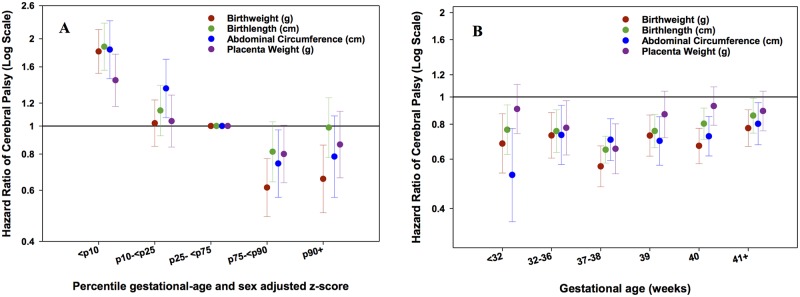
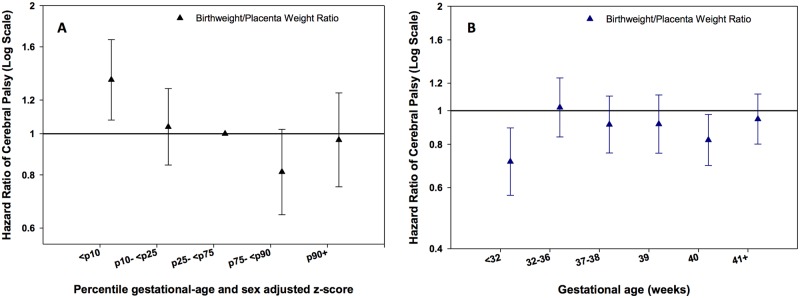
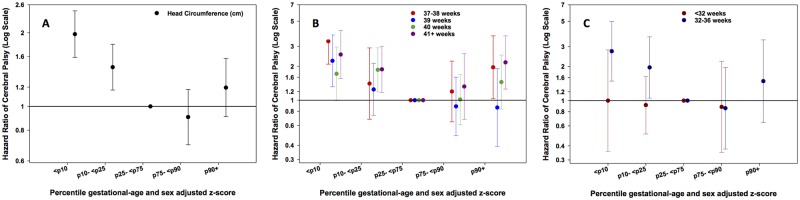
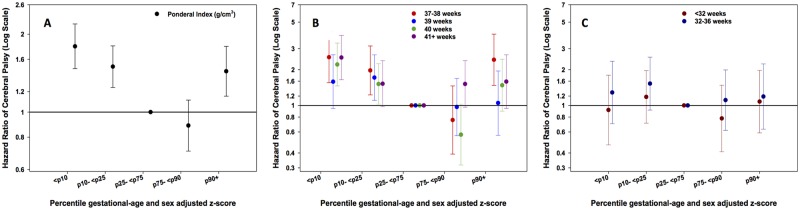
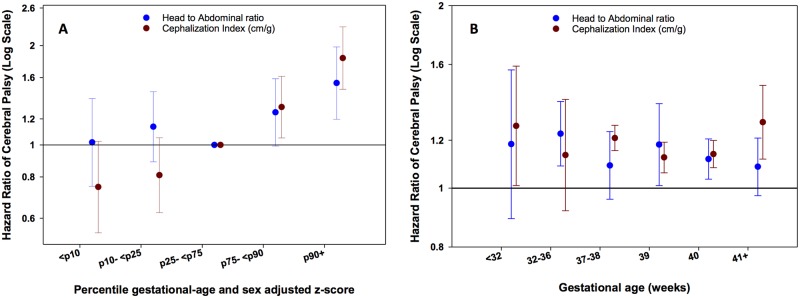
We identified all live-born singletons born in Denmark between 1995 and 2003 and followed them from 1 year of age until December 31st, 2008. Information on four indices of fetal growth: ponderal index, head circumference/ abdominal circumference ratio, cephalization index and birth weight/ placenta weight ratio was collected. Cox proportional hazards regression models were used to estimate adjusted hazard ratios (aHR) and 95% confidence intervals (CI). All measurements were evaluated as gestational age and sex specific z-scores and in z-score percentile groups, adjusted for potential confounders, and stratified on gestational age groups (<32, 32-36, 37-38, 39, 40, ≥ 41 weeks).
We identified 503,784 singleton births, of which 983 were confirmed cases of CP. Head/ abdominal circumference ratio (aHR:1.12; 95%CI:1.07-1.16) and cephalization index (aHR:1.14; 95%CI:1.11-1.16) were associated with the risk of CP irrespective of gestational age. Birth weight-placental weight ratio was also associated with CP in the entire cohort (aHR:0.90; 95%CI:0.83-0.97). Ponderal index had a u-shaped association with CP, where both children with low and high ponderal index were at higher risk of CP.
CP is associated with disproportions between birth weight, birth length, placental weight and head circumference suggesting pre and perinatal conditions contribute to fetal growth restriction in children with CP.
研究出生时测量的胎儿与胎盘生长比例与先天性脑瘫(CP)风险之间的关联。
我们确定了1995年至2003年在丹麦出生的所有活产单胎婴儿,并对他们从1岁开始随访至2008年12月31日。收集了四个胎儿生长指标的信息:体重指数、头围/腹围比、头化指数和出生体重/胎盘重量比。使用Cox比例风险回归模型来估计调整后的风险比(aHR)和95%置信区间(CI)。所有测量值均作为孕周和性别特异性z分数以及z分数百分位数组进行评估,对潜在混杂因素进行了调整,并按孕周组(<32、32 - 36、37 - 38、39、40、≥41周)进行分层。
我们确定了503,784例单胎出生,其中983例为确诊的CP病例。无论孕周如何,头/腹围比(aHR:1.12;95%CI:1.07 - 1.16)和头化指数(aHR:1.14;95%CI:1.11 - 1.16)均与CP风险相关。出生体重 - 胎盘重量比在整个队列中也与CP相关(aHR:0.90;95%CI:0.83 - 0.97)。体重指数与CP呈U形关联,即体重指数低和高的儿童患CP的风险均较高。
CP与出生体重、出生身长、胎盘重量和头围之间的比例失调有关,提示产前和围产期状况导致了CP患儿的胎儿生长受限。