Reito Aleksi, Elo Petra, Puolakka Timo, Pajamäki Jorma, Eskelinen Antti
Coxa Hospital for Joint Replacement, Biokatu 6b, 33520, Tampere, Finland.
BMC Musculoskelet Disord. 2015 May 15;16:118. doi: 10.1186/s12891-015-0566-6.
Adverse soft-tissue reaction to metal debris (ARMD) continues to be major source of concern in metal-on-metal (MoM) hip replacements. In our earlier study we were able to establish several risk factors for ARMD in patients who had received a small-diameter (<50 mm) Articular Surface Replacement (ASR, DePuy, Warsaw, IN, USA). The aims of the present study were to analyze whether these previously established risk factors also apply to patients who have received a large-headed (>50 mm) ASR™ XL THR.
Large-headed ASR total hip replacements were used in 225 operations (196 patients) at our institution. 176 patients (203 hips) attended a screening programme, consisting of a clinical evaluation, whole blood cobalt and chromium measurements, and cross-sectional imaging.
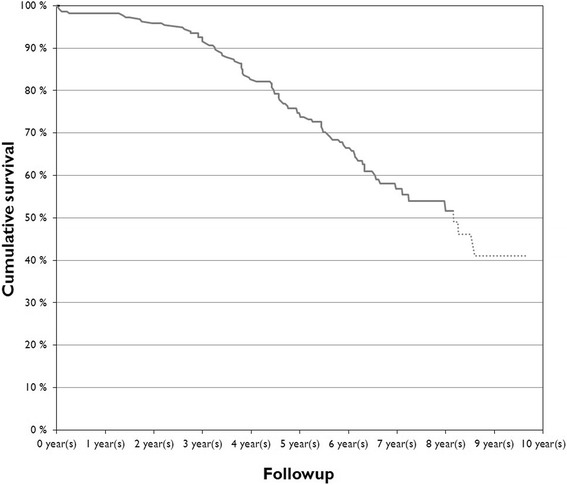
Revision surgery was performed on 84 hips (37%) in 75 patients. ARMD was diagnosed in the majority (n = 73 [87%]) of these revisions. Cumulative 8-year survivorship was 52%. The previously established risk factors for ARMD were not applicable. Interestingly, increasing femoral diameter and stem type were identified as independent risk factors for ARMD but reduced cup coverage had no significant association with ARMD.
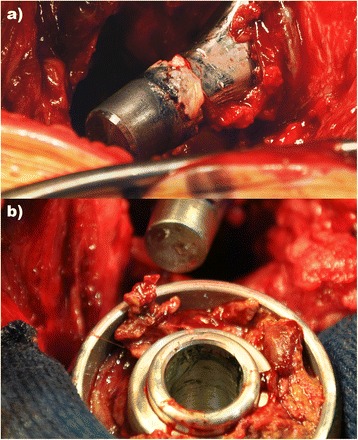
Stem type and increasing femoral size as independent risk factors for ARMD in the cohort of ASR XL THR patients, support the importance of taper failure in the development of ARMD. The present results suggest that the degree of taper failure may be variable and dependent on the taper design.
金属对金属(MoM)髋关节置换术中,金属碎屑引起的软组织不良反应(ARMD)仍是主要关注问题。在我们早期的研究中,我们确定了接受小直径(<50 mm)关节表面置换(ASR,美国印第安纳州华沙市迪普伊公司)的患者发生ARMD的几个风险因素。本研究的目的是分析这些先前确定的风险因素是否也适用于接受大头(>50 mm)ASR™ XL全髋关节置换术(THR)的患者。
我们机构使用大头ASR全髋关节置换术进行了225例手术(196例患者)。176例患者(203髋)参加了筛查项目,包括临床评估、全血钴和铬测量以及横断面成像。
75例患者中的84髋(37%)进行了翻修手术。这些翻修手术中的大多数(n = 73 [87%])被诊断为ARMD。8年累计生存率为52%。先前确定的ARMD风险因素并不适用。有趣的是,股骨直径增加和柄类型被确定为ARMD的独立风险因素,但髋臼覆盖率降低与ARMD无显著关联。
在ASR XL THR患者队列中,柄类型和股骨尺寸增加是ARMD的独立风险因素,这支持了锥度失效在ARMD发生中的重要性。目前的结果表明,锥度失效的程度可能是可变的,并且取决于锥度设计。