Khatri Raju, Shah Preeti, Guha Rupa, Rassool Feyruz V, Tomkinson Alan E, Brodie Angela, Jaiswal Anil K
Department of Pharmacology and Department of Radiation Oncology, University of Maryland School of Medicine, Baltimore, Maryland.
Department of Internal Medicine, University of New Mexico, Albuquerque, New Mexico.
Mol Cancer Ther. 2015 Jul;14(7):1728-37. doi: 10.1158/1535-7163.MCT-14-0672. Epub 2015 May 14.
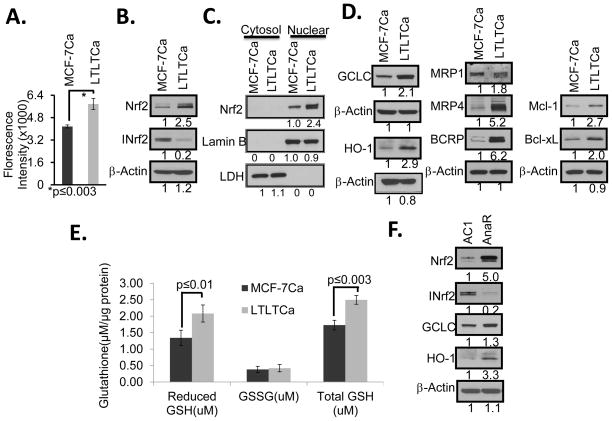
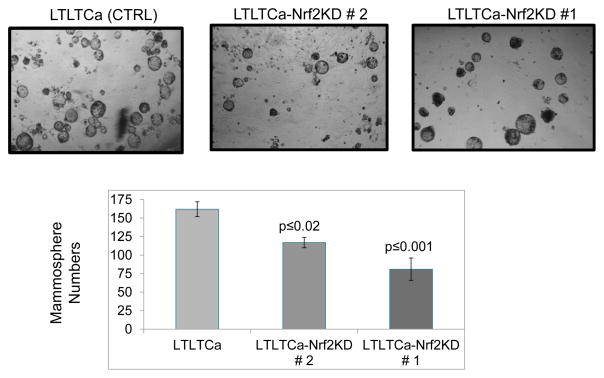
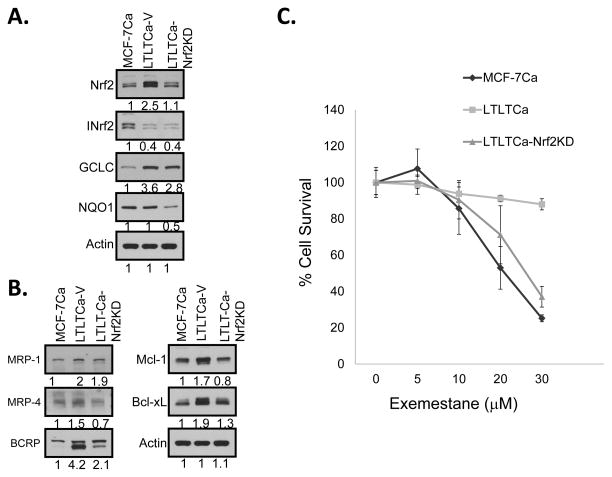
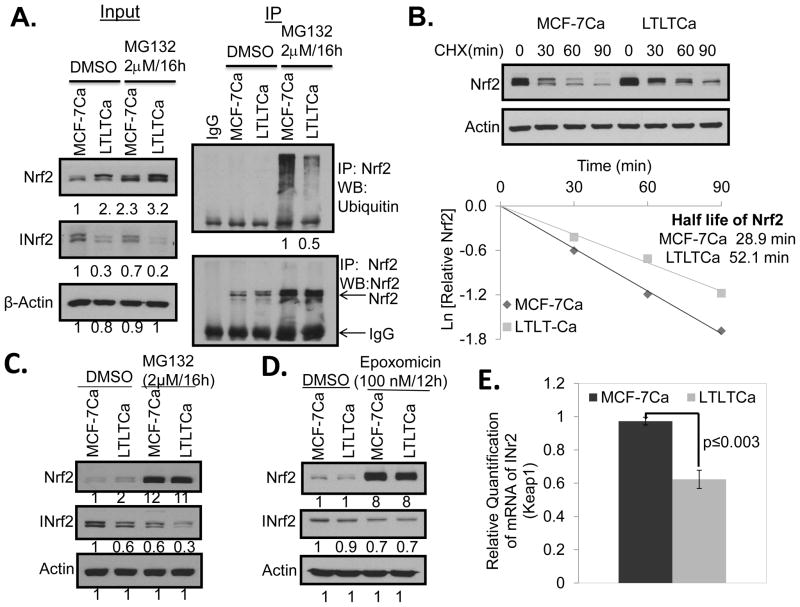
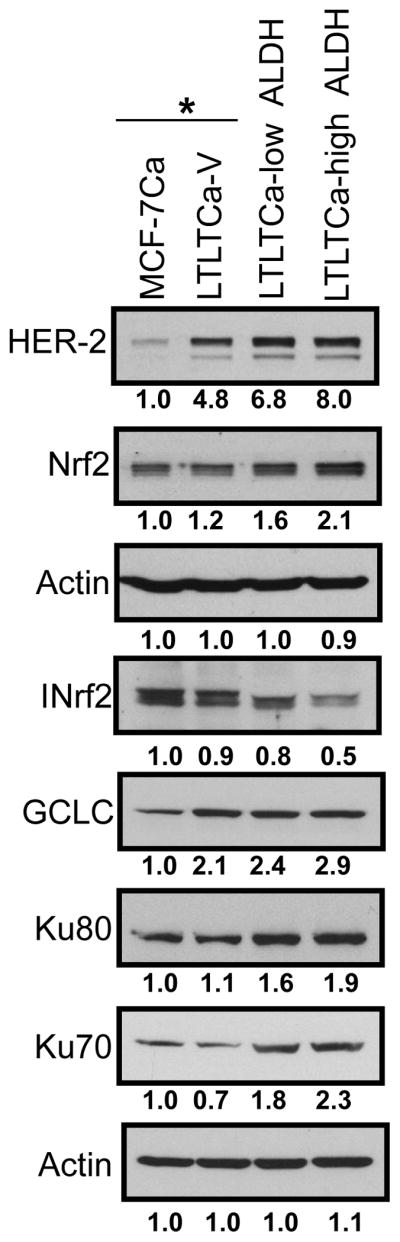
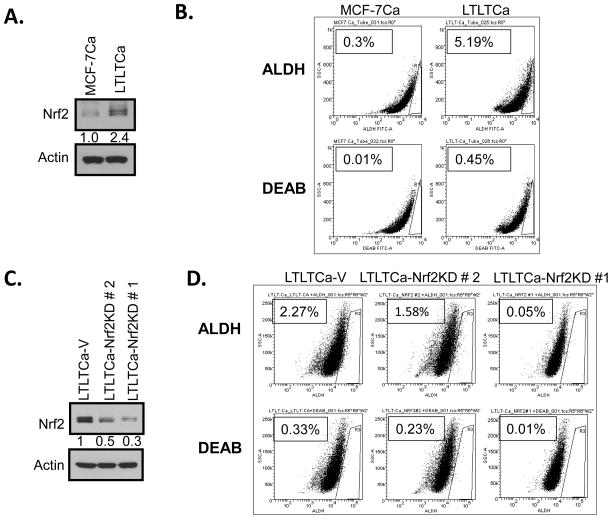
Aromatase inhibitors are effective drugs that reduce or eliminate hormone-sensitive breast cancer. However, despite their efficacy, resistance to these drugs can occur in some patients. The INrf2 (Keap1):Nrf2 complex serves as a sensor of drug/radiation-induced oxidative/electrophilic stress. INrf2 constitutively suppresses Nrf2 by functioning as an adapter protein for the Cul3/Rbx1-mediated ubiquitination/degradation of Nrf2. Upon stress, Nrf2 dissociates from INrf2, is stabilized, translocates to the nucleus, and coordinately induces a battery of cytoprotective gene expression. Current studies investigated the role of Nrf2 in aromatase inhibitor resistance. RT-PCR and immunoblot assays showed that aromatase inhibitor-resistant breast cancer LTLTCa and AnaR cells express lower INrf2 and higher Nrf2 protein levels, as compared with drug-sensitive MCF-7Ca and AC1 cells, respectively. The increase in Nrf2 was due to lower ubiquitination/degradation of Nrf2 in aromatase inhibitor-resistant cells. Higher Nrf2-mediated levels of biotransformation enzymes, drug transporters, and antiapoptotic proteins contributed to reduced efficacy of drugs and aversion to apoptosis that led to drug resistance. shRNA inhibition of Nrf2 in LTLTCa (LTLTCa-Nrf2KD) cells reduced resistance and sensitized cells to aromatase inhibitor exemestane. Interestingly, LTLTCa-Nrf2KD cells also showed reduced levels of aldehyde dehydrogenase, a marker of tumor-initiating cells and significantly decreased mammosphere formation, as compared with LTLTCa-Vector control cells. The results together suggest that persistent aromatase inhibitor treatment downregulated INrf2 leading to higher expression of Nrf2 and Nrf2-regulated cytoprotective proteins that resulted in increased aromatase inhibitor drug resistance. These findings provide a rationale for the development of Nrf2 inhibitors to overcome resistance and increase efficacy of aromatase inhibitors.
芳香化酶抑制剂是降低或消除激素敏感性乳腺癌的有效药物。然而,尽管其疗效显著,但部分患者可能会对这些药物产生耐药性。INrf2(Keap1):Nrf2复合物作为药物/辐射诱导的氧化/亲电应激的传感器。INrf2通过作为Cul3/Rbx1介导的Nrf2泛素化/降解的衔接蛋白,组成性地抑制Nrf2。在应激状态下,Nrf2与INrf2解离,被稳定下来,转位至细胞核,并协同诱导一系列细胞保护基因的表达。目前的研究探讨了Nrf2在芳香化酶抑制剂耐药中的作用。逆转录聚合酶链反应(RT-PCR)和免疫印迹分析表明,与药物敏感的MCF-7Ca和AC1细胞相比,对芳香化酶抑制剂耐药的乳腺癌LTLTCa和AnaR细胞分别表达较低的INrf2和较高的Nrf2蛋白水平。Nrf2的增加是由于芳香化酶抑制剂耐药细胞中Nrf2的泛素化/降解较低。较高的Nrf2介导的生物转化酶、药物转运蛋白和抗凋亡蛋白水平导致药物疗效降低和对凋亡的抵抗,从而产生耐药性。在LTLTCa(LTLTCa-Nrf2KD)细胞中,通过短发夹RNA(shRNA)抑制Nrf2可降低耐药性,并使细胞对芳香化酶抑制剂依西美坦敏感。有趣的是,与LTLTCa载体对照细胞相比,LTLTCa-Nrf2KD细胞中醛脱氢酶水平也降低,醛脱氢酶是肿瘤起始细胞的标志物,并且乳腺球形成显著减少。这些结果共同表明,持续的芳香化酶抑制剂治疗会下调INrf2,导致Nrf2和Nrf2调节的细胞保护蛋白表达增加,从而导致芳香化酶抑制剂耐药性增加。这些发现为开发Nrf2抑制剂以克服耐药性并提高芳香化酶抑制剂的疗效提供了理论依据。