Lintott Paul R, Bunnefeld Nils, Minderman Jeroen, Fuentes-Montemayor Elisa, Mayhew Rebekah J, Olley Lena, Park Kirsty J
Biological and Environmental Sciences, School of Natural Sciences, University of Stirling, Stirling, Scotland.
School of Biology, University of St Andrews, St Andrews, Scotland.
PLoS One. 2015 May 15;10(5):e0126850. doi: 10.1371/journal.pone.0126850. eCollection 2015.
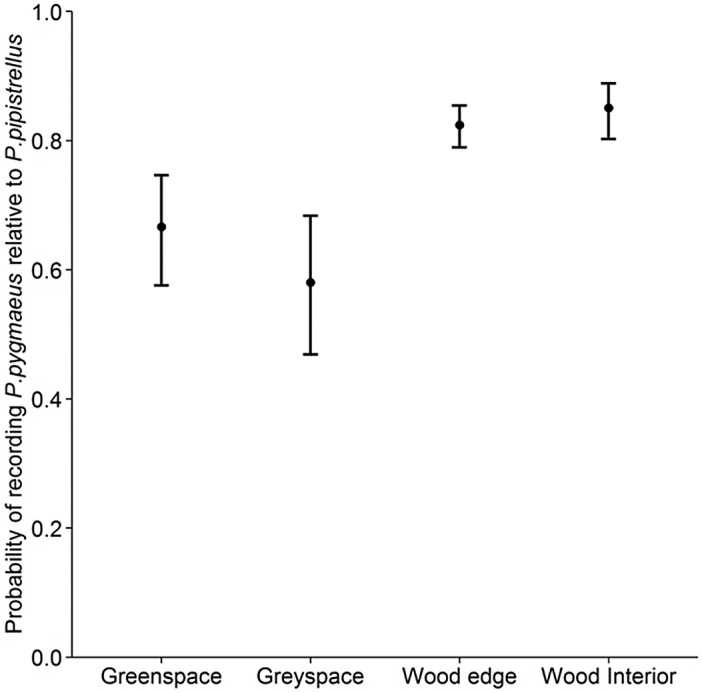
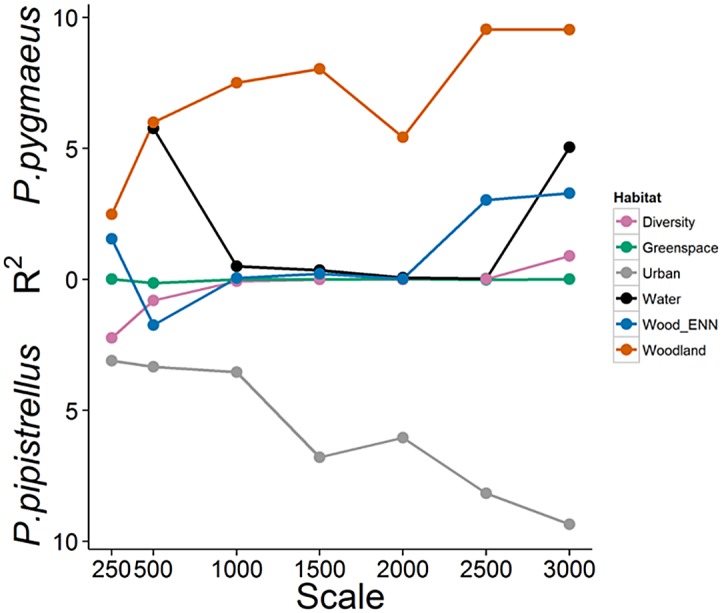
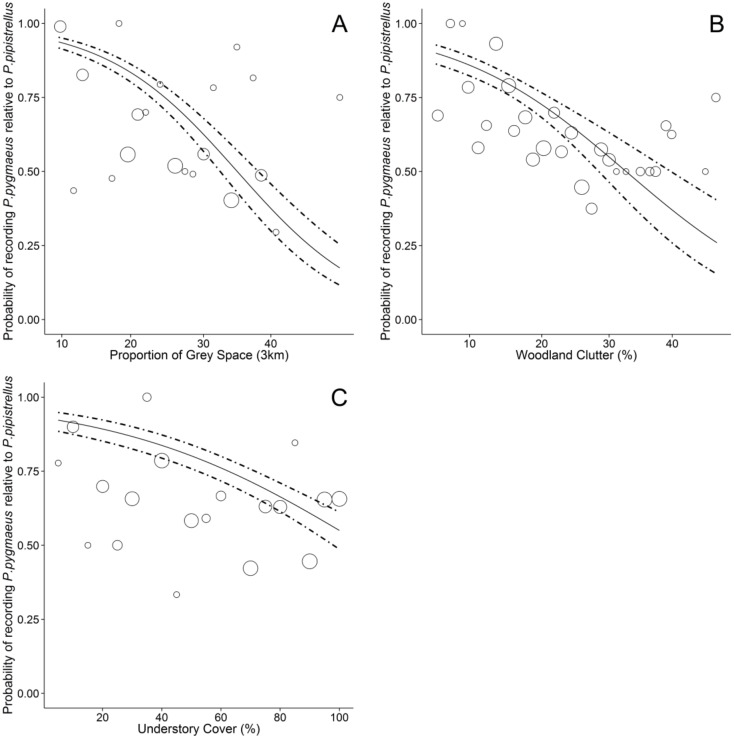
Urbanisation is one of the most dramatic forms of land use change which relatively few species can adapt to. Determining how and why species respond differently to urban habitats is important in predicting future biodiversity loss as urban areas rapidly expand. Understanding how morphological or behavioural traits can influence species adaptability to the built environment may enable us to improve the effectiveness of conservation efforts. Although many bat species are able to exploit human resources, bat species richness generally declines with increasing urbanisation and there is considerable variation in the responses of different bat species to urbanisation. Here, we use acoustic recordings from two cryptic, and largely sympatric European bat species to assess differential responses in their use of fragmented urban woodland and the surrounding urban matrix. There was a high probability of P. pygmaeus activity relative to P. pipistrellus in woodlands with low clutter and understory cover which were surrounded by low levels of built environment. Additionally, the probability of recording P. pygmaeus relative to P. pipistrellus was considerably higher in urban woodland interior or edge habitat in contrast to urban grey or non-wooded green space. These results show differential habitat use occurring between two morphologically similar species; whilst the underlying mechanism for this partitioning is unknown it may be driven by competition avoidance over foraging resources. Their differing response to urbanisation indicates the difficulties involved when attempting to assess how adaptable a species is to urbanisation for conservation purposes.
城市化是土地利用变化最显著的形式之一,相对而言很少有物种能够适应。随着城市地区迅速扩张,确定物种如何以及为何对城市栖息地有不同反应,对于预测未来生物多样性丧失至关重要。了解形态或行为特征如何影响物种对建筑环境的适应性,可能使我们能够提高保护工作的成效。尽管许多蝙蝠物种能够利用人类资源,但蝙蝠物种丰富度通常随着城市化程度的提高而下降,不同蝙蝠物种对城市化的反应存在相当大的差异。在这里,我们使用来自两种隐秘且在很大程度上同域分布的欧洲蝙蝠物种的声学记录,来评估它们在破碎化城市林地及其周围城市基质利用上的差异反应。在杂乱程度低且林下植被覆盖少、周围建筑环境水平低的林地中,与伏翼相比,姬鼠耳蝠活动的可能性很高。此外,与城市灰色或非林地绿地相比,在城市林地内部或边缘栖息地记录到姬鼠耳蝠相对于伏翼的概率要高得多。这些结果表明,两种形态相似的物种之间存在不同的栖息地利用情况;虽然这种划分的潜在机制尚不清楚,但可能是由对觅食资源的竞争回避驱动的。它们对城市化的不同反应表明,在试图评估一个物种为了保护目的对城市化的适应能力时存在困难。