Zhang Enyuan, Li Zhenyu, Che Jingjin, Chen Xin, Qin Tiantian, Tong Qing, Zhao Weiwei, Li Guangping
Tianjin Key Laboratory of Ionic-Molecular Function of Cardiovascular Disease (Key Lab-TIC) (EZ, JC, XC, GL), Department of Cardiology, Tianjin Institute of Cardiology, The Second Hospital, Tianjin Medical University, Tianjin, China; Intensive Care Unit (ZL), The Second Hospital, Tianjin Medical University, Tianjin, China; and Tianjin Medical University (TQ, QT, WZ), Tianjin, China.
Am J Med Sci. 2015 Jun;349(6):493-8. doi: 10.1097/MAJ.0000000000000471.
To investigate the factors predicting the onset of major adverse cardiovascular events (MACEs) after primary percutaneous coronary intervention for ST-segment elevation myocardial infarction (STEMI) patients.
Two hundred forty-eight STEMI patients (61.4 ± 10.8 years, 186 men) who underwent successful primary percutaneous coronary intervention were enrolled. Patients were followed-up for 1 year. Univariate, multivariate analyses, and receiver operating characteristic curve analysis were performed to determine the factors predicting MACEs.
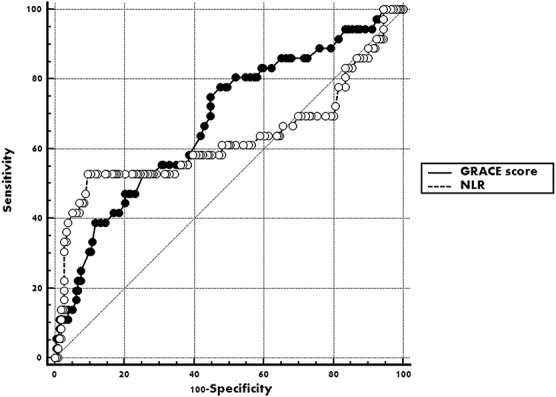
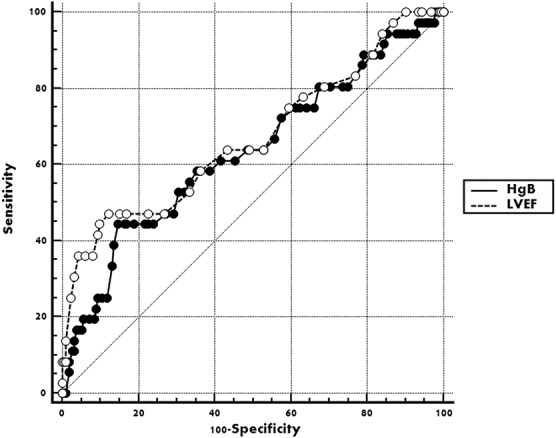
There were 36 patients (14.5%) who experienced MACEs in the follow-up period. Multivariate logistic regression analysis demonstrated that hemoglobin (HgB) (odds ratio = 0.972; 95% CI, 0.948-0.998; P = 0.033), neutrophil/lymphocyte ratio (NLR) (odds ratio = 1.511; 95% CI, 1.148-1.987; P = 0.003), Global Registry of Acute Coronary Event score, and postprocedure left ventricular ejection fraction (LVEF) were independent predictors of MACEs. Further subgroup analysis showed higher NLR (> 8.61), Global Registry of Acute Coronary Event score (> 167) and lower HgB (< 131 g/L) all show superior predictive value for patients with relatively higher LVEF (> 48%); moreover, the c-statistic of NLR and HgB both exceed 0.7. However, among patients with lower LVEF (≤ 48%), higher NLR and lower HgB lost the ability for predicting 1 year MACEs independently. In addition, abnormally higher NLR (> 8) could predict 1-month MACEs efficiently.
In summary, among STEMI patients, elevated NLR, decreased HgB level on admission both predicted 1-year MACEs independently, especially for those with relatively preserved LVEF (> 48%). Besides, abnormally higher NLR on admission should attract their attention for short-term MACEs.
探讨ST段抬高型心肌梗死(STEMI)患者直接经皮冠状动脉介入治疗后主要不良心血管事件(MACE)发生的预测因素。
纳入248例成功接受直接经皮冠状动脉介入治疗的STEMI患者(年龄61.4±10.8岁,男性186例)。对患者进行1年的随访。采用单因素分析、多因素分析和受试者工作特征曲线分析来确定预测MACE的因素。
随访期间有36例患者(14.5%)发生MACE。多因素logistic回归分析显示,血红蛋白(HgB)(比值比=0.972;95%可信区间,0.948 - 0.998;P = 0.033)、中性粒细胞/淋巴细胞比值(NLR)(比值比=1.511;95%可信区间,1.148 - 1.987;P = 0.003)、急性冠状动脉事件全球注册评分及术后左心室射血分数(LVEF)是MACE的独立预测因素。进一步亚组分析显示,较高的NLR(> 8.61)、急性冠状动脉事件全球注册评分(> 167)及较低的HgB(< 131 g/L)对LVEF相对较高(> 48%)的患者均显示出较好的预测价值;此外,NLR和HgB的c统计量均超过0.7。然而,在LVEF较低(≤ 48%)的患者中,较高的NLR和较低的HgB失去了独立预测1年MACE的能力。此外,异常升高的NLR(> 8)可有效预测1个月时的MACE。
综上所述,在STEMI患者中,NLR升高及入院时HgB水平降低均独立预测1年MACE,尤其是对于LVEF相对保留(> 48%)的患者。此外,入院时异常升高的NLR应引起对短期MACE的关注。