Liu Jun, Wang Cuimin, Fu Dongli, Hu Xiaoju, Xie Xiangmo, Liu Pengfei, Zhang Qiong, Li Meng-Hua
1] CAS Key Laboratory of Animal Ecology and Conservation Biology, Institute of Zoology, Chinese Academy of Sciences (CAS), Beijing 100101, China [2] Deep-Sea Research Department, Sanya Institute of Deep-Sea Science and Engineering, Chinese Academy of Sciences (CAS), Sanya 572000, China.
1] CAS Key Laboratory of Animal Ecology and Conservation Biology, Institute of Zoology, Chinese Academy of Sciences (CAS), Beijing 100101, China [2] College of Life Sciences, University of the Academy of Sciences, Beijing 100049, China.
Sci Rep. 2015 May 18;5:9857. doi: 10.1038/srep09857.
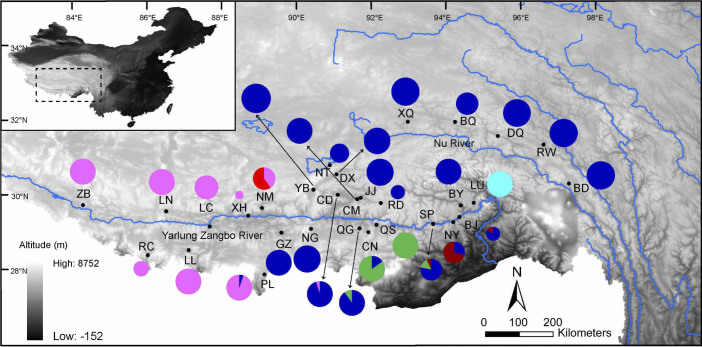
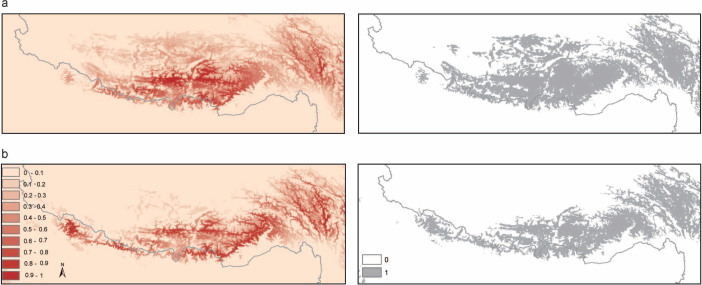
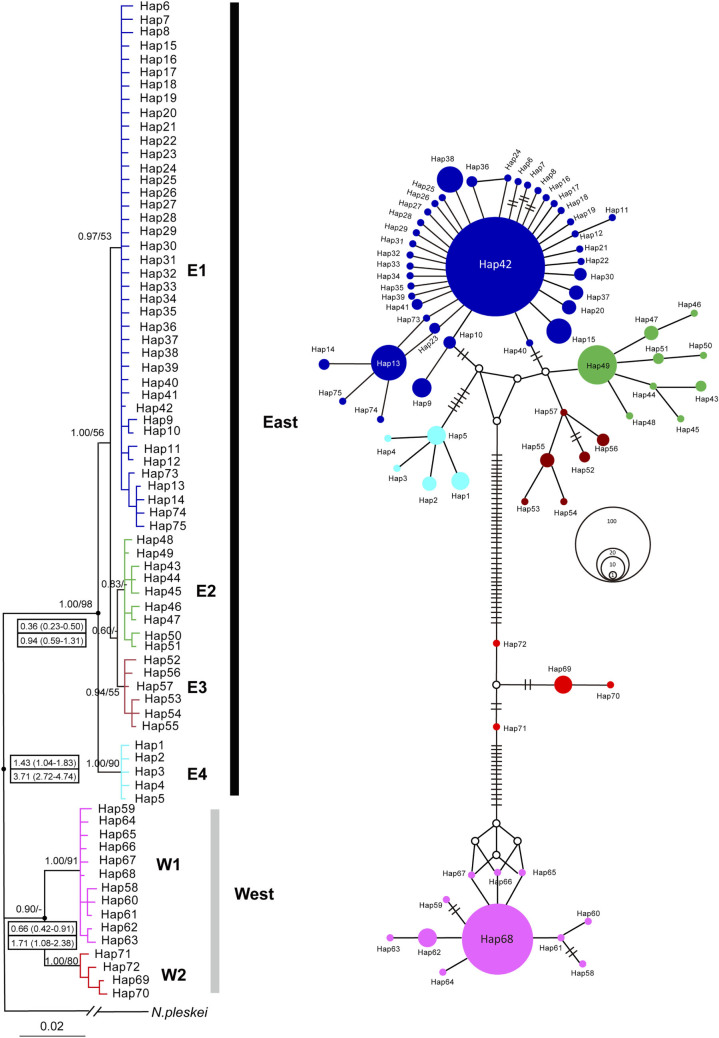
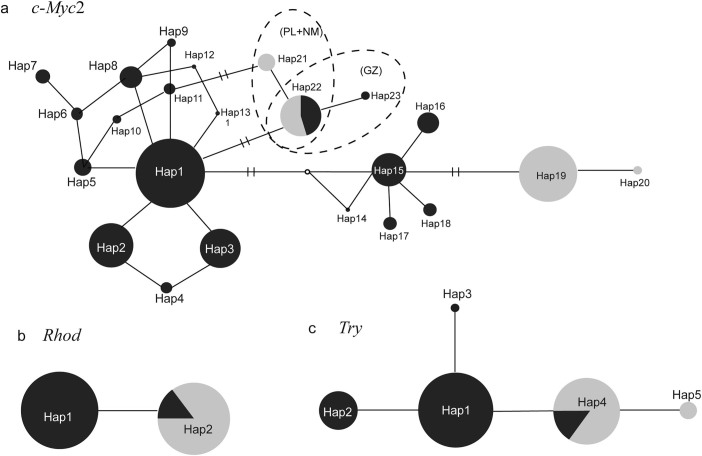
Quaternary climatic changes have been recognized to influence the distribution patterns and evolutionary histories of extant organisms, but their effects on alpine species are not well understood. To investigate the Pleistocene climatic oscillations on the genetic structure of amphibians, we sequenced one mitochondrial and three nuclear DNA fragments in Nanorana parkeri, a frog endemic to the Tibetan Plateau, across its distribution range in the southern plateau. Mitochondrial cytochrome b (Cytb) and three nuclear genes (c-Myc2, Rhod, and Tyr) revealed two distinct lineages (i.e. the lineages East and West), which were strongly geographically structured. The split of the two divergent lineages was dated back earlier than the Middle Pleistocene, probably being associated with climatic and ecological factors. Species distribution modeling, together with the phylogeographic structuring, supported the hypothesis of multiple refugia for N. parkeri on the Tibetan Plateau during the Pleistocene glaciations, and suggested the Yarlung Zangbo valley and the Kyichu catchment to be the potential refugia. Our findings indicate that Pleistocene climatic changes have had a great impact on the evolution and demographic history of N. parkeri. Our study has important implications for conservation of this and other frog species in the Tibetan Plateau.
第四纪气候变化已被认为会影响现存生物的分布格局和进化历史,但其对高山物种的影响尚不清楚。为了研究更新世气候振荡对两栖动物遗传结构的影响,我们对西藏高原特有的高山倭蛙(Nanorana parkeri)分布于高原南部的样本,测序了一个线粒体和三个核DNA片段。线粒体细胞色素b(Cytb)和三个核基因(c-Myc2、Rhod和Tyr)揭示了两个不同的谱系(即东部和西部谱系),它们具有很强的地理结构。这两个不同谱系的分化可追溯到早于中更新世,可能与气候和生态因素有关。物种分布模型与系统地理学结构一起,支持了更新世冰川期期间西藏高原上高山倭蛙存在多个避难所的假说,并表明雅鲁藏布江流域和基楚河流域是潜在的避难所。我们的研究结果表明,更新世气候变化对高山倭蛙的进化和种群历史产生了重大影响。我们的研究对保护西藏高原的这种及其他蛙类物种具有重要意义。