Park Joon Oh, Oh Do-Youn, Hsu Chiun, Chen Jen-Shi, Chen Li-Tzong, Orlando Mauro, Kim Jong Seok, Lim Ho Yeong
Department of Medicine, Samsung Medical Center, Sungkyunkwan University School of Medicine, Seoul, Korea.
Department of Internal Medicine, Seoul National University Hospital, Seoul, Korea.
Cancer Res Treat. 2015 Jul;47(3):343-61. doi: 10.4143/crt.2014.308. Epub 2015 May 18.
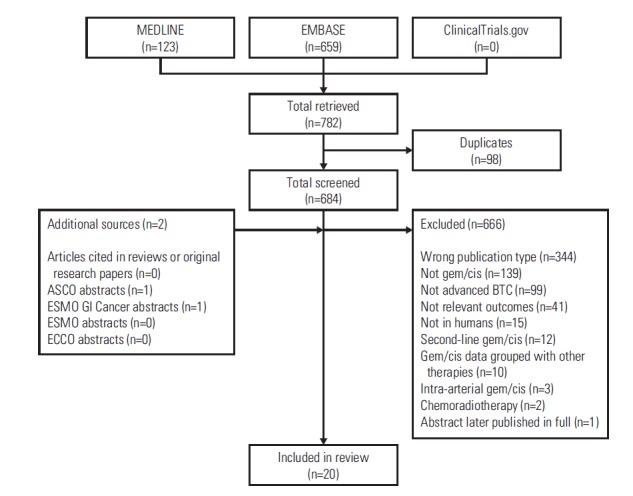
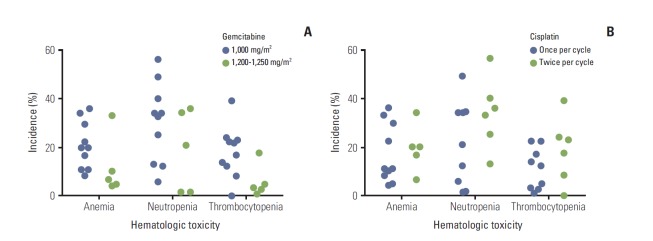
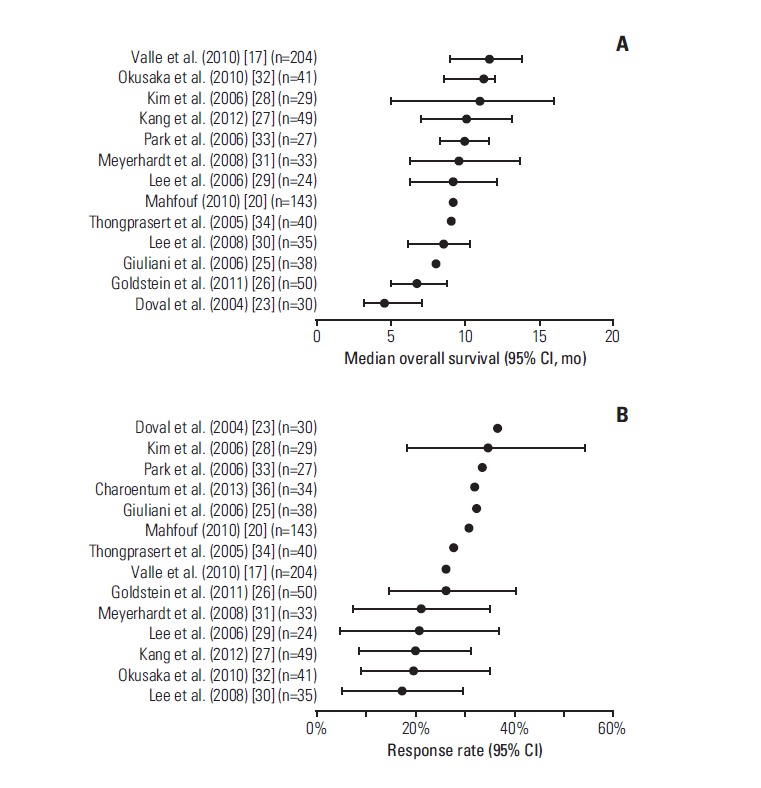
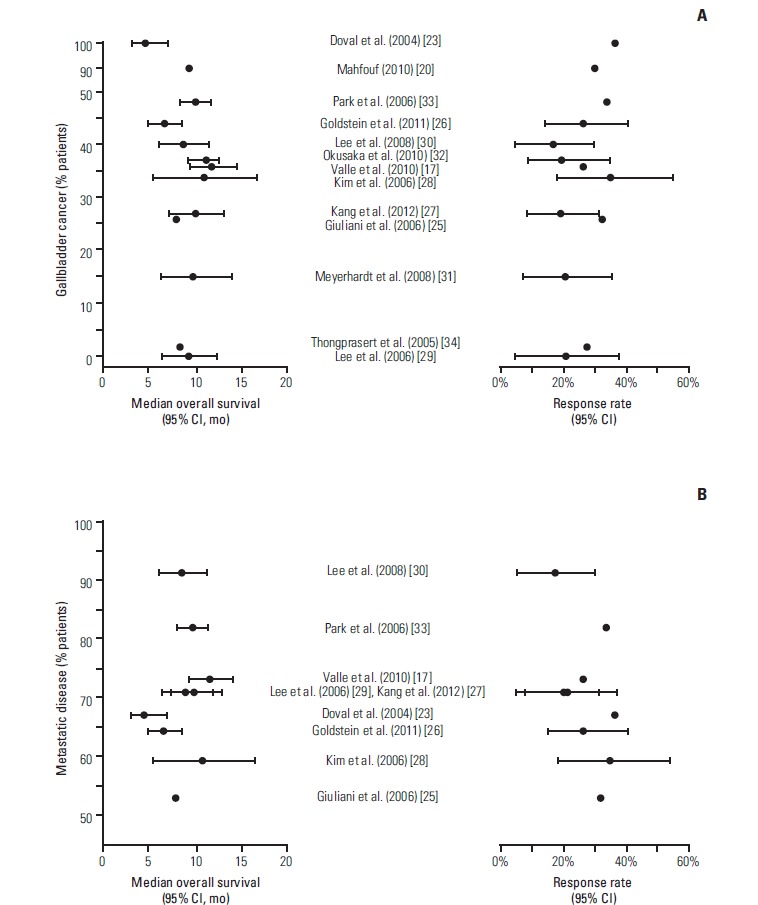
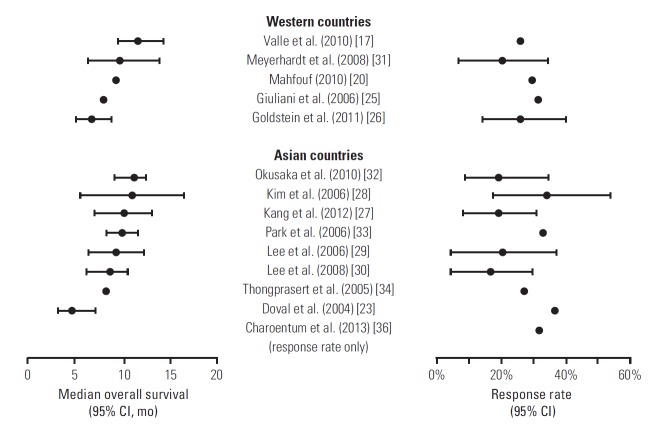
Evidence suggests that combined gemcitabine-cisplatin chemotherapy extends survival in patients with advanced biliary tract cancer (BTC). We conducted a systematic review in order to collate this evidence and assess whether gemcitabine-cisplatin efficacy is influenced by primary tumor site, disease stage, or geographic region, and whether associated toxicities are related to regimen. MEDLINE (1946-search date), EMBASE (1966-search date), ClinicalTrials. gov (2008-search date), and abstracts from major oncology conferences (2009- search date) were searched (5 Dec 2013) using terms for BTC, gemcitabine, and cisplatin. All study types reporting efficacy (survival, response rates) or safety (toxicities) outcomes of gemcitabine-cisplatin in BTC were eligible for inclusion; efficacy data were extracted from prospective studies only. Evidence retrieved from one meta-analysis (abstract), four randomized controlled trials, 12 nonrandomized prospective studies, and three retrospective studies supported the efficacy and safety of gemcitabine-cisplatin for BTC. Median overall survival ranged from 4.6 to 11.7 months, and response rate ranged from 17.1% to 36.6%. Toxicities were generally acceptable and manageable. Heterogeneity in study designs and data collected prevented formal meta-analysis, however exploratory assessments suggested that efficacy did not vary with primary tumor site (gallbladder vs. others), disease stage (metastatic vs. locally advanced), or geographic origin (Asia vs. other). Incidence of grade 3/4 toxicities was not related to gemcitabine dose or cisplatin frequency. Despite individual variation in study designs, the evidence presented suggests that gemcitabine-cisplatin is effective in patients from a diverse range of countries and with heterogeneous disease characteristics. No substantial differences in toxicity were observed among the different dosing schedules of gemcitabine and cisplatin.
有证据表明,吉西他滨联合顺铂化疗可延长晚期胆管癌(BTC)患者的生存期。我们进行了一项系统评价,以整理这些证据,并评估吉西他滨联合顺铂的疗效是否受原发肿瘤部位、疾病分期或地理区域的影响,以及相关毒性是否与治疗方案有关。使用BTC、吉西他滨和顺铂等检索词,检索了MEDLINE(1946年至检索日期)、EMBASE(1966年至检索日期)、ClinicalTrials.gov(2008年至检索日期)以及主要肿瘤学会议的摘要(2009年至检索日期)(2013年12月5日)。所有报告吉西他滨联合顺铂在BTC中的疗效(生存率、缓解率)或安全性(毒性)结果的研究类型均符合纳入标准;疗效数据仅从前瞻性研究中提取。从一项荟萃分析(摘要)、四项随机对照试验、十二项非随机前瞻性研究和三项回顾性研究中检索到的证据支持吉西他滨联合顺铂治疗BTC的疗效和安全性。中位总生存期为4.6至11.7个月,缓解率为17.1%至36.6%。毒性一般可接受且可控。研究设计和收集的数据的异质性妨碍了正式的荟萃分析,然而探索性评估表明,疗效并不随原发肿瘤部位(胆囊与其他部位)、疾病分期(转移性与局部晚期)或地理来源(亚洲与其他地区)而变化。3/4级毒性的发生率与吉西他滨剂量或顺铂频率无关。尽管研究设计存在个体差异,但所提供的证据表明,吉西他滨联合顺铂对来自不同国家且疾病特征各异的患者有效。在吉西他滨和顺铂的不同给药方案之间未观察到毒性的实质性差异。