Kroon Albert M, Taanman Jan-Willem
Department of Clinical Neurosciences, Institute of Neurology, University College London, London NW3 2PF, UK.
Int J Mol Sci. 2015 May 18;16(5):11178-95. doi: 10.3390/ijms160511178.
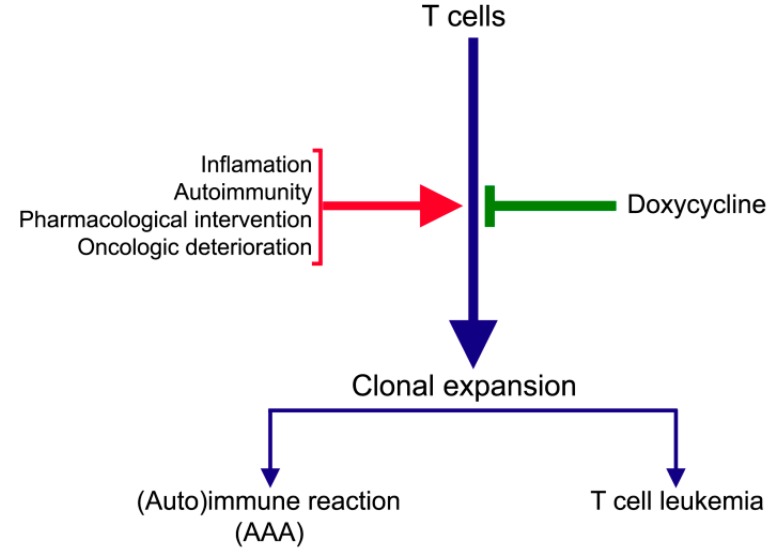
Most reported studies with animal models of abdominal aortic aneurysm (AAA) and several studies with patients have suggested that doxycycline favourably modifies AAA; however, a recent large long-term clinical trial found that doxycycline did not limit aneurysm growth. Thus, there is currently no convincing evidence that doxycycline reduces AAA expansion. Here, we critically review the available experimental and clinical information about the effects of doxycycline when used as a pharmacological treatment for AAA. The view that AAA can be considered an autoimmune disease and the observation that AAA tissue shows clonal expansion of T cells is placed in the light of the well-known inhibition of mitochondrial protein synthesis by doxycycline. In T cell leukaemia animal models, this inhibitory effect of the antibiotic has been shown to impede T cell proliferation, resulting in complete tumour eradication. We suggest that the available evidence of doxycycline action on AAA is erroneously ascribed to its inhibition of matrix metalloproteinases (MMPs) by competitive binding of the zinc ion co-factor. Although competitive binding may explain the inhibition of proteolytic activity, it does not explain the observed decreases of MMP mRNA levels. We propose that the observed effects of doxycycline are secondary to inhibition of mitochondrial protein synthesis. Provided that serum doxycycline levels are kept at adequate levels, the inhibition will result in a proliferation arrest, especially of clonally expanding T cells. This, in turn, leads to the decrease of proinflammatory cytokines that are normally generated by these cells. The drastic change in cell type composition may explain the changes in MMP mRNA and protein levels in the tissue samples.
大多数关于腹主动脉瘤(AAA)动物模型的报道研究以及一些针对患者的研究表明,强力霉素能对AAA产生有利的改善作用;然而,最近一项大型长期临床试验发现,强力霉素并不能限制动脉瘤的生长。因此,目前尚无令人信服的证据表明强力霉素能减少AAA的扩张。在此,我们严格审查了有关强力霉素作为AAA药物治疗效果的现有实验和临床信息。鉴于强力霉素对线粒体蛋白质合成的已知抑制作用,将AAA可被视为自身免疫性疾病的观点以及AAA组织显示T细胞克隆性扩增的观察结果进行了分析。在T细胞白血病动物模型中,已证明这种抗生素的抑制作用会阻碍T细胞增殖,从而导致肿瘤完全根除。我们认为,现有关于强力霉素对AAA作用的证据被错误地归因于其通过锌离子辅因子的竞争性结合来抑制基质金属蛋白酶(MMPs)。尽管竞争性结合可能解释了蛋白水解活性的抑制,但它并不能解释所观察到的MMP mRNA水平的降低。我们提出,所观察到的强力霉素的作用是线粒体蛋白质合成抑制的继发效应。只要血清强力霉素水平保持在适当水平,这种抑制将导致增殖停滞,尤其是克隆性扩增的T细胞。反过来,这会导致这些细胞通常产生的促炎细胞因子减少。细胞类型组成的剧烈变化可能解释了组织样本中MMP mRNA和蛋白质水平的变化。