Wang Jun, Lee I-Min, Tworoger Shelley S, Buring Julie E, Ridker Paul M, Rosner Bernard, Hankinson Susan E
Department of Biostatistics and Epidemiology, School of Public Health and Health Sciences, University of Massachusetts Amherst, Amherst, Massachusetts.
Division of Preventive Medicine, Department of Medicine, Brigham and Women's Hospital and Harvard Medical School, Boston, Massachusetts. Department of Epidemiology, Harvard School of Public Health, Boston, Massachusetts.
Cancer Epidemiol Biomarkers Prev. 2015 Aug;24(8):1199-206. doi: 10.1158/1055-9965.EPI-15-0187. Epub 2015 May 20.
C-reactive protein (CRP) has been evaluated as a risk factor for breast cancer in epidemiologic studies. However, results from prospective studies are inconsistent.
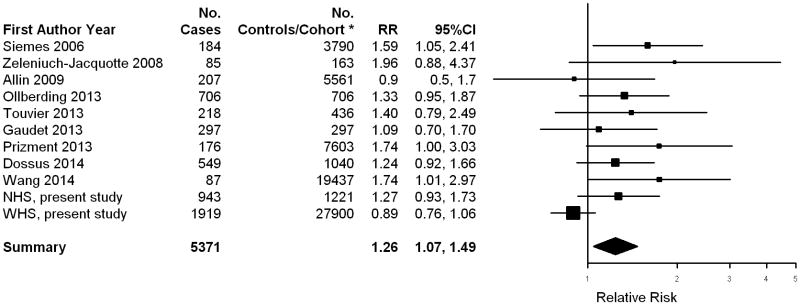
We evaluated the association using prediagnostic blood samples in a case-control study nested within the Nurses' Health Study (NHS) and the full cohort of the Women's Health Study (WHS). A total of 943 cases in the NHS and 1,919 cases in the WHS contributed to the analysis. Conditional logistic regression and Cox proportional hazards model were used in the NHS and WHS, respectively. We pooled our results with prior prospective studies using random effect meta-analysis.
In the NHS, higher CRP levels were associated with a suggestively increased risk of breast cancer [quintile 5 vs. 1: relative risk (RR), 1.27; 95% confidence interval (CI), 0.93-1.73; Ptrend = 0.02]; results did not vary significantly by tumor invasiveness or hormone receptor status. However, no association was observed in the WHS for overall risk (quintile 5 vs. 1: RR, 0.89; 95% CI, 0.76-1.06; Ptrend = 0.38) or by tumor invasiveness or hormone receptor status. The meta-analysis (including 5,371 cases from 11 studies) showed a modestly increased risk among women in the highest versus lowest categories of CRP (RR, 1.26; 95% CI, 1.07-1.49).
Existing data from prospective studies suggest that CRP, a nonspecific marker of inflammation, is modestly positively associated with breast cancer risk.
Our findings provide support to the concept that inflammation can influence breast cancer development.
在流行病学研究中,C反应蛋白(CRP)已被评估为乳腺癌的一个风险因素。然而,前瞻性研究的结果并不一致。
我们在护士健康研究(NHS)中的一项病例对照研究以及妇女健康研究(WHS)的全队列研究中,使用诊断前血样评估这种关联。NHS中有943例病例,WHS中有1919例病例纳入分析。NHS和WHS分别使用条件逻辑回归和Cox比例风险模型。我们使用随机效应荟萃分析将我们的结果与先前的前瞻性研究结果进行汇总。
在NHS中,较高的CRP水平与乳腺癌风险提示性增加相关[第5分位数与第1分位数:相对风险(RR),1.27;95%置信区间(CI),0.93 - 1.73;P趋势 = 0.02];结果在肿瘤侵袭性或激素受体状态方面没有显著差异。然而,在WHS中未观察到总体风险的关联(第5分位数与第1分位数:RR,0.89;95% CI,0.76 - 1.06;P趋势 = 0.38),在肿瘤侵袭性或激素受体状态方面也未观察到关联。荟萃分析(包括来自11项研究的5371例病例)显示,CRP最高类别与最低类别女性相比,风险适度增加(RR,1.26;95% CI,1.07 - 1.49)。
前瞻性研究的现有数据表明,CRP作为一种非特异性炎症标志物,与乳腺癌风险呈适度正相关。
我们的研究结果支持炎症可影响乳腺癌发展这一概念。