
一种新型血糖仪估算糖化血红蛋白(HbA1c)值方法的评估
Evaluation of a Methodology for Estimating HbA1c Value by a New Glucose Meter.
作者信息
Sieber Jochen, Flacke Frank, Dumais Bonnie, Peters Casey C, Mallery Erin B, Taylor Liz
机构信息
Sanofi-Aventis Deutschland GmbH, Global Diabetes Division, Frankfurt am Main, Germany
Sanofi-Aventis Deutschland GmbH, Global Diabetes Division, Frankfurt am Main, Germany.
出版信息
J Diabetes Sci Technol. 2015 May 22;10(1):67-71. doi: 10.1177/1932296815587323.
BACKGROUND
Accuracy/robustness of HbA1c estimation (eA1c) with an algorithm built into the MyStar Extra blood glucose (BG) meter has been demonstrated by in silico testing. We evaluated the performance and use of eA1c in a clinical setting.
METHODS
Subjects took the BG meter home for 4 months to obtain eA1c in this open-label, single-center study. Laboratory HbA1c values were obtained approximately every 2 weeks and the corresponding eA1c documented. Subjects completed a questionnaire at study end (NCT01885546).
RESULTS
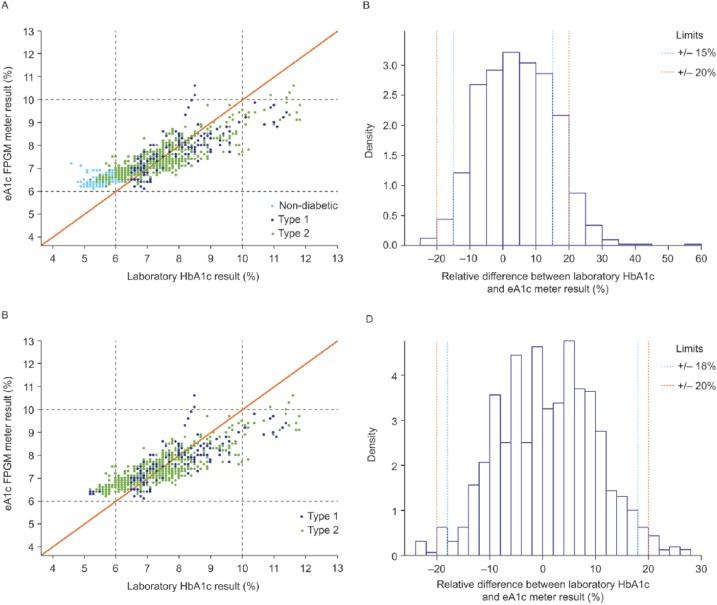
There were 133 enrolled subjects (mean [SD] age 60.0 [15.0] years, 69 males, 104 with diabetes, HbA1c 7.0% [1.4]). A total of 1008 pairs of eA1c and laboratory HbA1c values were available. In subjects with diabetes, 97.5% of the eA1c results fell within ± 20% of the laboratory HbA1c, 95.0% within ± 18%, and 90.7% within ± 15%. When results were limited to the reportable HbA1c range of ≥ 6 to ≤ 10%, 99.3% of eA1c values fell within ± 20% of the laboratory HbA1c, 98.5% within ± 18%, and 96.2% within ± 15% Most subjects agreed/strongly agreed that the eA1c section in the user guide and flash cards was easy to follow (72%), they would use the system to track their eA1c (70%), they found the eA1c tool helpful (79%), and the tool may motivate them to manage their diabetes better (83%).
CONCLUSIONS
Accuracy of the eA1c feature in this clinical setting was similar to the performance in silico. The majority of subjects found this tool helpful and agreed it may motivate to manage their diabetes better.
背景
通过计算机模拟测试已证明,MyStar Extra血糖仪内置算法估算糖化血红蛋白(eA1c)的准确性/稳健性。我们在临床环境中评估了eA1c的性能及应用。
方法
在这项开放标签、单中心研究中,受试者将血糖仪带回家4个月以获取eA1c。大约每2周获取一次实验室糖化血红蛋白值,并记录相应的eA1c。受试者在研究结束时完成一份问卷(NCT01885546)。
结果
共有133名受试者入组(平均[标准差]年龄60.0[15.0]岁,男性69名,糖尿病患者104名,糖化血红蛋白7.0%[1.4])。总共获得了1008对eA1c和实验室糖化血红蛋白值。在糖尿病患者中,97.5%的eA1c结果落在实验室糖化血红蛋白值的±20%范围内,95.0%落在±18%范围内,90.7%落在±15%范围内。当结果限于可报告的糖化血红蛋白范围≥6%至≤10%时,99.3%的eA1c值落在实验室糖化血红蛋白值的±20%范围内,98.5%落在±18%范围内,96.2%落在±15%范围内。大多数受试者同意/强烈同意用户指南和闪存卡中的eA1c部分易于理解(72%),他们会使用该系统来跟踪自己的eA1c(70%),他们发现eA1c工具很有帮助(79%),并且该工具可能会激励他们更好地管理糖尿病(83%)。
结论
在这种临床环境中,eA1c功能的准确性与计算机模拟测试中的性能相似。大多数受试者认为该工具很有帮助,并同意它可能会激励他们更好地管理糖尿病。

 Zotero 插件