Yıldırım Işıl, Özer Sema, Karagöz Tevfik, Şahin Murat, Özkutlu Süheyla, Alehan Dursun, Çeliker Alpay
Department of Pediatric Cardiology, Adana Numune Teaching and Research Hospital; Adana-Turkey.
Anatol J Cardiol. 2015 Jun;15(6):485-90. doi: 10.5152/akd.2014.5462. Epub 2014 Jun 23.
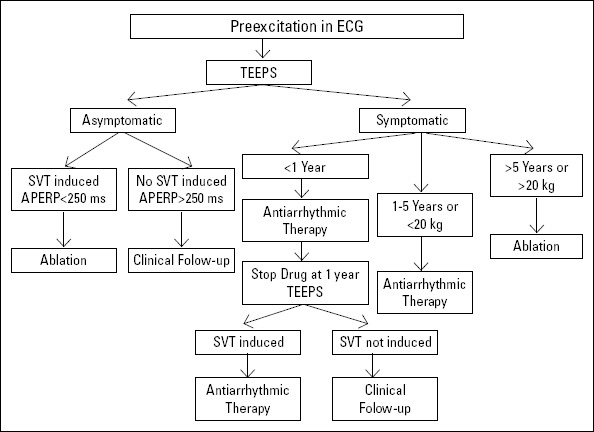
Wolff-Parkinson-White (WPW) syndrome presents with paroxysmal supraventricular tachycardia and is characterized by electrocardiographic (ECG) findings of a short PR interval and a delta wave. The objective of this study was to evaluate the electrophysiological properties of children with WPW syndrome and to develop an algorithm for the management of these patients with limited access to electrophysiological study.
A retrospective review of all pediatric patients who underwent electrophysiological evaluation for WPW syndrome was performed.
One hundred nine patients underwent electrophysiological evaluation at a single tertiary center between 1997 and 2011. The median age of the patients was 11 years (0.1-18). Of the 109 patients, 82 presented with tachycardia (median age 11 (0.1-18) years), and 14 presented with syncope (median age 12 (6-16) years); 13 were asymptomatic (median age 10 (2-13) years). Induced AF degenerated to ventricular fibrillation (VF) in 2 patients. Of the 2 patients with VF, 1 was asymptomatic and the other had syncope; the accessory pathway effective refractory period was ≤180 ms in both. An intracardiac electrophysiological study was performed in 92 patients, and ablation was not attempted for risk of atrioventricular block in 8 (8.6%). The success and recurrence rate of ablation were 90.5% and 23.8% respectively.
The induction of VF in 2 of 109 patients in our study suggests that the prognosis of WPW in children is not as benign as once thought. All patients with a WPW pattern on the ECG should be assessed electrophysiologically and risk-stratified. Ablation of patients with risk factors can prevent sudden death in this population.
预激综合征(WPW)表现为阵发性室上性心动过速,其特征为心电图(ECG)显示PR间期缩短和δ波。本研究的目的是评估WPW综合征患儿的电生理特性,并制定一种算法来管理这些难以进行电生理研究的患者。
对所有接受WPW综合征电生理评估的儿科患者进行回顾性研究。
1997年至2011年间,109例患者在单一三级中心接受了电生理评估。患者的中位年龄为11岁(0.1 - 18岁)。在这109例患者中,82例表现为心动过速(中位年龄11岁(0.1 - 18岁)),14例表现为晕厥(中位年龄12岁(6 - 16岁));13例无症状(中位年龄10岁(2 - 13岁))。2例患者诱发的房颤恶化为室颤(VF)。在这2例室颤患者中,1例无症状,另1例有晕厥;两者的旁道有效不应期均≤180 ms。92例患者进行了心内电生理研究,8例(8.6%)因存在房室传导阻滞风险未尝试进行消融。消融的成功率和复发率分别为90.5%和23.8%。
我们研究中的109例患者中有2例诱发了室颤,这表明儿童WPW的预后并不像曾经认为的那么良好。所有心电图显示WPW图形的患者都应进行电生理评估并进行危险分层。对有危险因素的患者进行消融可预防该人群的猝死。