Spangler Derek P, Bell Martha Ann, Deater-Deckard Kirby
Department of Psychology, Virginia Tech, Blacksburg, Virginia, USA.
Psychophysiology. 2015 Sep;52(9):1175-85. doi: 10.1111/psyp.12451. Epub 2015 May 28.
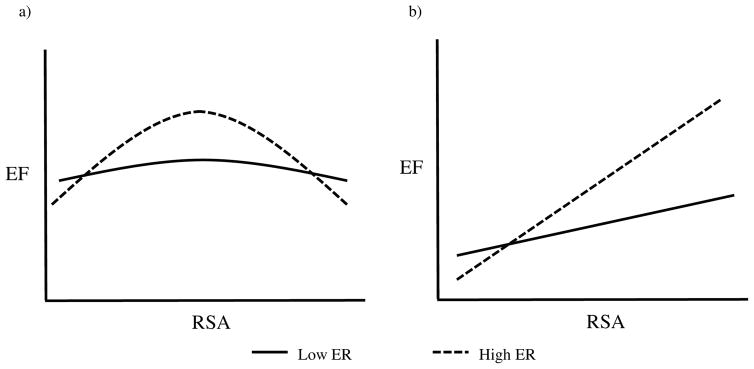
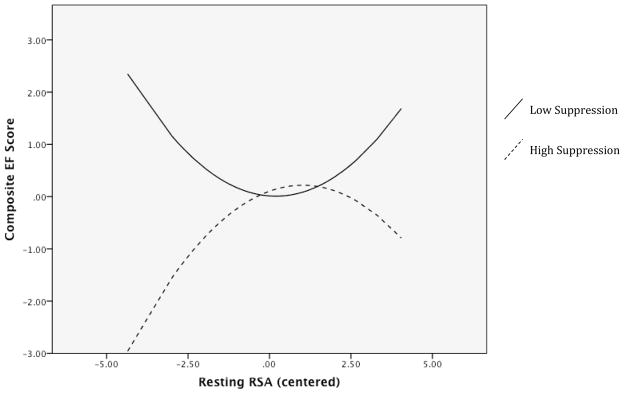
There is uncertainty about whether respiratory sinus arrhythmia (RSA), a cardiac marker of adaptive emotion regulation, is involved in relatively low or high executive function performance. In the present study, we investigated (a) whether RSA during rest and tasks predict both relatively low and high executive function within a larger quadratic association among the two variables, and (b) the extent to which this quadratic trend was moderated by individual differences in emotion regulation. To achieve these aims, a sample of ethnically and socioeconomically diverse women self-reported reappraisal and emotion suppression. They next experienced a 2-min resting period during which electrocardiogram (ECG) was continually assessed. In the next phase, the women completed an array of executive function and nonexecutive cognitive tasks while ECG was measured throughout. As anticipated, resting RSA showed a quadratic association with executive function that was strongest for high suppression. These results suggest that relatively high resting RSA may predict poor executive function ability when emotion regulation consumes executive control resources needed for ongoing cognitive performance.
作为适应性情绪调节的心脏标志物,呼吸性窦性心律不齐(RSA)是否与相对较低或较高的执行功能表现有关,目前尚不确定。在本研究中,我们调查了:(a)在休息和任务期间的RSA是否能在两个变量之间更大的二次关联中预测相对较低和较高的执行功能;以及(b)这种二次趋势在多大程度上受到情绪调节个体差异的调节。为实现这些目标,一个由不同种族和社会经济背景的女性组成的样本自我报告了重新评价和情绪抑制情况。接下来,她们经历了一个2分钟的休息期,在此期间持续评估心电图(ECG)。在下一阶段,这些女性完成了一系列执行功能和非执行认知任务,同时全程测量ECG。正如预期的那样,静息RSA与执行功能呈二次关联,在高抑制情况下最为明显。这些结果表明,当情绪调节消耗了持续认知表现所需的执行控制资源时,相对较高的静息RSA可能预示着执行功能能力较差。