Zhang Yuguang, Cong Jing, Lu Hui, Li Guangliang, Xue Yadong, Deng Ye, Li Hui, Zhou Jizhong, Li Diqiang
Institute of Forestry Ecology, Environment and Protection, Key Laboratory of Forest Ecology and Environment of State Forestry Administration, The Chinese Academy of Forestry, Beijing, 100091, China.
School of Mineral Processing and Bioengineering, Central South University, Changsha, 410083, China.
Microb Biotechnol. 2015 Jul;8(4):739-46. doi: 10.1111/1751-7915.12288. Epub 2015 May 29.
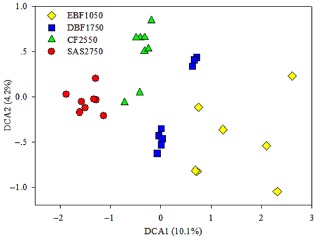
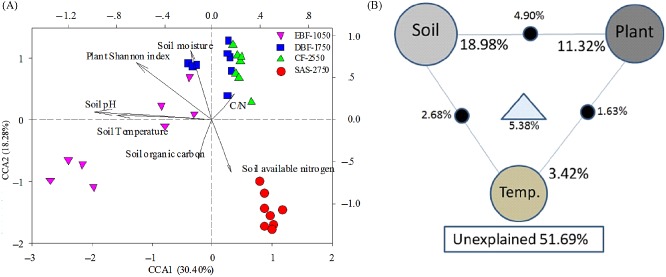
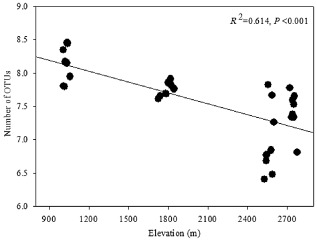
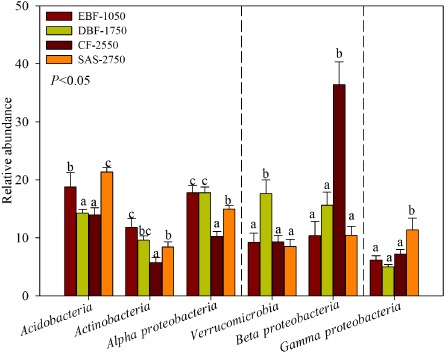
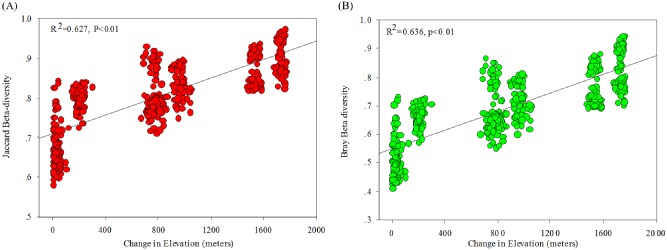
Understanding biological diversity elevational pattern and the driver factors are indispensable to develop the ecological theories. Elevational gradient may minimize the impact of environmental factors and is the ideal places to study soil microbial elevational patterns. In this study, we selected four typical vegetation types from 1000 to 2800 m above the sea level on the northern slope of Shennongjia Mountain in central China, and analysed the soil bacterial community composition, elevational patterns and the relationship between soil bacterial diversity and environmental factors by using the 16S rRNA Illumina sequencing and multivariate statistical analysis. The results revealed that the dominant bacterial phyla were Acidobacteria, Actinobacteria, Alphaproteobacteria, Betaproteobacteria, Gammaproteobacteria and Verrucomicrobia, which accounted for over 75% of the bacterial sequences obtained from tested samples, and the soil bacterial operational taxonomic unit (OTU) richness was a significant monotonous decreasing (P < 0.01) trend with the elevational increasing. The similarity of soil bacterial population composition decreased significantly (P < 0.01) with elevational distance increased as measured by the Jaccard and Bray-Curtis index. Canonical correspondence analysis and Mantel test analysis indicated that plant diversity and soil pH were significantly correlated (P < 0.01) with the soil bacterial community. Therefore, the soil bacterial diversity on Shennongjia Mountain had a significant and different elevational pattern, and plant diversity and soil pH may be the key factors in shaping the soil bacterial spatial pattern.
了解生物多样性的海拔格局及其驱动因素对于发展生态学理论不可或缺。海拔梯度可以最大限度地减少环境因素的影响,是研究土壤微生物海拔格局的理想场所。在本研究中,我们在中国中部神农架山北坡海拔1000至2800米处选取了四种典型植被类型,采用16S rRNA Illumina测序和多元统计分析方法,分析了土壤细菌群落组成、海拔格局以及土壤细菌多样性与环境因素之间的关系。结果表明,优势细菌门类为酸杆菌门、放线菌门、α-变形菌纲、β-变形菌纲、γ-变形菌纲和疣微菌门,它们占测试样本中获得的细菌序列的75%以上,且土壤细菌操作分类单元(OTU)丰富度随海拔升高呈显著单调下降趋势(P < 0.01)。用Jaccard和Bray-Curtis指数衡量,随着海拔距离增加,土壤细菌种群组成的相似度显著降低(P < 0.01)。典范对应分析和Mantel检验分析表明,植物多样性和土壤pH与土壤细菌群落显著相关(P < 0.01)。因此,神农架山的土壤细菌多样性具有显著且不同的海拔格局,植物多样性和土壤pH可能是塑造土壤细菌空间格局的关键因素。