Garza Jennifer L, Cavallari Jennifer M, Wakai Sara, Schenck Paula, Simcox Nancy, Morse Tim, Meyer John D, Cherniack Martin
Division of Occupational and Environmental Medicine, UConn Health, Farmington, Connecticut.
Department of Community Medicine and Health Care, Farmington, Connecticut.
Am J Ind Med. 2015 Sep;58(9):988-95. doi: 10.1002/ajim.22484. Epub 2015 Jun 4.
We investigated the associations between traditional and environmentally preferable cleaning product exposure and dermal, respiratory, and musculoskeletal symptoms in a population of custodians.
We analyzed associations between symptoms and exposure to traditional and environmentally preferable cleaning product exposure among 329 custodians.
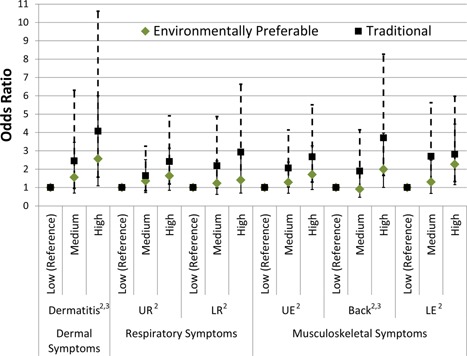
We observed increased odds of dermal (P < 0.01), upper (P = 0.01) and lower respiratory (P = 0.01), and upper extremity (P < 0.01), back (P < 0.01), and lower extremity (P = 0.01) musculoskeletal symptoms associated with increased typical traditional cleaning product exposure. We observed significant trends for increased odds of dermal (P = 0.03) and back (P = 0.04) and lower (P = 0.02) extremity musculoskeletal symptoms associated with increased typical environmentally preferable cleaning product exposure.
Fewer positive associations and reduced odds of health symptoms associated with environmentally preferable cleaning product exposure suggest that these products may represent a safer alternative to traditional cleaning products.
我们调查了一群 custodians 使用传统清洁产品和环保清洁产品与皮肤、呼吸和肌肉骨骼症状之间的关联。
我们分析了 329 名 custodians 的症状与使用传统清洁产品和环保清洁产品之间的关联。
我们观察到,随着典型传统清洁产品使用量增加,皮肤症状(P < 0.01)、上呼吸道症状(P = 0.01)、下呼吸道症状(P = 0.01)、上肢肌肉骨骼症状(P < 0.01)、背部肌肉骨骼症状(P < 0.01)和下肢肌肉骨骼症状(P = 0.01)的患病几率增加。我们观察到,随着典型环保清洁产品使用量增加,皮肤症状(P = 0.03)、背部肌肉骨骼症状(P = 0.04)和下肢肌肉骨骼症状(P = 0.02)的患病几率增加,且呈显著趋势。
与使用环保清洁产品相关的阳性关联较少,健康症状的患病几率降低,这表明这些产品可能是传统清洁产品的更安全替代品。