Llanos Paola, Contreras-Ferrat Ariel, Barrientos Genaro, Valencia Marco, Mears David, Hidalgo Cecilia
Institute for Research in Dental Sciences, Facultad de Odontología, Universidad de Chile, Santiago, Chile; Center of Molecular Studies of the Cell, Facultad de Medicina, Universidad de Chile, Santiago, Chile.
Physiology and Biophysics Program, Facultad de Medicina, Universidad de Chile, Santiago, Chile.
PLoS One. 2015 Jun 5;10(6):e0129238. doi: 10.1371/journal.pone.0129238. eCollection 2015.
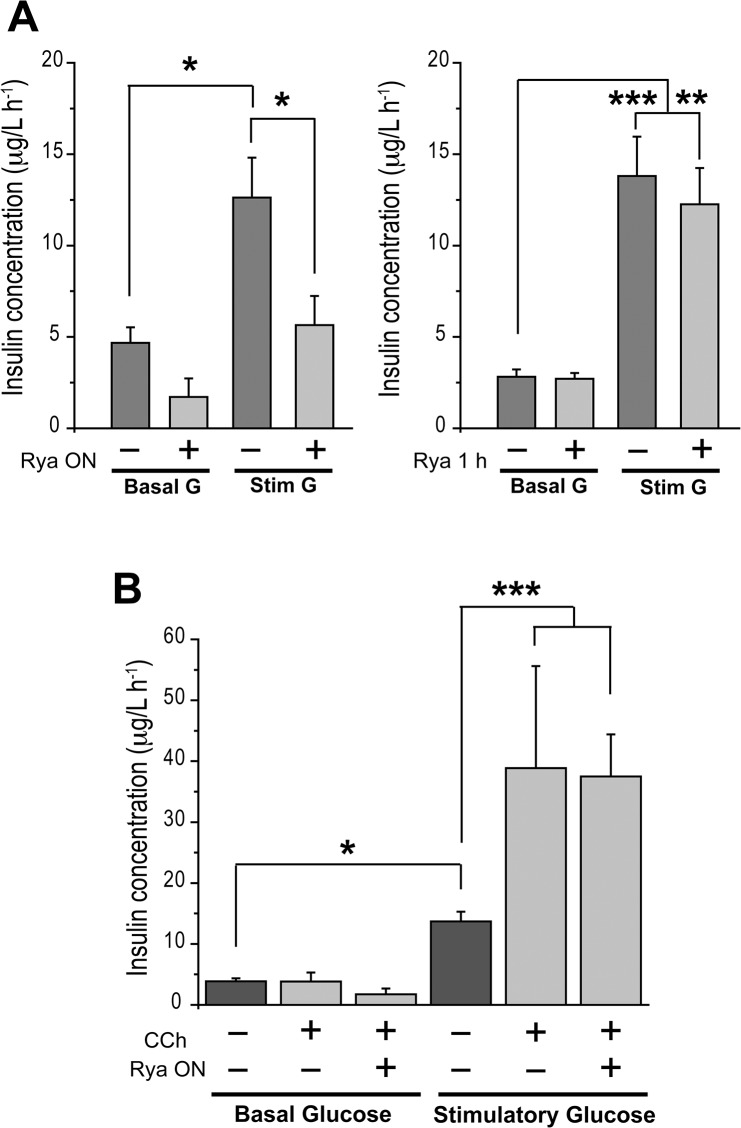
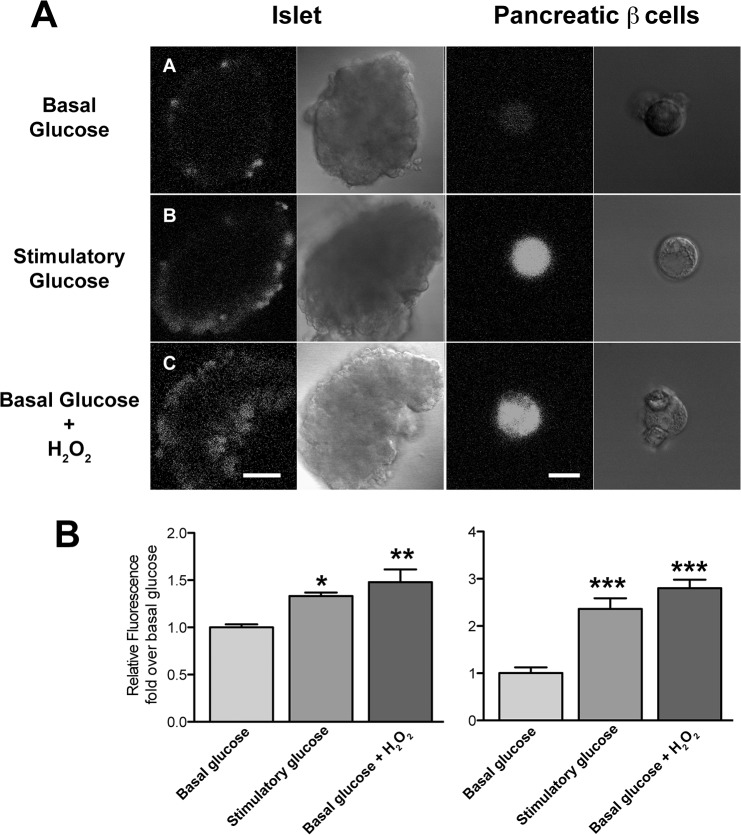
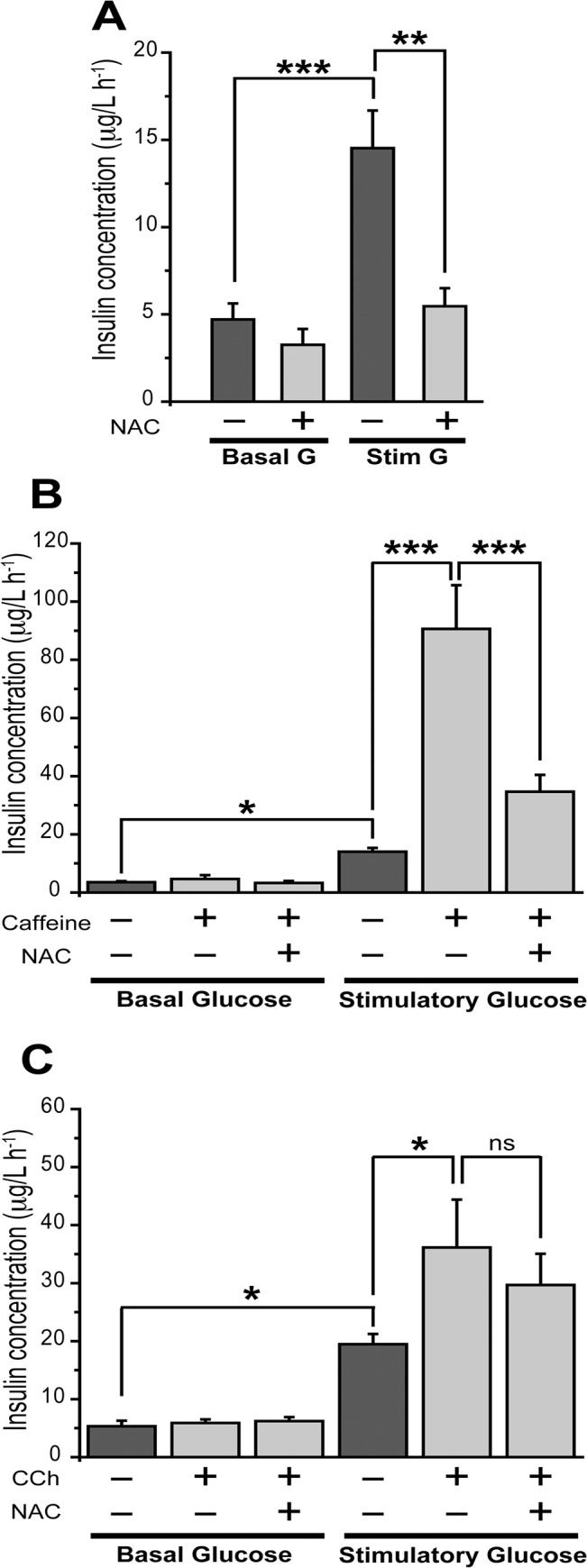
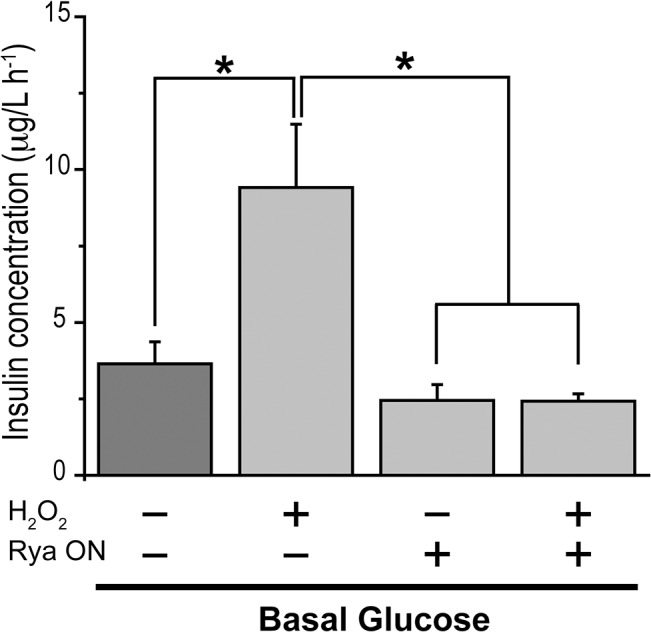
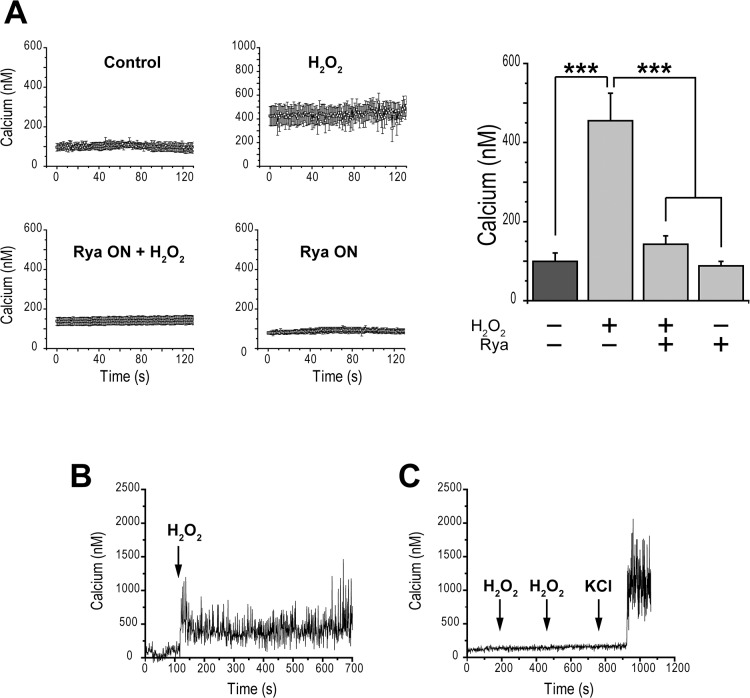
Glucose-stimulated insulin secretion (GSIS) from pancreatic β-cells requires an increase in intracellular free Ca2+ concentration ([Ca2+]). Glucose uptake into β-cells promotes Ca2+ influx and reactive oxygen species (ROS) generation. In other cell types, Ca2+ and ROS jointly induce Ca2+ release mediated by ryanodine receptor (RyR) channels. Therefore, we explored here if RyR-mediated Ca2+ release contributes to GSIS in β-cell islets isolated from male rats. Stimulatory glucose increased islet insulin secretion, and promoted ROS generation in islets and dissociated β-cells. Conventional PCR assays and immunostaining confirmed that β-cells express RyR2, the cardiac RyR isoform. Extended incubation of β-cell islets with inhibitory ryanodine suppressed GSIS; so did the antioxidant N-acetyl cysteine (NAC), which also decreased insulin secretion induced by glucose plus caffeine. Inhibitory ryanodine or NAC did not affect insulin secretion induced by glucose plus carbachol, which engages inositol 1,4,5-trisphosphate receptors. Incubation of islets with H2O2 in basal glucose increased insulin secretion 2-fold. Inhibitory ryanodine significantly decreased H2O2-stimulated insulin secretion and prevented the 4.5-fold increase of cytoplasmic [Ca2+] produced by incubation of dissociated β-cells with H2O2. Addition of stimulatory glucose or H2O2 (in basal glucose) to β-cells disaggregated from islets increased RyR2 S-glutathionylation to similar levels, measured by a proximity ligation assay; in contrast, NAC significantly reduced the RyR2 S-glutathionylation increase produced by stimulatory glucose. We propose that RyR2-mediated Ca2+ release, induced by the concomitant increases in [Ca2+] and ROS produced by stimulatory glucose, is an essential step in GSIS.
胰腺β细胞的葡萄糖刺激胰岛素分泌(GSIS)需要细胞内游离Ca2+浓度([Ca2+])升高。葡萄糖进入β细胞促进Ca2+内流和活性氧(ROS)生成。在其他细胞类型中,Ca2+和ROS共同诱导由兰尼碱受体(RyR)通道介导的Ca2+释放。因此,我们在此探究RyR介导的Ca2+释放是否有助于雄性大鼠分离的胰岛β细胞中的GSIS。刺激性葡萄糖增加了胰岛胰岛素分泌,并促进了胰岛和分离的β细胞中的ROS生成。传统PCR检测和免疫染色证实β细胞表达RyR2,即心脏RyR亚型。用抑制性兰尼碱长时间孵育β细胞胰岛可抑制GSIS;抗氧化剂N-乙酰半胱氨酸(NAC)也有此作用,它还降低了葡萄糖加咖啡因诱导的胰岛素分泌。抑制性兰尼碱或NAC不影响葡萄糖加卡巴胆碱诱导的胰岛素分泌,卡巴胆碱作用于肌醇1,4,5-三磷酸受体。在基础葡萄糖条件下用H2O2孵育胰岛可使胰岛素分泌增加2倍。抑制性兰尼碱显著降低H2O2刺激的胰岛素分泌,并阻止了分离的β细胞与H2O2孵育所产生的细胞质[Ca2+] 4.5倍的增加。向从胰岛中解离的β细胞中添加刺激性葡萄糖或H2O2(在基础葡萄糖条件下)可使RyR2 S-谷胱甘肽化增加到相似水平,这是通过邻近连接分析测定的;相比之下,NAC显著降低了刺激性葡萄糖产生的RyR2 S-谷胱甘肽化增加。我们提出,由刺激性葡萄糖产生的[Ca2+]和ROS同时增加所诱导的RyR2介导的Ca2+释放是GSIS中的一个关键步骤。