
利用遗传条码测序筛选慢病毒转导的造血干细胞改变的群体动力学。
Genetic barcode sequencing for screening altered population dynamics of hematopoietic stem cells transduced with lentivirus.
机构信息
Center for Translational Investigation in Oncology/LIM 24, Cancer Institute of Sao Paulo, School of Medicine, University of Sao Paulo , Sao Paulo, Brazil.
Department of Clinical and Toxicologic Analyses, School of Pharmaceutical Sciences, University of Sao Paulo , Sao Paulo, Brazil.
出版信息
Mol Ther Methods Clin Dev. 2014 Nov 19;1:14052. doi: 10.1038/mtm.2014.52. eCollection 2014.
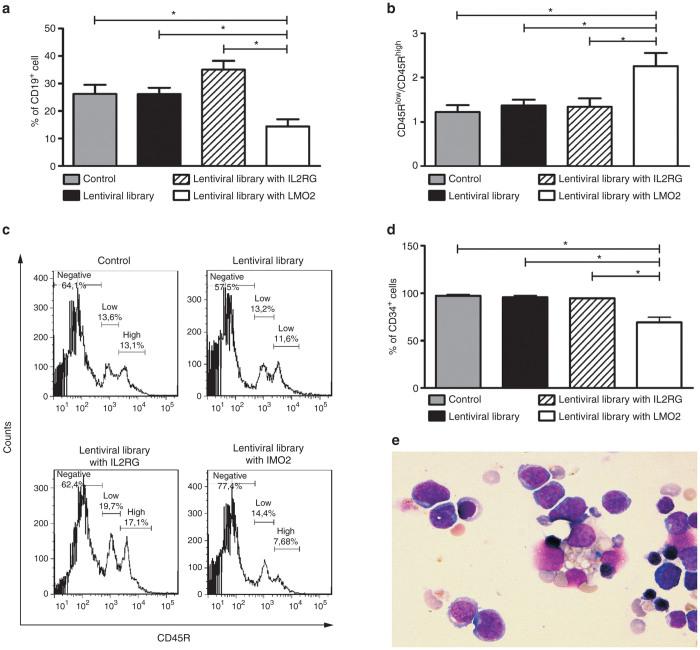
Insertional mutagenesis has been associated with malignant cell transformation in gene therapy protocols, leading to discussions about vector security. Therefore, clonal analysis is important for the assessment of vector safety and its impact on patient health. Here, we report a unique approach to assess dynamic changes in clonality of lentivirus transduced cells upon Sanger sequence analysis of a specially designed genetic barcode. In our approach, changes in the electropherogram peaks are measured and compared between successive time points, revealing alteration in the cell population. After in vitro validation, barcoded lentiviral libraries carrying IL2RG or LMO2 transgenes, or empty vector were used to transduce mouse hematopoietic (ckit+) stem cells, which were subsequently transplanted in recipient mice. We found that neither the empty nor IL2RG encoding vector had an effect on cell dynamics. In sharp contrast, the LMO2 oncogene was associated with altered cell dynamics even though hematologic counts remained unchanged, suggesting that the barcode could reveal changes in cell populations not observed by the frontline clinical assay. We describe a simple and sensitive method for the analysis of clonality, which could be easily used by any laboratory for the assessment of cellular behavior upon lentiviral transduction.
插入诱变与基因治疗方案中的恶性细胞转化有关,这引发了对载体安全性的讨论。因此,克隆分析对于评估载体安全性及其对患者健康的影响非常重要。在这里,我们报告了一种独特的方法,通过对专门设计的遗传条码进行桑格测序来评估慢病毒转导细胞的克隆性动态变化。在我们的方法中,通过测量和比较连续时间点的电泳峰变化来检测细胞群体的变化。在体外验证后,携带 IL2RG 或 LMO2 转基因或空载体的条形码慢病毒文库被用于转导小鼠造血(ckit+)干细胞,随后将其移植到受体小鼠中。我们发现,空载体或编码 IL2RG 的载体均未对细胞动力学产生影响。相比之下,LMO2 癌基因与改变的细胞动力学相关,尽管血液学计数保持不变,这表明条码可以揭示临床一线检测未观察到的细胞群体变化。我们描述了一种简单而敏感的克隆性分析方法,任何实验室都可以轻松用于评估慢病毒转导后细胞的行为。


 Zotero 插件