Yang Shan, Kawamura Kiyoko, Okamoto Shinya, Yamauchi Suguru, Shingyoji Masato, Sekine Ikuo, Kobayashi Hiroshi, Tada Yuji, Tatsumi Koichiro, Hiroshima Kenzo, Shimada Hideaki, Tagawa Masatoshi
Division of Pathology and Cell Therapy, Chiba Cancer Center Research Institute, 666-2 Nitona, Chuo-ku, 260-8717, Chiba, Japan.
Department of Molecular Biology and Oncology, Graduate School of Medicine, Chiba University, Chiba, Japan.
BMC Cancer. 2015 Jun 10;15:464. doi: 10.1186/s12885-015-1482-8.
Improvement of transduction and augmentation of cytotoxicity are crucial for adenoviruses (Ad)-mediated gene therapy for cancer. Down-regulated expression of type 5 Ad (Ad5) receptors on human tumors hampered Ad-mediated transduction. Furthermore, a role of the p53 pathways in cytotoxicity mediated by replication-competent Ad remained uncharacterized.
We constructed replication-competent Ad5 of which the E1 region genes were activated by a transcriptional regulatory region of the midkine or the survivin gene, which is expressed preferentially in human tumors. We also prepared replication-competent Ad5 which were regulated by the same region but had a fiber-knob region derived from serotype 35 (AdF35). We examined the cytotoxicity of these Ad and a possible combinatory use of the replication-competent AdF35 and Ad5 expressing the wild-type p53 gene (Ad5/p53) in esophageal carcinoma cells. Expression levels of molecules involved in cell death, anti-tumor effects in vivo and production of viral progenies were also investigated.
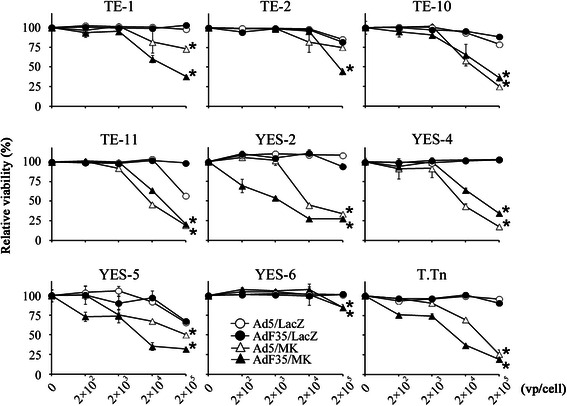
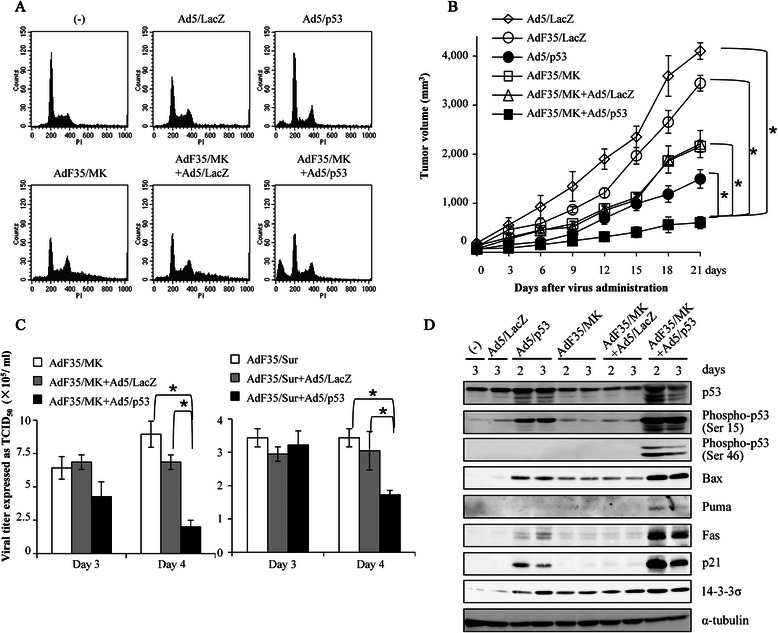
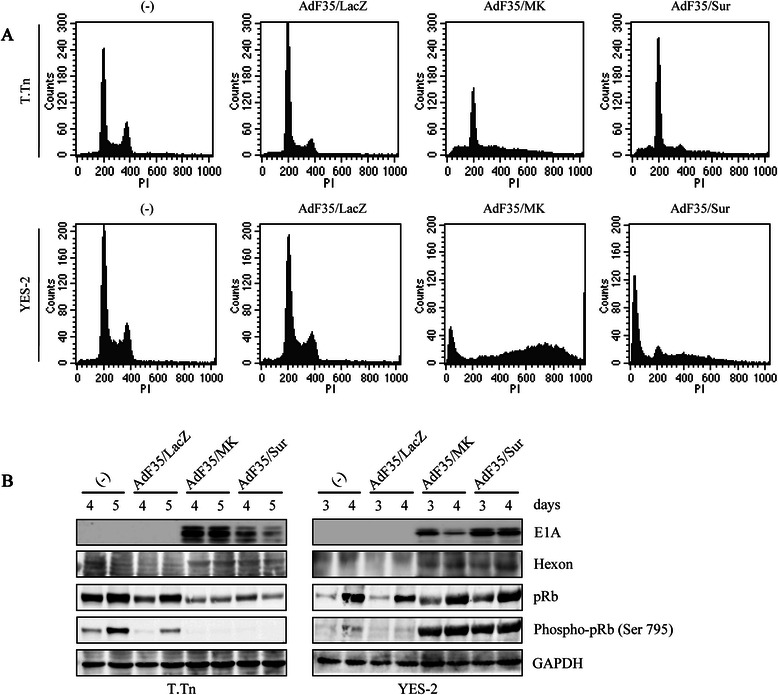
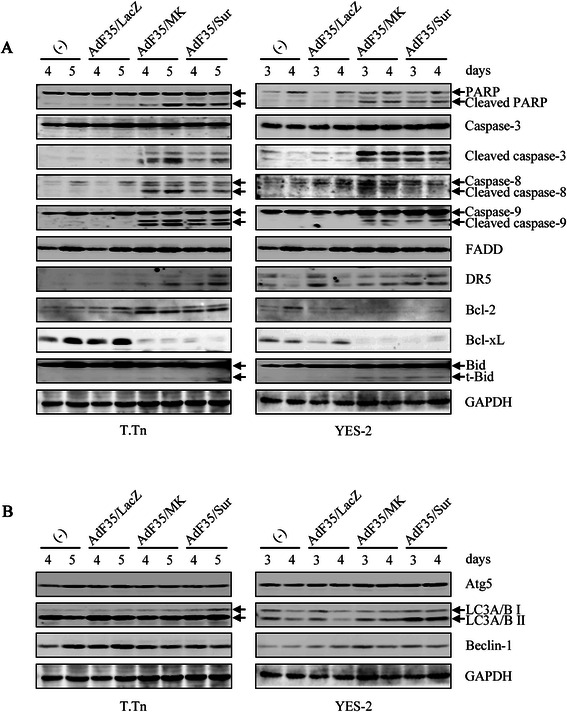
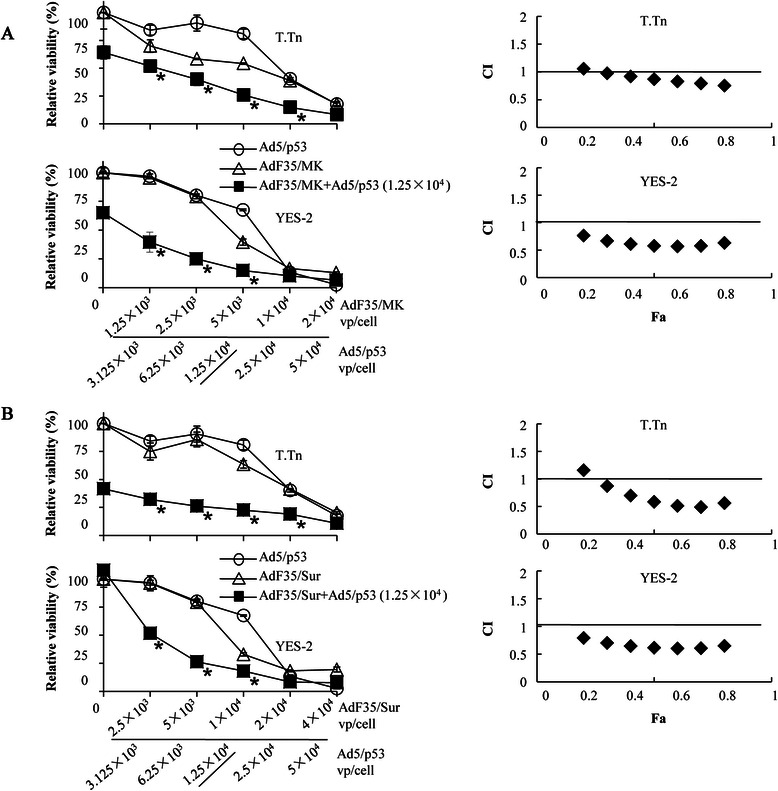
Replication-competent AdF35 in general achieved greater cytotoxic effects to esophageal carcinoma cells than the corresponding replication-competent Ad5. Infection with the AdF35 induced cleavages of caspases and increased sub-G1 fractions, but did not activate the autophagy pathway. Transduction with Ad5/p53 in combination with the replication-competent AdF35 further enhanced the cytotoxicity in a synergistic manner. We also demonstrated the combinatory effects in an animal model. Transduction with Ad5/p53 however suppressed production of replication-competent AdF35 progenies, but the combination augmented Ad5/p53-mediated p53 expression levels and the downstream pathways.
Combination of replication-competent AdF35 and Ad5/p53 achieved synergistic cytotoxicity due to enhanced p53-mediated apoptotic pathways.
提高转导效率和增强细胞毒性对于腺病毒(Ad)介导的癌症基因治疗至关重要。人类肿瘤上5型腺病毒(Ad5)受体的表达下调阻碍了Ad介导的转导。此外,p53通路在具有复制能力的Ad介导的细胞毒性中的作用仍未明确。
我们构建了具有复制能力的Ad5,其E1区基因由在人类肿瘤中优先表达的中期因子或生存素基因的转录调控区激活。我们还制备了受相同区域调控但具有源自35型血清型的纤维钮区域(AdF35)的具有复制能力的Ad5。我们研究了这些Ad的细胞毒性以及具有复制能力的AdF35与表达野生型p53基因的Ad5(Ad5/p53)在食管癌细胞中的联合使用可能性。还研究了参与细胞死亡的分子表达水平、体内抗肿瘤作用以及病毒子代的产生。
一般来说,具有复制能力的AdF35对食管癌细胞的细胞毒性比相应的具有复制能力的Ad5更大。AdF35感染诱导了半胱天冬酶的切割并增加了亚G1期细胞比例,但未激活自噬途径。Ad5/p53与具有复制能力的AdF35联合转导以协同方式进一步增强了细胞毒性。我们还在动物模型中证明了联合作用。然而,Ad5/p53转导抑制了具有复制能力的AdF35子代的产生,但联合使用增强了Ad5/p53介导的p53表达水平及其下游通路。
具有复制能力的AdF35和Ad5/p53的联合使用由于增强了p53介导的凋亡途径而实现了协同细胞毒性。