Mitra Moutushy, Dilnawaz Fahima, Misra Ranjita, Harilal Anju, Verma Rama Shenkar, Sahoo Sanjeeb K, Krishnakumar Subramanian
Department of Ocular Pathology, Vision Research Foundation, Sankara Nethralaya, No 18 College Road, Nungambakkam, Chennai, 600006 India ; CeNTAB, Sastra University, Tanjore, India.
Institute of Life Sciences, Nalco Square, Chandrasekharpur, Bhubaneswar, Orissa India.
Cancer Nanotechnol. 2011;2(1-6):21-36. doi: 10.1007/s12645-010-0010-4. Epub 2010 Dec 17.
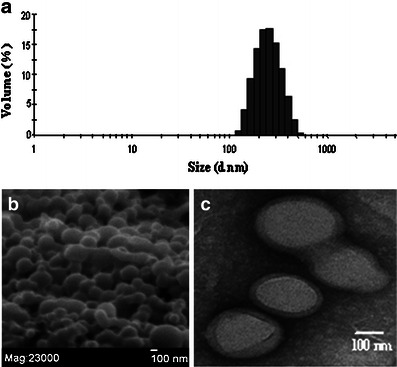
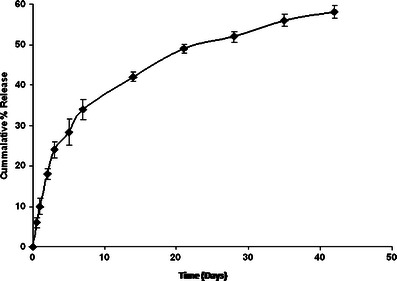
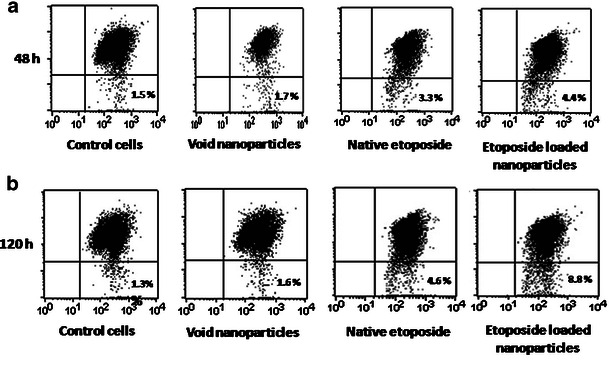
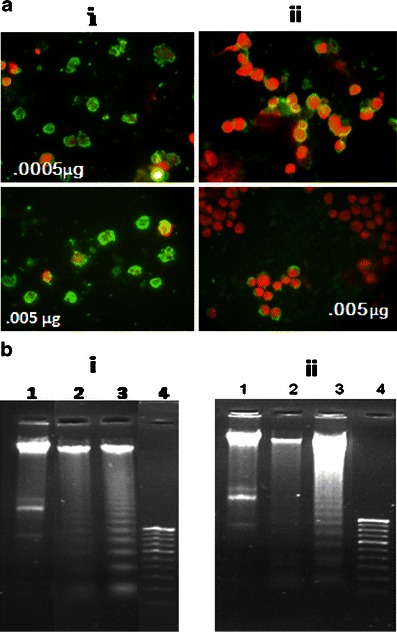
To develop a suitable formulation with high entrapment efficiency, etoposide-loaded poly(lactide--glycolide) nanoparticles (NPs) were formulated by single emulsion-solvent evaporation method by changing different formulation parameters such as drug loading, choice of organic solvent and percentage of emulsifier polyvinyl alcohol. The NPs showed higher entrapment efficiency, 86% (with 15% (/) drug loading). The physicochemical parameters revealed smooth topology with size range (240-320 nm), a negative zeta potential (19 mV) and in vitro sustained-release activity (~60% drug release in 40 days). Greater anti-proliferative activity ~100 times was observed with NPs (IC = 0.002 μg/ml) than that of native etoposide (IC = 0.2 μg/ml) in retinoblastoma cell line (Y-79). These NPs demonstrated greater (G1/S) blocking and decreased mitochondrial membrane potential as measured by flow cytometry. There was upregulation of apoptotic gene activity in NPs than native etoposide, as revealed through microarray analysis. However, this is the first ever report demonstrating the intricate modulation of genetic network affected by NPs. Collectively, these results suggest that etoposide-loaded NPs could be potentially useful as a novel drug delivery system for retinoblastoma in the future. FigureNanoparticle-mediated etoposide delivery promotes apoptosis through upregulating several apoptotic inducer genes.
为了开发一种具有高包封率的合适制剂,通过改变不同的制剂参数,如药物负载量、有机溶剂的选择和乳化剂聚乙烯醇的百分比,采用单乳液-溶剂蒸发法制备了载有依托泊苷的聚(丙交酯-乙交酯)纳米颗粒(NPs)。这些纳米颗粒显示出较高的包封率,约86%(药物负载量为15%(/))。物理化学参数显示其拓扑结构光滑,粒径范围为(240 - 320 nm),zeta电位为负值(约 - 19 mV),体外具有持续释放活性(40天内约60%的药物释放)。在视网膜母细胞瘤细胞系(Y - 79)中,观察到纳米颗粒的抗增殖活性比天然依托泊苷高约100倍(IC = 0.002 μg/ml),而天然依托泊苷的IC = 0.2 μg/ml。通过流式细胞术测量发现,这些纳米颗粒表现出更强的(G1/S)阻滞作用,并降低了线粒体膜电位。通过微阵列分析发现,纳米颗粒中凋亡基因活性的上调程度高于天然依托泊苷。然而,这是首次报道证明纳米颗粒对遗传网络的复杂调节作用。总体而言,这些结果表明载有依托泊苷的纳米颗粒未来可能作为一种新型的视网膜母细胞瘤药物递送系统具有潜在用途。图纳米颗粒介导的依托泊苷递送通过上调多个凋亡诱导基因促进凋亡。